



UPDATED: June 29, 2026
Fashion operates in a space with relatively minimal regulations, particularly when compared to other industries in the United States. In the absence of stringent rules, and in the face of a growing footprint thanks to increasingly complex supply chains and rising rates of consumption, and consumers that are increasingly demanding information about the environmental, social, and governance (“ESG”) elements of companies’ operations, fashion industry entities have largely turned to self-regulation.
This has prompted an onslaught of mechanisms – from third-party certifications, such as B Corp. status, and controversial standardized measures like the Higg Index to the adoption of brand-crafted ESG-centric action plans – that are almost entirely devoid of legal consequences in the event that a company and/or its board fails to follow through.
As for the fashion and apparel-focused regulations that do exist, they are not without drawbacks and/or loopholes. Laws that aim to ensure the safety of consumers, for instance, have been enforced with “an undercurrent of caveat emptor,” according to Melissa Gamble, an assistant professor in the Fashion Studies Department at Columbia College Chicago – or in other words, the laws make it so that “buyers are responsible for checking the quality and suitability of goods before a purchase is made.”
At the same time, federal wage and hour laws are “often rendered ineffective [at protecting garment workers] when manufacturers subcontract cut and sew work to other companies,” Gamble says, thereby enabling these brands to avoid liability by arguing that they cannot be responsible for what they – as the retailer and not the manufacturer – cannot control.
This has been the status quo for the industry for quite some time, but change appears to be afoot. Signals are coming by way of new government initiatives and new laws that are being implemented in Europe. As part of a broader push under France’s Anti-Waste for a Circular Economy (AGEC) law, the country is phasing in environmental labeling requirements for textiles (Decree 2022-748) and has banned the destruction of unsold non-food goods, including apparel. This follows closely on the heels of an “anti-waste” law passed in 2020 by the French government that prohibits the destruction of excess inventory and samples, among other things, Gamble notes, saying that, taken together, these developments indicate that “fashion industry regulations and the larger regulatory environment is, indeed, shifting.”
All the while, the U.S. is seeing a rise in fashion-centric legislation that is worth keeping an eye on. With that in mind, here is a running list of key domestic and international legislation that industry occupants should be aware of – and we will continue to track developments for each and update accordingly …
Adopted: April 27, 2026 by voice/bipartisan support (following a 40–0 approval in the House Ways and Means Committee in Dec. 2025)
Introduced by: Blake Moore (R-UT) and Brad Schneider (D-IL)
Snapshot: Expands the authority of U.S. Customs and Border Protection (CBP) to share detailed shipment data with intellectual property owners, logistics carriers, and e-commerce platforms in order to detect and intercept counterfeit goods earlier in the supply chain.
Key Provisions: The bill authorizes CBP to disclose previously restricted information tied to suspected counterfeit shipments, including shipping labels, tracking data, sender and recipient addresses, invoices, manifests, and images of outer packaging. It also broadens the pool of recipients to include carriers (e.g., UPS, FedEx, DHL) and platforms (e.g., Amazon, Etsy), enabling coordinated enforcement. In practice, the measure allows for pattern detection—such as repeat shippers, shared “drop” addresses, or consistent routing through specific ports—shifting enforcement upstream rather than relying solely on port-of-entry seizures.
Status: Passed the House on 4/27/26; awaiting consideration in the Senate.
Adopted: Feb. 9, 2026, by the European Commission under Regulation (EU) 2024/1781 (Ecodesign for Sustainable Products Regulation).
Snapshot: The European Commission adopted a Delegated Act and an Implementing Act to operationalize rules under the ESPR prohibiting the destruction of unsold apparel, clothing accessories, and footwear. The measures are intended to reduce textile waste and associated emissions by restricting the disposal of excess inventory and reinforcing the EU’s circular economy framework.
Key Provisions: The Delegated Act confirms the ban on the destruction of unsold apparel, clothing accessories, and footwear listed in Annex VII of the ESPR. The ban applies to large companies beginning July 19, 2026, and to medium-sized companies starting in 2030; micro and small enterprises are exempt. The Delegated Act also clarifies limited derogations, including destruction for safety reasons or where products are damaged. National authorities are responsible for enforcement. Separately, Article 24 of the ESPR requires companies to disclose information on unsold consumer products discarded as waste. That disclosure obligation has applied to large companies since July 19, 2025, and will extend to medium-sized companies in 2030. The Implementing Act adopted on Feb. 9, 2026 establishes a standardized format for such disclosures, applicable from February 2027.
Potential Implications: The measures transform the destruction of excess stock from a reputational and ESG issue into a formal compliance matter under EU product law. Fashion and footwear companies placing products on the EU market will need to reassess inventory planning, returns management, and resale, donation, or reuse strategies to mitigate regulatory and enforcement risk.
Adopted: Sept. 9, 2025, by European Parliament
Snapshot: Introduces 2030 EU food waste reduction targets and mandates 2028 textile EPR schemes; progress toward circularity but weaker than earlier proposals and criticized as a missed climate alignment opportunity.
Key Provisions: Food Waste: 30% per capita reduction by 2030 for retail, restaurants, food services, and households; 10% reduction for manufacturing/processing sector; textiles: Mandatory EPR schemes by mid-2028; no binding EU-wide targets yet for collection, reuse, or recycling; implementation: 30-month transposition period; Member States may introduce producer fees tied to business practices.
Status: Adopted; subject to review under 2026 Circular Economy Act.
Introduced: May 5, 2025 to Assembly by Asm. David Bailey, Jr. and Asm. Verlina Reynolds-Jackson
Snapshot: Broad PFAS bill restricting sale/distribution of products – including apparel and “outdoor apparel for severe wet conditions” – with intentionally added PFAS on phased timelines.
Key Provisions: Defines “apparel”; bans/conditions PFAS content across categories; labeling/disclosure rules; staggered effective dates; enforcement under Title 13.
Status: Referred to Assembly Consumer Affairs; pending.
Introduced: H.R. 1840 on Mar. 4, 2025 to House by Rep. Linda T. Sánchez; S. 1867 on May 22, 2025 to Senate by Sens. Sheldon Whitehouse and Lindsey Graham
Snapshot: Phases out de minimis tariff treatment under the Tariff Act of 1930; high relevance to direct-to-consumer fast-fashion imports.
Key Provisions: Ends or phases out 19 U.S.C. §1321(a)(2)(C) treatment; directs CBP rulemaking and data/process upgrades to enforce; aims to curb illicit goods and level the playing field.
Status: Pending in House Ways & Means and Senate Finance. Note: CBP is already enforcing an administration action ending duty-free de minimis as of Aug. 29, 2025.
Reintroduced: Feb. 7, 2025 by New York Sen. Brad Hoylman-Sigal (originally introduced in 2022)
Snapshot: Requires fashion sellers to be accountable to standardized environmental and social due diligence policies, and establishes a fashion remediation fund.
Key Provisions: Under the proposed NYFSSA (S.4558 / A.4631), fashion companies must map out their entire supply chain and identify, cease, prevent, mitigate and account for actual and potential adverse impacts to human rights and the environment in both their own operations and their supply chain. The NYFSSA additionally requires public disclosure of labor practices, wages, and sourcing policies, ensuring that brands cannot hide unethical business operations behind vague sustainability pledges.
Status: Both S.4558 and A.4631 remain in committee as of spring 2025.
Introduced: Jan. 24, 2025 to Senate by Sen. Brian Kavanagh; Feb. 26, 2025 to Assembly by Asm. Anna Kelles
Snapshot: Would establish an extended producer responsibility (EPR) program for textiles sold in New York.
Key Provisions: Producers must submit a DEC-approved plan for collection/reuse/recycling or proper disposal; producer-funded compliance (individually, jointly, or via a representative organization); creates program administration/enforcement mechanisms in state law.
Status: Active in the 2025–26 session; S3217 and A6193 are in their respective Environmental Conservation committees.
Introduced: Feb. 12, 2025 by Reps. Sean Casten (D-IL) and María Elvira Salazar (R-FL).
Snapshot: Establishes a voluntary sustainable apparel labeling program at EPA (in consultation with FTC and USDA). Participants may place an EPA-specified label on products or packaging.
Key Provisions: EPA will set label content and verification; participants choose product or packaging placement.
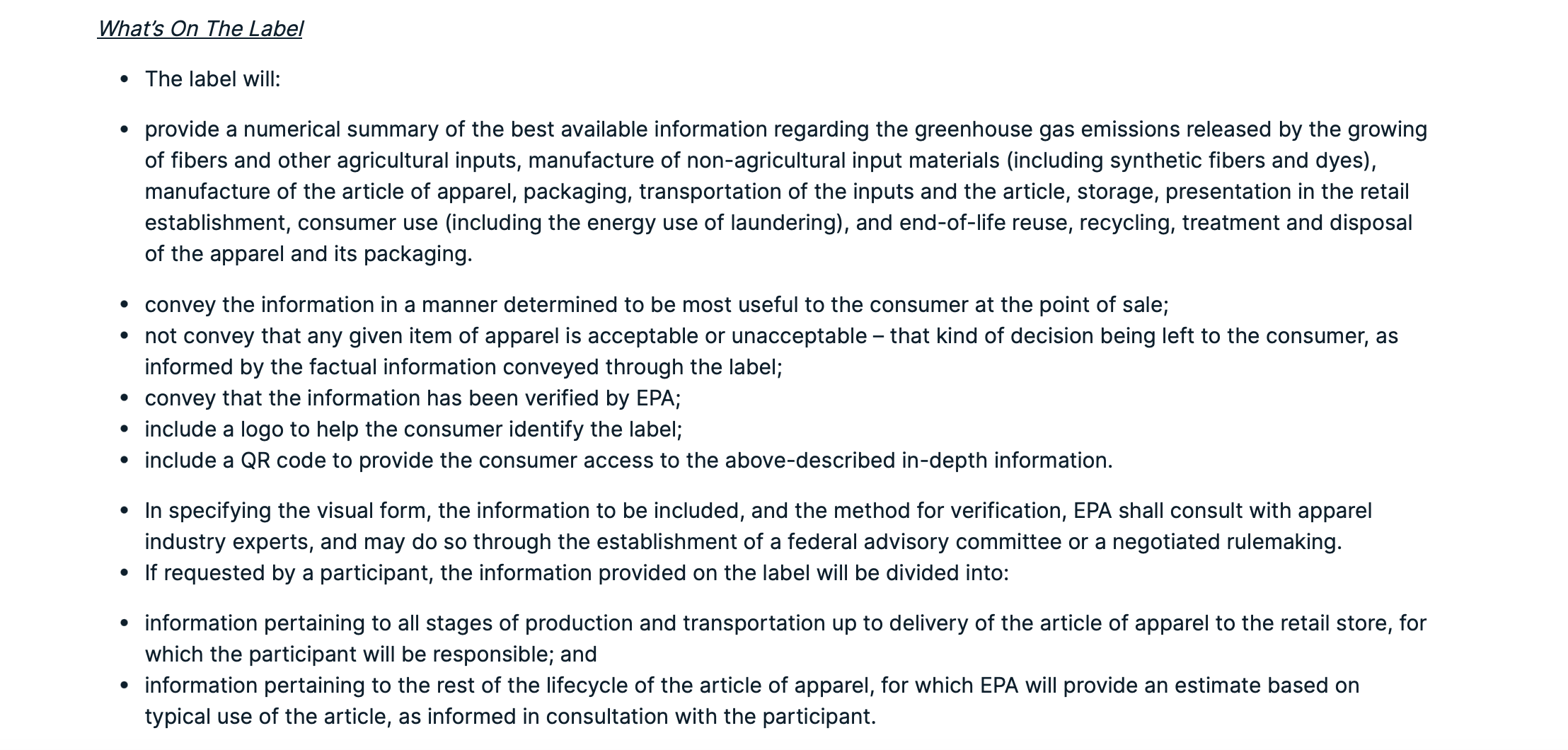
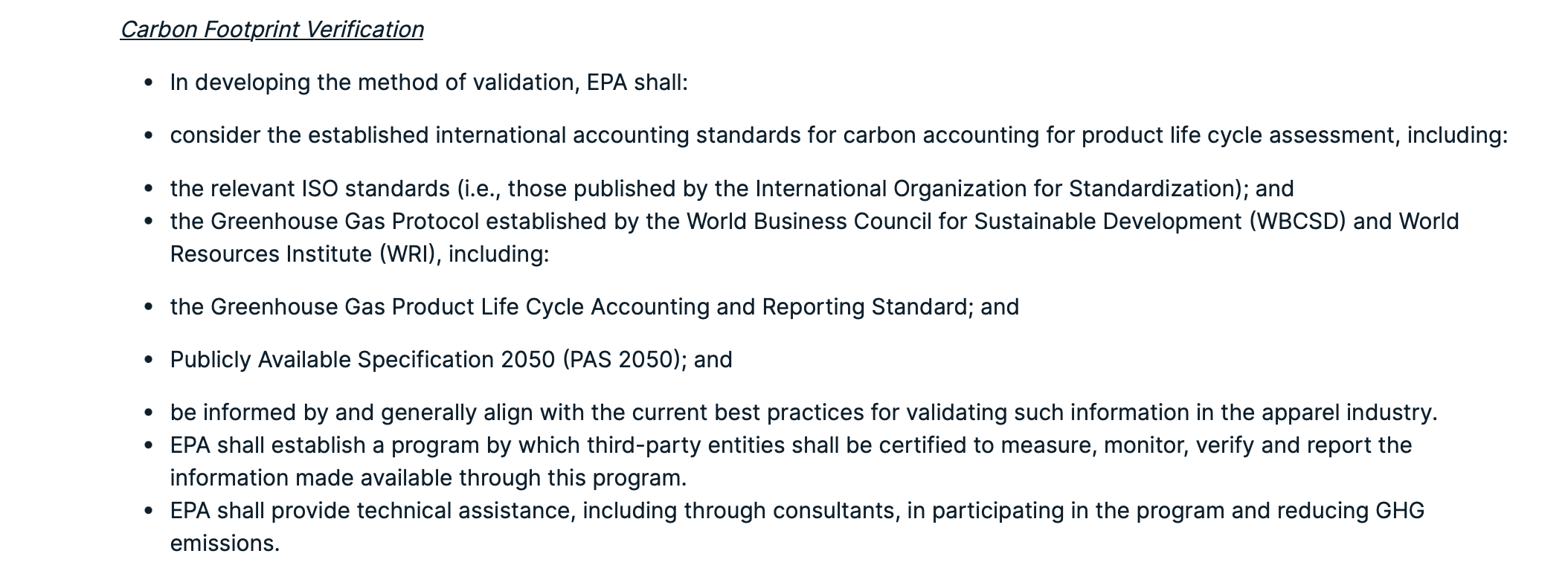
Potential Implications: The label will include information on the greenhouse gas emissions released during the production, manufacturing, distribution, consumer use, end-of-life reuse, and recycling of an item of apparel. This will help apparel producers showcase the work they’ve done to reduce their carbon footprint while empowering consumers with more information to shop more sustainably. The bill will require civil penalties for any entity that uses the label fraudulently.
Reintroduced: Feb. 7, 2025 by New York Sen. Brad Hoylman-Sigal (Originally introduced in 2022)
Snapshot: Requires fashion sellers to be accountable to standardized environmental and social due diligence policies, and establishes a fashion remediation fund.
Key Provisions: Under the proposed NYFSSA (S4558), fashion companies must map out their entire supply chain and identify, cease, prevent, mitigate and account for actual and potential adverse impacts to human rights and the environment in both their own operations and their supply chain. The NYFSSA additionally requires public disclosure of labor practices, wages, and sourcing policies, ensuring that brands cannot hide unethical business operations behind vague sustainability pledges.
Introduced: Feb. 5, 2025 to House (H 5293); Senate companion S 324 followed – both moved through committees in March
Snapshot: Establishes a statewide public education program on textile recycling via DEM and the R.I. Resource Recovery Corporation.
Key Provisions: Defines covered “textiles”; mandates coordinated public outreach to households/businesses on diversion and proper recycling; inter-agency collaboration and timelines.
Status: Signed into law June 23, 2025.
Introduced: Feb. 4, 2025 by California Assemblymember Dawn Addis
Snapshot: The Fashion Environmental Accountability Act of 2025 (AB 405) would require fashion sellers to conduct effective environmental due diligence and publish environmental due diligence reports with the Department of Toxic Substances Control.
Key Provisions: The bill would require companies to: (1) submit an annual Environmental Due Diligence Report, starting July 1, 2027; (2) embed responsible business practices in policies and supply chains; (3) identify, assess, and mitigate environmental and societal risks; (4) establish quantitative greenhouse gas baselines and reduction targets; and (5) require tier 2 suppliers (dyeing, finishing, printing, garment washing) to report wastewater chemical concentrations and water usage by January 1, 2028.
Potential Implications: “Fast fashion has fueled a global crisis,” said Rep Addis. “We cannot stand by while companies profit from depleting natural resources, and using toxic chemicals that pollute and harm our environment and people. The Fashion Environmental Accountability act will hold them accountable.”
Introduced: Feb. 4, 2025 by Reps. Chellie Pingree (D-Maine) and Blake Moore (R-Utah)
Snapshot: The bill would amend Chapter 62 of the Harmonized Tariff Schedule so water-resistant garments don’t have to use rubber/plastic applications (PFAS-laden DWR) to qualify for lower duty rates.
Key Provisions: The bill would make it easier for outdoor retailers to sell safer apparel that does not contain Per-and Polyfluoroalkyl Substances, or PFAS by eliminating a significant trade barrier that currently penalizes companies for choosing environmentally friendly alternatives to these harmful “forever chemicals” in water-resistant apparel.
The U.S. Harmonized Tariff Schedule Chapter 62 requires garments pass a water-resistance test and that the water-resistance must be the result of a rubber or plastics application to the garment’s outer shell, lining, or inner lining. This is commonly referred to as a durable water repellent finish (DWR), which often contain PFAS. The Protect Our Clothes from PFAS Act would remove the requirement that water-resistant garments must be the result of a rubber or plastics application to qualify for lower duty rates. This change would allow manufacturers to use innovative, PFAS-free waterproofing technologies while maintaining competitive pricing.
Introduced: Jan. 20, 2025 to House by Rep. Kristine Reeves (with Reps. Berry, Mena, Peterson, Ramel, Doglio, Pollet, Ormsby, Hill)
Snapshot: Creates a statewide producer-responsibility system for textiles, prioritizing reduction, reuse, and recycling.
Key Provisions: Requires producers to join/form a Producer Responsibility Organization (PRO) and file a plan; staged implementation with Department of Ecology oversight and approvals.
Status: Public hearing Jan. 30, 2025; exec action Feb. 13, 2025; referred to Appropriations Feb. 17; no floor vote as of late Aug. 2025.
Introduced: Reintroduced on Jan. 17, 2025 (HD 4220; initially introduced in Feb. 2023) by Representatives Rogers and Nguyen
Snapshot: The bill (H.1032) would establish fashion sustainability and social accountability by requiring entities designated as fashion sellers or manufacturers to carry out human rights and environmental due diligence for their apparel and footwear products.
Key provisions: The bill would require major fashion companies (i.e., selling in excess of $100 million in global revenues) to map tiers 1-4 of their supply chains, including all raw materials suppliers (including subcontractors), raw material processors (fiber, yarn manufacturing, and chemical suppliers), material processors (fabric manufacturing, dyeing, finishing, etc.), component manufacturers (buttons, zippers, etc.), and finished product manufacturers.
Companies would need to disclose all suppliers across the four tiers, and create and submit a due diligence report to the attorney general within 24 months of the effective date. Specific targets are set for when the different tiers of suppliers must be mapped and what proportion.
In furtherance of the due diligence report, a company shall “identify, cease, prevent, mitigate, account for and remediate actual and potential adverse impacts to the environment in their own operations and in their supply chain, in compliance with, at a minimum, the standards outlined in the most recent Organization for Economic Cooperation and Development Guidelines for Multinational Enterprises and the Organization for Economic Cooperation and Development Due Diligence Guidance for Responsible Supply Chains in the Garment and Footwear Sector.”
Status: Hearing scheduled for July 1, 2025 in the Joint Committee on Environment & Natural Resources.
Introduced: Reintroduced Jan. 13, 2025
Snapshot: The bill (HB 1107) seeks to mitigate the environmental impacts of the fashion industry in Washington State by implementing new regulations for fashion producers and sellers.
Key provisions: Starting January 1, 2027, producers will be required to disclose various environmental impacts of their products, including the use of high-priority chemicals and sustainability-related marketing terms. Additionally, producers with a gross income exceeding $100 million must provide detailed information on their environmental due diligence policies and working conditions. The bill establishes the Community Environmental and Public Health Improvement Account, funded by penalties imposed on non-compliant producers, and outlines escalating civil penalties for violations.
Status: Public hearing held Jan. 13, 2025 in the House Environment & Energy Committee; no floor vote as of Sept. 5, 2025. The bill would create the Community Environmental and Public Health Improvement Account and set civil penalties (up to $5,000 first offense; $10,000 repeat).
Introduced: March 23, 2022 by State Sen. Brad Hoylman and Assemblymember Karines Reyes and signed into law Dec. 21, 2024.
Snapshot: The New York Fashion Workers Act (S8638-A/A9762-A) aims to mandate registration of and impose duties upon model management companies and creative management companies,” and provide complaint procedures and penalties for violations by amending the New York state labor code. If enacted, the bill – which is co-sponsored by New York State Sen. Brad Hoylman and New York State Assembly Member Karines Reyes – will regulate management agencies and provide labor protection for figures designated as independent contractors, from runway models to makeup artists, stylists, and influencers, among others.
The legislation would create new compliance requirements for “retail stores, manufacturers, clothing designers, advertising agencies, photographers, publishing companies, or any other such person or entity that receives modeling services from a creative, directly or through intermediaries.” Such obligations center on things like payment (companies will be required to pay models/creatives within 45 days); contracts (companies will be required to provide models/creatives with copies of contracts and agreements; and contracts between a company and a model/creative will be limited to two years and cannot be renewed without affirmative consent); and disputes.

Potential Implications: “Construed broadly,” Morgan Lewis attorneys Leni Battaglia, Melissa Rodriguez, and Carolyn Corcoran state that the bill “could have massive implications not only for traditional model or creative management companies using fee-based structures, but also for retailers who directly hire models/creatives for studio photoshoots and ad campaigns.”
Status (Jun. 19, 2026): The Act’s substantive protections took effect on June 19, 2025, and the one-year registration period for model management companies expired on June 19, 2026. With the close of that registration window, the law has entered a more consequential compliance phase, with the New York Department of Labor now positioned to monitor which companies are formally registered and to oversee compliance with the Act’s broader requirements. The deadline also arrives as disputes over AI-generated model likenesses are beginning to surface in court, underscoring the practical significance of the Act’s digital-replica and consent provisions.
Introduced: February 16, 2023 by Senators Josh Newman, Nancy Skinner and Scott Wiener
Snapshot: The bill (SB 707) would establish an Extended Producer Responsibility scheme for the collection and recycling of “covered products,” which include any apparel, textile, or textile article that is unsuitable for reuse by a consumer in its current state or condition.
Gov. Gavin Newsom signed SB 707 into law on September 28, 2024 and subsequently Chaptered by Secretary of State (Chapter 864, Statutes of 2024), thereby, establishing the first Extended Producer Responsibility (EPR) textile recycling program in the U.S. “SB 707 isn’t just about recycling; it’s about transforming the way we think about textile waste,” Senator Josh Newman (D-Fullerton), the bill’s author, said in a statement. “The framework created by SB 707 will create new opportunities for every Californian to participate in a more sustainable future.”
Status (Feb. 27, 2026): CalRecycle has selected Landbell USA to serve as the producer responsibility organization (PRO) responsible for implementing California’s textile extended producer responsibility law, the Responsible Textile Recovery Act of 2024 (S.B. 707). As the designated PRO, Landbell will develop and oversee a statewide system for collecting, transporting, repairing, reusing, and recycling apparel and textile products sold in California, with producers required to join the program by July 1, 2026.
Introduced: March 14, 2024, when the French National Assembly approved the bill on first reading following its introduction by MP Anne-Cécile Violland.
Snapshot: The bill seeks to curb the environmental impacts of ultra-fast fashion by targeting companies that rapidly place large volumes of low-cost apparel on the French market. Originally drafted to regulate fast fashion more broadly, the legislation was subsequently narrowed to focus primarily on ultra-fast fashion platforms, such as Shein, Temu, and AliExpress, rather than traditional fast-fashion retailers with established European retail operations.
Key Provisions: The bill establishes a framework for identifying ultra-fast fashion companies based on factors including the volume of products placed on the market and the relationship between a garment’s purchase price and repairability. It would introduce environmental penalties tied to companies’ environmental performance, with per-item penalties increasing over time to as much as €10 by 2030, subject to a cap of 50 percent of the product’s pre-tax sale price, with a portion of the proceeds earmarked for textile collection and recycling infrastructure.
The bill would also prohibit advertising by qualifying ultra-fast fashion companies, including through influencers, and require covered companies to provide consumers with information about the environmental impacts of their products while displaying messages encouraging garment reuse, repair, and more responsible consumption.
Status (Jun. 29, 2026): Approved by both the National Assembly and the Senate on June 29, 2026, the bill is awaiting presidential promulgation and publication in the Journal officiel before entering into force. Certain provisions—particularly the advertising restrictions—may also face further scrutiny under European Union law following concerns raised by the European Commission regarding their compatibility with EU single-market rules.
Introduced: March 6, 2024 by Sens. Bill Cassidy (R-LA) and Michael Bennet (D-CO)
Snapshot: The Americans Trade and Investment Act (“America Act”) is intended to “transform and unleash economic potential in the United States and Latin America through encouraging reshoring and nearshoring industry from China.” The bipartisan bill includes “over $14 billion in incentives for for apparel, footwear, and accessories reuse and recycling, onshoring/reshoring, closing the de minimis loophole, addressing forced labor, and more,” according to its sponsors.
Key Provisions (for the apparel industry): Apparel and textile provisions in the new bill include a 15 percent net income exclusion for businesses engaged in collecting, reselling, reusing, renting, repairing, sorting, pre-processing, and/or recycling apparel, footwear, accessories and home linens; $10 billion in loans and $3 billion in grants for: (i) programs to carry out reuse and recycling; (ii) manufacturing support programs to build new facilities, expand or retrofit existing facilities, and provide low carbon emissions transportation for covered product collection/drop-off or mail-back, sortation, pre-processing, reuse, and/or recycling; and (iii) provision of components and machinery via grants and loans to the businesses to provide components, chemicals/solvents, or machinery necessary for covered product transportation, collection, mail-back, sortation, pre-processing, reuse or recycling.
Additionally, the bill would pave the way for a $1 billion innovation program for research and development related to textile reuse and recycling, and the establishment of a $100 million public education program.
Potential Implications: The bill could serve to chip away at the dominance of fast fashion giants like Shein and Temu, which have been accused of shipping Chinese-made goods directly to consumers in the U.S. and exploiting tax rules in the process. Both companies have come under fire for relying on a trade loophole that enables them to benefit from tax exemptions and less oversight from U.S. Customs when they ship packages with contents that are valued at less than $800.
“Temu and Shein are building empires around the de minimis loophole in our import rules – dodging import taxes and evading scrutiny on the millions of goods they sell to Americans,” Representative Mike Gallagher, a Wisconsin Republican who chairs the House Select Committee on the Chinese Communist Party, said in a statement this summer. The America Act directly speaks to that by way of its aim to close the de minimis loophole.
Status: On July 30, 2025, President Trump signed Executive Order 14324, which suspends duty-free de minimis treatment for imports under $800, effective August 29, 2025. The order directs U.S. Customs and Border Protection (CBP) to implement the suspension, with penalties for noncompliance and guidance published in the Federal Register. This marks the most sweeping change to U.S. de minimis trade policy in decades, eclipsing pending congressional proposals.
Introduced: June 15, 2023 by Sens. Sherrod Brown (D-OH) and Marco Rubio (R-FL)
Snapshot: S.2004, a bill to amend the Tariff Act of 1930 relating to de minimis treatment under that Act, would “close a key loophole” that foreign companies exploit to avoid paying duties and fees to unfairly compete in the U.S. marketplace.
Potential Implications: “Right now, packages under $800 in valuation are exempted from U.S. duties, taxes, and fees. The number of packages using this loophole to avoid duties has exploded in recent years, to more than two million packages per day. Competitors will often split large shipments into many small packages to cheat the rules and evade the duties they owe, gaining an unfair competitive advantage,” Sen. Brown said in a release. The “bipartisan, bicameral legislation would ensure low-value shipments from non-market economies, such as China, are no longer exempt from paying any duties, taxes, or fees to the U.S. Government.”
“China exploits our capital markets and uses slave labor to undercut American businesses,” said Sen. Rubio. “It is bad for our country to let China flood our country with duty-free packages using the de minimis exception. The Import Security and Fairness Act will close this loophole and take another critical step to stop China from cheating on trade.”
Status: Introduced and referred to committee in the 118th Congress; no further action and the bill expired at the end of the session.
Introduced: June 14, 2023 by Sens. Bill Cassidy (R-LA) and Tammy Baldwin (D-WI)
Snapshot: S. 1969, a bill to amend the Tariff Act of 1930 to require reciprocity with respect to de minimis entries of articles, would bar Chinese exports from entry via the expedited “de minimis” channel and reduce the threshold for duty-free imports into the U.S. to an amount that matches the threshold our trade partners use, ensuring reciprocity and increasing transparency at our borders. The De Minimis Reciprocity Act would also: (1) Exclude untrustworthy countries from using the ‘trusted’ de minimis channel; (2) only allow express carriers to facilitate de minimis imports into the U.S. to help better at stop counterfeits and fentanyl at the border; (3) Require more information on every package entering the U.S.; and (4) Use the revenue proceeds to establish a fund for reshoring industry from China.
Potential Implications: “Our customs laws are outdated. China is taking advantage of that by importing billions of dollars of cheap goods into the U.S. with no oversight. This bill will allow U.S. manufacturers to compete fairly for U.S. store shelves and counter those who wish to use our trade system to launder money or smuggle counterfeits and drugs,” said Sen. Cassidy.
“A trade loophole is allowing Chinese companies to import goods in the U.S. with no oversight – letting them bring in cheap, counterfeit goods that undercut American manufactures and traffic drugs into our communities,” said Sen. Baldwin. “Our bipartisan bill will close this loophole to create a level playing field for our Made in America manufactures, curb the illicit drugs like fentanyl from coming into the country, and help ensure Americans are not supporting goods made with forced labor.”
Status: Introduced and referred to committee in the 118th Congress; no further action and the bill expired at the end of the session.
Introduced: May 3, 2023 by Sen. Brian Kavanagh
Snapshot: The bill (A8078/S6654) would establish extended producer responsibility for textiles; requires a producer, either individually or cooperatively in a group or with a representative organization to submit to the department of environmental conservation a plan for the establishment of a collection program for textile covered products no later than December 31, 2024.
Status: Referred to Environmental Conservation in both chambers and did not progress at the end of the 2023–24 session. The proposal has been reintroduced in the 2025–26 session as A6193 / S3217.
Introduced: Jan. 30, 2023 as part of California’s Climate Accountability Package
SB 253: Requires companies with >$1 billion in annual revenue doing business in California to report greenhouse gas emissions (Scopes 1–3). Scope 1 and 2 reporting begins in 2026; Scope 3 reporting begins in 2027. Reports must be independently verified and published on a public digital registry.
SB 261: Requires companies with >$500 million in annual revenue to disclose climate-related financial risk in line with the TCFD framework, with reports submitted to the California Air Resources Board and posted publicly.
Status: Both laws were signed Oct. 7, 2023. A federal district court denied a preliminary injunction on Aug. 13, 2025, but on Nov. 18, 2025, the Ninth Circuit enjoined enforcement of SB 261 while the appeal is pending and allowed SB 253 to proceed.
S.1322 Introduced: Jan. 11, 2023 by State Sen. Brad Hoylman-Sigal
S.6291A Introduced: April 20, 2021 by State Sens. Hoylman, Bailey, Cleare, Mannion, Myrie, Rivera, and Sepulveda
The New York state legislature has passed a bill (S.1322/A.994) to modify legislation that was previously passed by the New York State Senate in the spring of 2022 and signed by Governor Kathy Hochul in December (S.6291A). Both bills are aimed at banning per- and polyfluoroalkyl substances (“PFAS”) in clothing and apparel.
Snapshot: The new bill expands the scope of the state’s ban on PFAS chemicals in clothing and apparel by including additional categories, such as outdoor apparel, which were previously excluded. Now, the ban broadly applies to “apparel and outdoor apparel for severe wet conditions,” and specifically defines “apparel” as meaning “clothing items intended for regular wear or formal occasions including, but not limited to, undergarments, shirts, pants, skirts, dresses, overalls, bodysuits, vests, dancewear, suits, saris, scarves, tops, leggings, leisurewear, formal wear, OUTDOOR APPAREL, onesies, bibs, and diapers.”
Potential Implications: The legislation comes amid a nation-wide push by regulators to ban these “forever chemicals,” with roughly two dozen states either enacting or proposing PFAS-specific legislation as of December 2022.
Penalties: Civil penalties of up to $1,000/day for initial violations and up to $2,500/day for continuing violations.
Effective Date: January 1, 2025 for apparel with intentionally added PFAS. Additional phased restrictions apply to outdoor apparel and “severe wet conditions” products, with thresholds and enforcement extending into 2027–2028.
Introduced: January 2023 by Senators Nguyen, Frame, Hunt, Kuderer, Lovelett, and Salomon.
Snapshot: The bill (SB 5607) would require fashion retail sellers and manufacturers to disclose environmental due diligence policies. Key requirements include: (a) Supply chain transparency, including mapping of suppliers and associated supply chains, and disclosure of prioritized suppliers and risks; (b) Impact and due diligence disclosure, including an environmental sustainability report with information on due diligence policies, processes, and activities conducted to identify, prevent, mitigate, and account for potential adverse impacts; (c) Impact disclosure on prioritized adverse environmental impacts within 18 months after enactment of the policies, processes, and outcomes; and (d) Disclosure of reduction targets on energy and greenhouse gas emissions, water, and chemical management, as well as annual volume of material produced and how much production has been displaced with recycled materials. Climate change targets must align with the apparel and footwear sector’s science-based targets guidance and include all scopes of production.
Introduced: May 12, 2022 to Senate by U.S. Sen. Kirsten Gillibrand (D-NY); Jul. 21, 2022 to House of Rep. by Rep. Carolyn Maloney
Snapshot: Aimed at “accelerat[ing] domestic apparel manufacturing and establishing new workplace protections to cement the U.S. as the global leader in responsible apparel production, the Fashioning Accountability and Building Real Institutional Change (“FABRIC”) Act (S.4213 / H.R. 8473) would “amend the Fair Labor Standards Act of 1938 to prohibit employers from paying employees in the garment industry by piece rate, to require manufacturers and contractors in the garment industry to register with the Department of Labor, and for other purposes.” The legislation would establish a nationwide garment industry registry through the Dept. of Labor to “promote transparency, hold bad actors accountable, and level the playing field;” create new requirements to hold fashion brands and retailers, as well as manufacturing partners jointly accountable for workplace wage violations; and set hourly pay in the garment industry and eliminating piece rate pay until the minimum wage is met.
The bill would allow for fines of up to $50 million for violations.
Potential Implications: A key point of contention in this bill comes by way of the “Joint and Several Liability of Brand Guarantors” provision, which would hold brands accountable for violations that occur under the watch of their suppliers. Specifically, the FABRIC Act states, that “a brand guarantor who contracts with an employer of an employee … for the performance of services in the garment industry shall share joint and several liability with such employer for any violations of the employer under this Act involving such employee.” This has prompted pushback from the American Apparel and Footwear Association and the Council of Fashion Designers of America, which called for a more limited approach to joint liability. The bill writers included a clause on joint liability.
Thus, brands (including licensors) as well as subcontractors will share joint liability for any violations, including the payback of lost wages and additional damages, where applicable.
Status: Sept. 14, 2023 – Sen. Gillibrand (D-NY) reintroduced the FABRIC Act, which she says “proposes major new manufacturing investments and world-leading workplace protections with the aim of ramping up domestic apparel production and creating more dignified jobs in the United States. The federal bill builds on key elements of California’s landmark Garment Worker Protection Act, combined with major incentives to expand domestic production.”
As of Sept. 14, 2023, the bill had 5 cosponsors: Senator Cory Booker (D-NJ), Senator Elizabeth Warren (D-MA), Senator Bernard Sanders (I-VT), Senator Alex Padilla (D-CA), Senator, and Senator Dianne Feinstein (D-CA). “More are expected to sign on in the next few days,” according to a release.
Introduced: February 23, 2022
Snapshot: Comprehensive EU regulation establishing harmonized rules on fair access to and use of data. Central pillar of the EU’s data strategy and Digital Decade goals, designed to empower users, promote innovation, and ensure fair competition in the data economy.
Key Provisions: Access & sharing: Users gain rights to access data generated by connected devices (cars, smart TVs, industrial machinery) and share it with third parties; fair contracts: Prohibits unfair contract terms that limit data-sharing, especially impacting SMEs; cloud portability: Enables switching between cloud and data-processing providers; requires interoperability and removal of lock-in practices; public interest access: Allows government authorities to request private-sector data in emergencies or for public interest purposes; balance of interests: Clarifies database rights, ensures fair treatment between data holders and users, and supports competition in aftermarket services like repairs; sectoral impacts: Facilitates cost-effective maintenance of connected products, optimizes industrial performance data, enhances precision farming, and supports sustainability goals.
Status: Applicable across all EU Member States as of September 12, 2025; additional interoperability and portability obligations take effect in 2026 and 2027. Guidance, FAQs, and a Commission-led Data Act Legal Helpdesk are being rolled out to support implementation.
Introduced: May 2021 by the House Judiciary Committee after the original introduction of SHOP Safe in 2020.
Snapshot: The bill would (1) Establish trademark infringement liability for e-commerce platforms when a third party sells a counterfeit product that poses a risk to consumer health or safety and that platform has not implemented certain best practices; (2) Require brand owners to provide platforms with advanced notice of their mark(s) and a point of contact so that the platforms can implement proactive measures to prevent sales of counterfeit goods; and (3) Provide a safe harbor from liability for platforms that vet sellers to ensure their legitimacy, remove counterfeit listings, and remove sellers who repeatedly sell counterfeits.
Potential Implications: The SHOP SAFE Act aims to reduce the availability of harmful counterfeit products by incentivizing online platforms to adopt best practices that will prevent third-party sellers from listing counterfeit products for sale.
Status: The bill was reintroduced again on Sept. 26, 2023 by Senators Chris Coons (D-Del.) and Thom Tillis (R-N.C.).
Introduced: December 2020
Intended to prevent wage theft, mandate fair pay and improve working conditions for the roughly 45,000 garment workers in the state of California, The California Garment Worker Protection Act (SB 62) was signed into law by California Governor Gavin Newsom on September 27, 2021. Among other things, the law requires that employees engaged in garment manufacturing must be paid an hourly rate not less than the minimum wage and cannot be paid a piece rate.
Snapshot: The Act (1) prohibits piecework pay; (2) creates joint and several liability for unpaid wages for “brand guarantors,” along with manufacturers and contractors; and (3) creates new record keeping requirements for manufacturers and brand guarantors. Employees may seek to recover unpaid wages and associated penalties by filing a claim with the Labor Commissioner against the contractor, garment manufacturer and brand guarantor, and the Act may also pursue other applicable remedies under California or federal law.
Potential Implications: Although SB 62 may “ultimately curb the practices of some ‘bad actors’ in the garment industry,” Sheppard Mullin’s Robert Foster and Morgan Forsey have claimed that “the more immediate impact of the new law’s requirements will likely be that some companies contract with garment manufacturers outside of California, thereby decreasing the number of garment manufacturers and workers in California.”
Effective Date: January 1, 2022