



Europe’s largest online fashion retailer, Zalando, has lost its legal challenge to the European Commission’s decision to designate it as a very large online platform (“VLOP”) under the Digital Services Act. The EU General Court rejected Zalando’s appeal, the first of its kind, upholding regulators’ finding that Zalando has more than 83 million active monthly users, far above the company’s claim of 30 million.
As a VLOP, Zalando is now subject to stricter obligations, including enhanced oversight to combat illegal and harmful content. The ruling marks the first court challenge to the DSA, reinforcing the EU’s push to hold major platforms accountable regardless of whether they are U.S. tech giants or European players. Zalando said it was “disappointed” and will appeal to the Court of Justice for the EU.
The RealReal, the world’s largest online marketplace for authenticated resale luxury goods, has released its 2025 Resale Report this week. Now in its 14th year, the annual report captures how economic forces, cultural shifts, and creative director shakeups are shaping the luxury resale market. With more than 40 million members and years of proprietary data, The RealReal reveals that fine jewelry, timeless handbags, and vintage pieces continue to lead demand, while nostalgia-driven revivals and generational shifts are redefining how consumers shop, sell, and invest in luxury today.
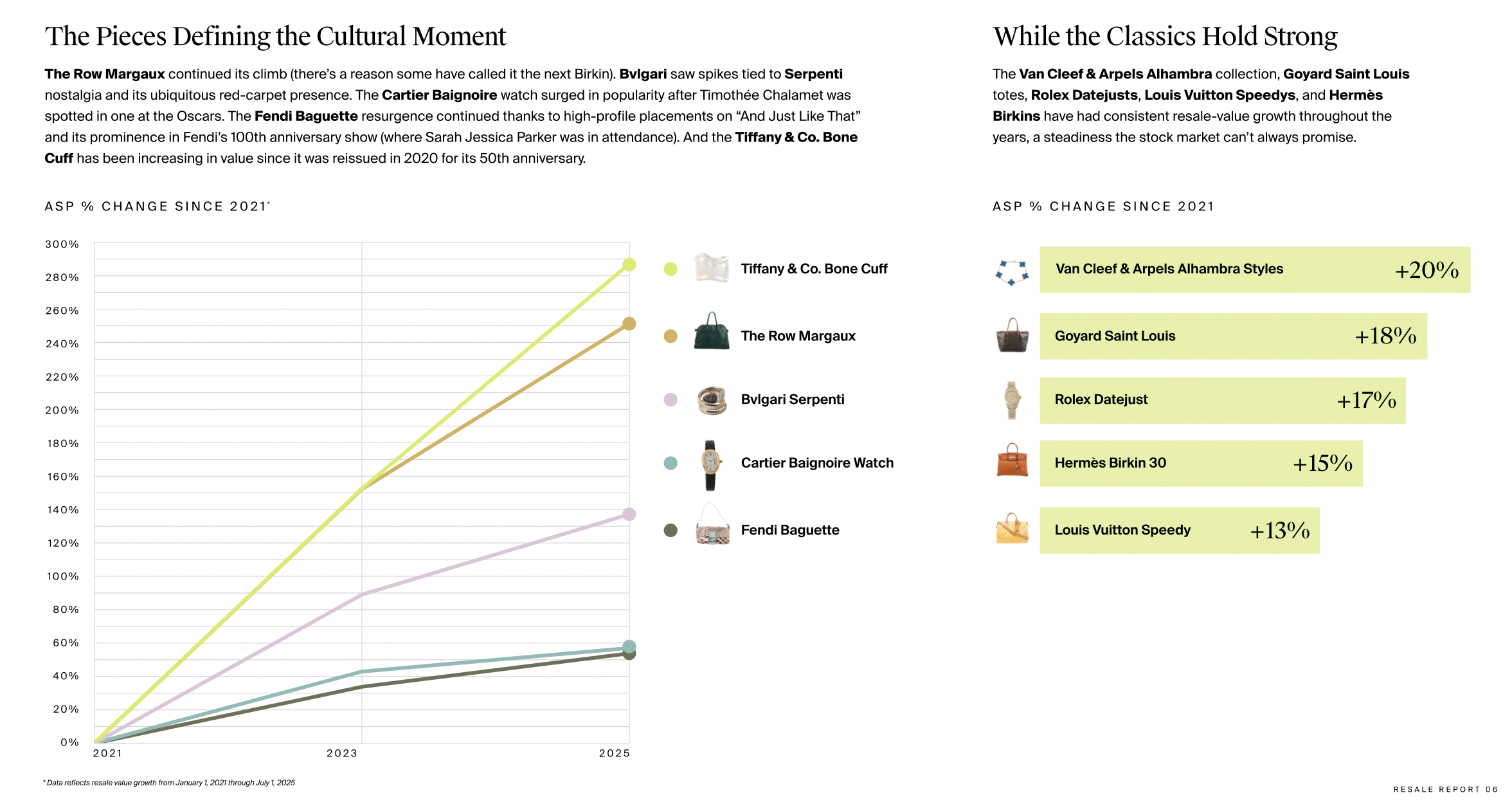
Key highlights from the 2025 Resale Report include …
Some of the top-line takeaways: Approximately one-third of clothing and apparel purchased in the U.S. over the past year was secondhand, and 58% of shoppers now prefer the secondary market outright. 47% of consumers now consider resale value before buying new.
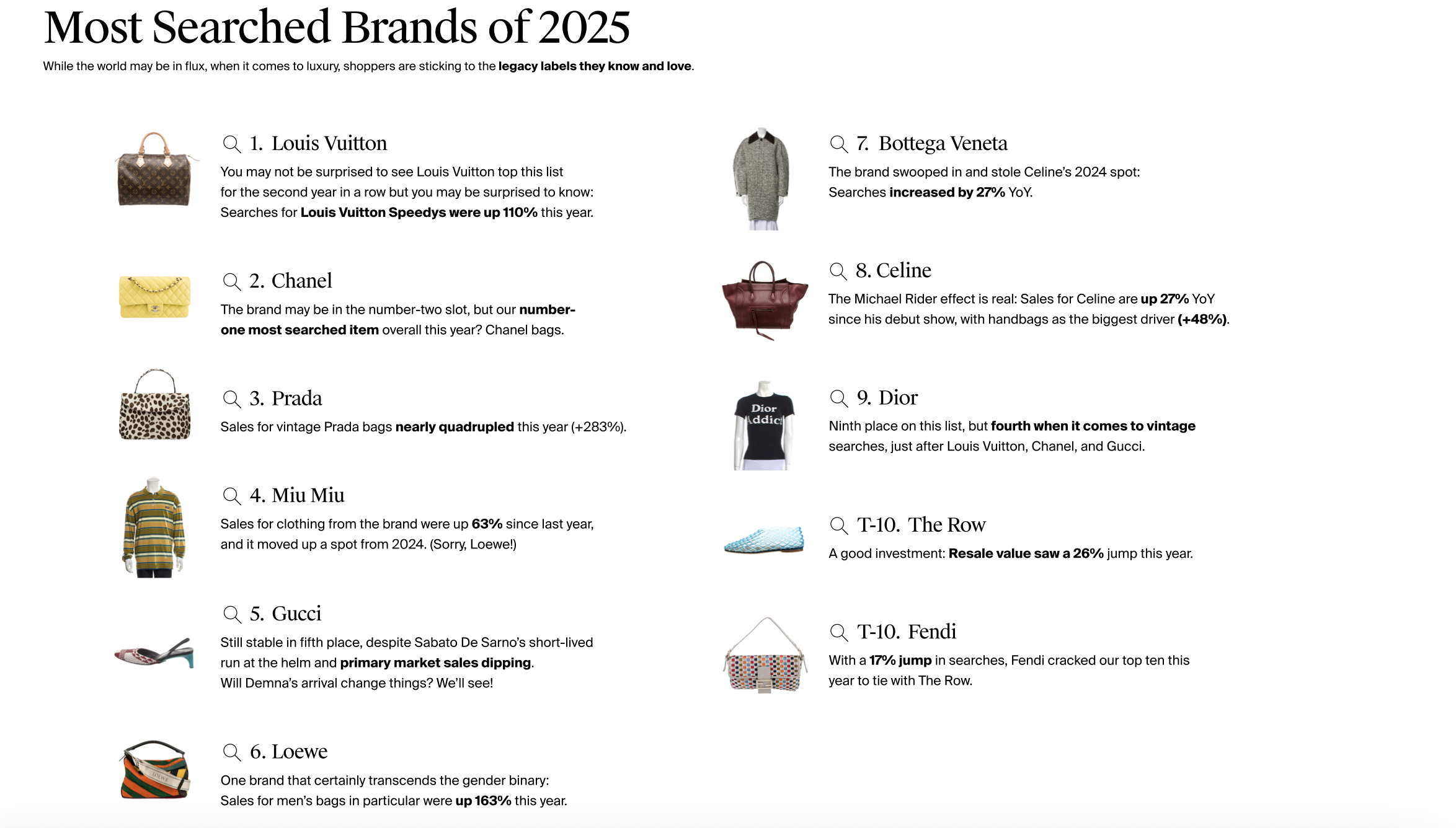
Brand Momentum Most-searched & rising brands: Coach, Ferragamo, Pucci, Toteme and American designers surged: Diotima (+152%), Zankov (+65%), Marina Moscone (+44%).
The Patina Effect: “Well-loved” items surged: Fair Condition sales +32%. Distressed leather jackets (+155%), stickered Rimowa luggage (+65%), visibly worn bags (+45%).
Investment Categories: Fine jewelry ASPs rose +17%, sterling silver at record highs. Tiffany & Co. resale prices reached all-time records. Piaget Polo named “Watch to Watch” with +285% sales growth.
According to a new report in MIT Sloan’s Management Review, senior managers’ limited understanding of intellectual property often has far-reaching consequences for the strategic decisions that define their companies’ success. Drawing on insights from senior IP strategists, the study reveals that executives’ blind spots in this area frequently result in costly errors, from undervaluing intangible assets to mishandling mergers and acquisitions or neglecting crucial differences in IP protection across jurisdictions. Nearly 40% of surveyed experts reported observing poor decisions tied directly to inadequate executive knowledge of IP.
The research identifies three main gaps: (1) Executives frequently miss the fundamentals of IP law; (2) underestimate its role in strategic partnerships and corporate transactions; and (3) fail to leverage IP proactively as a competitive tool.
Case studies show how such oversights – whether failing to secure international trademark rights, overlooking ownership in collaborations, or filing weak patent claims misaligned with expansion plans – can undermine valuation, bargaining power, and long-term growth.
The report concludes that while senior leaders do not need to be IP experts, they must develop enough literacy to recognize risks, engage specialists early, and ensure IP strategy aligns with overall business objectives. Stronger collaboration between executives and IP teams, the authors argue, could transform intellectual property from a neglected technical concern into a driver of sustainable competitive advantage.
The U.K. Intellectual Property Office has launched a “comprehensive consultation” to modernize Britain’s design protection framework, seeking views from across the £100 billion design sector by November 27, 2025. The review aims to simplify overlapping rights, tackle design theft, and adapt the system to new tech, while making enforcement more accessible for the 80,000 businesses that support nearly 2 million jobs. The main areas for potential reform include …
– Fighting design theft: Introducing search and examination powers to reject designs lacking novelty or filed in bad faith.
– Streamlining processes: Harmonizing time limits, simplifying overlapping rights, and allowing confidentiality for up to 18 months.
– Resolving post-Brexit complexities: Providing clarity for U.K. businesses that lost automatic EU protections.
– Strengthening enforcement and access to justice: Exploring a small claims track within the Intellectual Property Enterprise Court.
– Modernizing for the digital age: Expanding file formats for applications, updating legal definitions, and considering protection for AI-generated designs.

>> At the same time, the UKIPO also announced this week that it is reviewing whether AI-generated designs should be eligible for protection under existing IP law, a move that could reshape how creators, brands, and innovators safeguard works produced with the aid of AI.
In a landmark national decision, Mexico’s Supreme Court (“SCJN”) has ruled that works created entirely by AI are ineligible for copyright protection, affirming that authorship under the Federal Copyright Law belongs solely to humans. The court, whose positions mirrors that of the U.S. Copyright Office and courts, held that automated systems lack the creativity, originality, and individuality required for authorship, describing copyright as a “human right” derived from intellect, feelings, and lived experience.
The ruling stems from a case involving Virtual Avatar: Gerald García Báez, an AI-generated artwork. After the Copyright National Institute denied registration for the work, the applicant argued that excluding AI-created works violated equality and international treaties. The SCJN rejected this claim, finding no obligation under the Berne Convention or USMCA to extend authorship to works created by machines.
> However, the court clarified that works created with substantial human input, such as directing, editing, or transforming AI outputs, remain eligible for registration. Experts note that documenting the creative process will be key for securing protection of collaborative human-AI works going forward.