



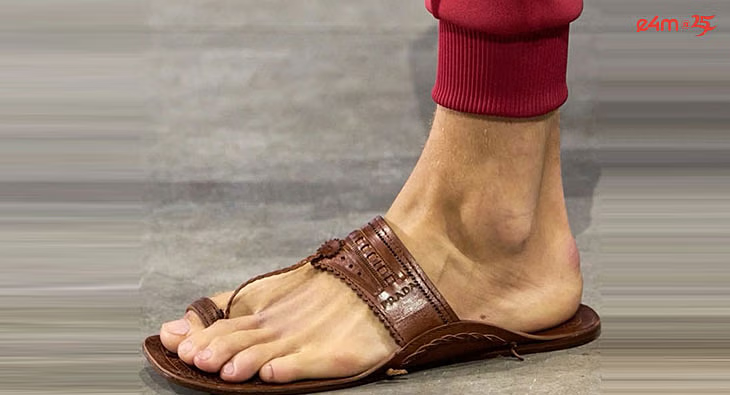
Prada’s recent debut of leather sandals resembling India’s iconic Kolhapuris sparked an online backlash that highlights both the cultural pride and digital power of Indian consumers. The Italian fashion house’s failure to credit the traditional design, a handcrafted style with centuries-old roots in Maharashtra and Karnataka, quickly ignited accusations of cultural appropriation, boosting sales of authentic Kolhapuris and forcing Prada to issue an acknowledgment of its inspiration.
The controversy serves as a cautionary tale for global luxury brands vying for a foothold in India’s fast-growing $7.7 billion luxury market. With social media engagement surging among the country’s 462 million users, cultural missteps can escalate into brand crises overnight. For Prada, the episode underscores the growing influence of India’s digital-savvy consumers, a force international brands can no longer afford to underestimate.
THE TAKEAWAY: Success in India requires more than just market entry; it demands cultural fluency and a genuine respect for local heritage, as demonstrated by brands like Bulgari, which has successfully incorporated Indian traditions into its high-end offerings.
This week, the White House released its national Artificial Intelligence action plan entitled, Winning the Race: America’s AI Action Plan. Organized around three pillars: innovation, infrastructure, and international diplomacy and security, the plan calls for the U.S. to innovate faster and more comprehensively than its competitors, dismantling regulatory barriers that hinder the private sector. As the plan notes, imposing burdensome regulations “would not only unfairly benefit incumbents … it would mean paralyzing one of the most promising technologies we have seen in generations.” At the same time, it underscores the need to protect advanced technologies from misuse, theft, and emerging risks.
The plan seeks to accelerate AI innovation by encouraging open-source and open-weight AI to drive both commercial and government adoption. It emphasizes empowering American workers through AI literacy and skills development, continuous evaluation of AI’s labor market impact, and rapid retraining programs to help workers thrive in an AI-driven economy. It also sets forth a blueprint to build American AI infrastructure and to lead in international AI diplomacy and security.
Among some of the standout elements, according to the Trump Administration, are …
> Exporting American AI: The Commerce and State Departments will partner with industry to deliver secure, full-stack AI export packages – including hardware, models, software, applications, and standards – to America’s friends and allies around the world.
> Promoting Rapid Buildout of Data Centers: Expediting and modernizing permits for data centers and semiconductor fabs, as well as creating new national initiatives to increase high-demand occupations.
> Enabling Innovation and Adoption: Removing onerous Federal regulations that hinder AI development and deployment, and seek private sector input on rules to remove.
> Upholding Free Speech in Frontier Models: Updating Federal procurement guidelines to ensure that the government only contracts with frontier large language model developers who ensure that their systems are objective and free from top-down ideological bias.
Interestingly (or worryingly) enough, “intellectual property” is mentioned just once in the plan …

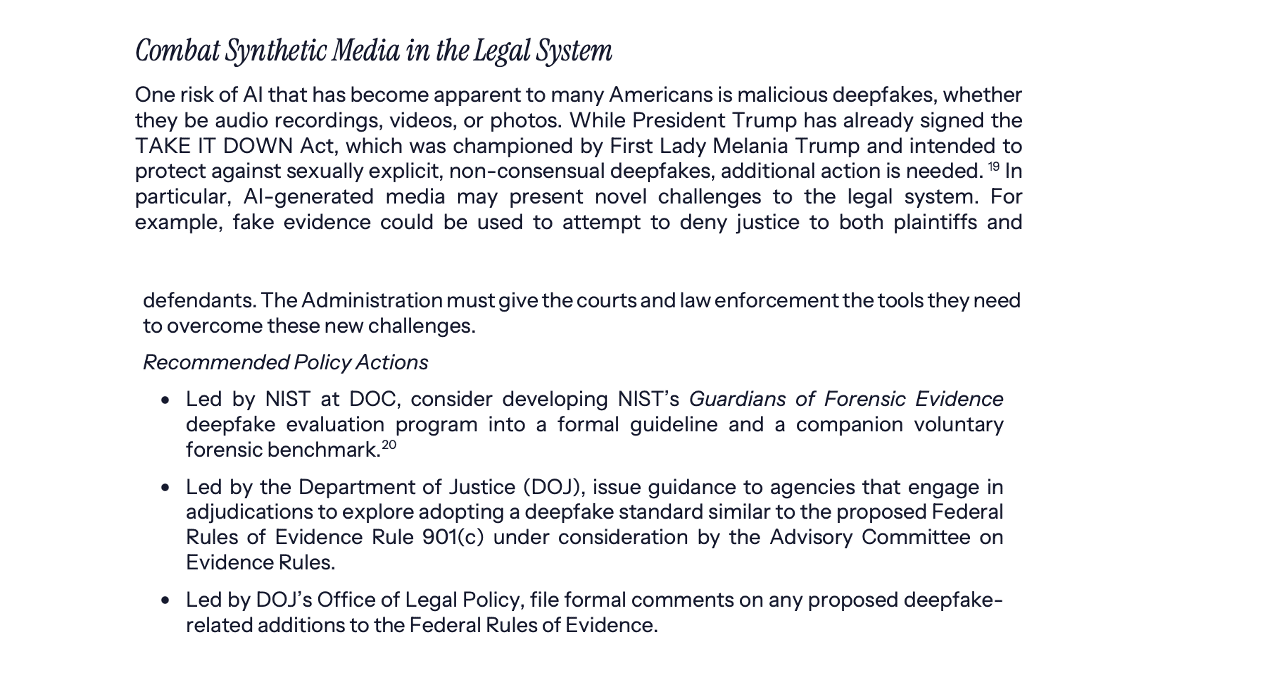
As for the issue of “deepfakes,” the plan addresses it as follows …
Looking Ahead: While it does not mention retail specifically, the implications of this action plan could still be transformative for players in this space. From creating more resilient supply chains and enabling hyper-personalized customer journeys to bolstering cybersecurity and brand protection against deepfakes, the policy framework could pave the way towards a new AI-powered retail ecosystem.
The latest handbag to test the boundary between homage and infringement? A $1,600 upcycled tote called the “Boatkin,” which splices together the iconic Birkin silhouette with L.L. Bean’s rugged Boat and Tote. Created by Philadelphia-based designer Jen Risk under her label Hathaway Hutton, the viral bag – described by Risk as “quiet luxury with a smirk” – has drawn significant attention, not just for its cheeky design but also for what appears to be an abrupt disappearance from the market.
Each Boatkin is (or … was) handmade by Risk – a process that takes upwards of 10 hours – and was offered in two price tiers: $1,200 for bags crafted from customer-supplied L.L. Bean totes, and almost $1,600 for those made with materials sourced by Risk herself. Since its debut earlier this year, the cheeky creation has gone viral, landing on Good Morning America, in People magazine, and, most notably, in a New York Times Style feature in May, “The Birkin Inspires Yet Another Homage,” which chronicled the Boatkin’s rise as a playful and (relatively) accessible alternative to the real thing.
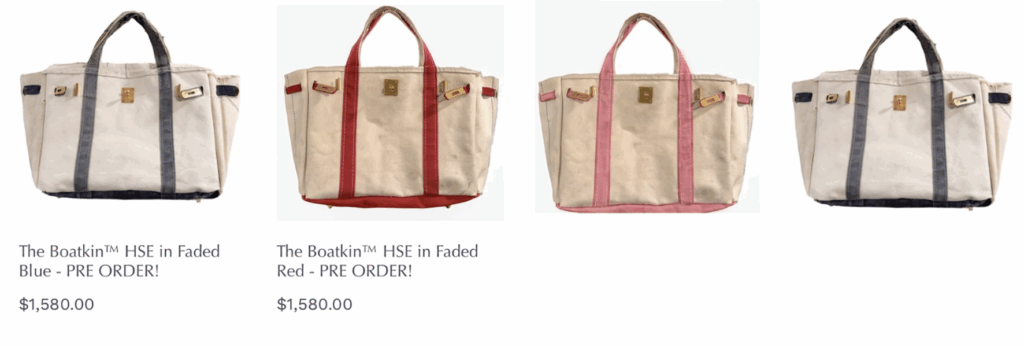
As of the time of the article’s publication, Hathaway Hutton had pre-sold 300 Boatkin bags and amassed a growing waitlist. And all the whole, dupes began hitting the market, in a testament to the appeal of the buzzy new bag.
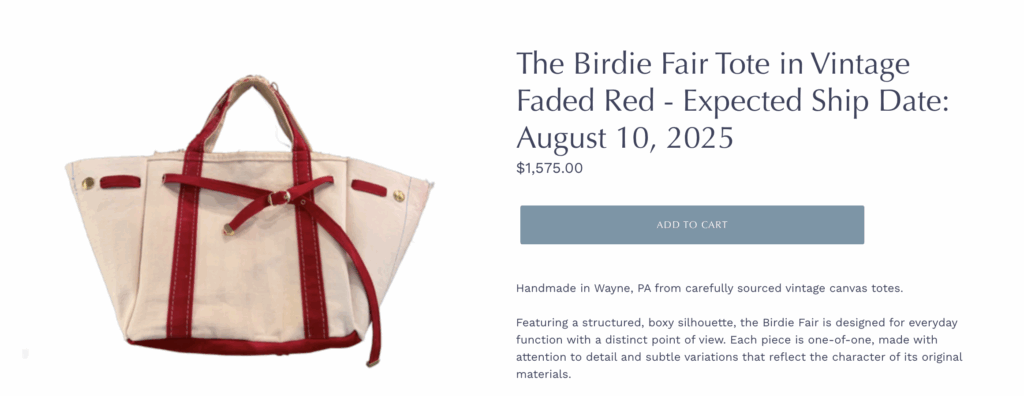
But since then, the Boatkin has effectively vanished. Hathaway Hutton’s Instagram feed has been scrubbed of all but one Boatkin reference – a photo of the Times feature – and the brand’s e-commerce site, which previously offered up at least 10 iterations of the bag, no longer features the design. In its place is a similar, but not identical, style dubbed the “Birdie.”
What explains the sudden of disappearance of the budding “it” bag? It is not difficult to imagine that Hermès may have quietly stepped in. A behind-the-scenes cease-and-desist scenario would be in line with the brand’s long-standing approach: Hermès rarely opts for high-profile litigation; exceptions include the MetaBirkins case and others like its relatively short-lived case against Thursday Friday almost 15 years ago. Given the Boatkin’s not-inexpensive price point and viral success, however, the lookalike may have become too visible – and too close for comfort – to be ignored.
At the same time, the positioning of the Boatkin as a “sustainable” upcycled product and the undeniable David v. Goliath element of a luxury behemoth like Hermès (hypothetically) taking on a teeny-tiny brand like Hathaway Hutton would make a quiet resolution the appropriate move from a court-of-public-opinion perspective.
> There is also a chance L.L. Bean is behind the sudden stop of Boatkin sales; that seems a bit less likely (to me, at least) since Hathaway Hutton would have something of a first sale argument to make (save for the glaring material difference issue) given that it is using authentic Boat and Totes to craft the Boatkins bags.
THE TAKEAWAY: The Boatkin’s brief but meteoric run underscores how quickly the internet can turn an upcycled, tongue-in-cheek creation into a cultural phenomenon – and potentially, how equally fast such creations can vanish if they skirt too close to luxury brands’ most prized IP.
The U.S. and EU are nearing a potential trade deal that could set a 15% tariff on European imports, echoing the recent U.S.-Japan agreement, while averting President Trump’s threat to raise tariffs to 30% by August 1. Although negotiations have advanced, no deal has been finalized, and the White House has described reports of an agreement as premature or speculative. Brussels appears ready to accept the reciprocal levies to prevent a more damaging trade war, with exemptions likely for key goods such as aircraft, spirits, and medical devices. Tariffs on cars, currently about 27.5%, could fall to 15% under the proposed framework.
For retailers and brands, the implications are significant. A 15% tariff baseline – up from the current 10% surcharge on top of existing 4.8% duties – would pressure margins on European consumer goods, luxury products, and automotive imports. Retailers may face tough decisions about whether to absorb costs or pass them on to consumers, reshaping pricing, inventory strategies, and seasonal promotions.
> Sectors like fashion, cosmetics, and specialty food could see higher prices as the key holiday season approaches.
> In an H1 earnings call on Thursday, LVMH management said a potential tariff rate of 15% for exports to the U.S., as opposed to the threatened 30%, would be an “overall good outcome for the general mood of our clients.” Meanwhile, LVMH chairman and CEO Bernard Arnault said in an interview this week that he is “pushing as much as I can for us to reach a [trade] agreement” with the U.S.
Meanwhile, the EU is keeping contingency plans alive. A €93 billion package of retaliatory tariffs, with rates up to 30%, is ready to take effect on August 7 if talks collapse. Brussels is also prepared to invoke its Anti-Coercion Instrument, known as its “trade bazooka,” to restrict U.S. companies from public tenders and tighten import/export rules. While markets have reacted positively – with the euro and U.S. equities rising on hopes of a resolution – the final decision rests with President Trump, and the scope of exemptions and tariff reductions remains fluid.