



Nearly 1,000 of the 1,500 largest companies in the U.S. have mentioned tariffs on earnings calls or at investor events since the beginning of the year, according to LSEG data – many among them being in the apparel and footwear segments, as well as luxury more broadly. I have started a running list here of tariffs mentions from relevant companies …
Abercrombie – On March 5, Abercrombie revealed that its margins will take a hit due to higher freight costs and increased promotions early in the year to manage excess inventory. The retailer, which expects FY2025 revenue to rise by 3% to 5%—below analyst expectations of 6.8%, per LSEG—confirmed that its forecast accounts for current tariffs on China, Canada, and Mexico but does not include “other potential incremental tariffs.”
CFO Robert Ball told investors that the company aims to avoid making “significant changes” to pricing (i.e., raising prices substantially). This strategy makes sense, according to William Blair analyst Dylan Carden, who told Yahoo Finance, “You’re talking about a category that has no pricing power, having to absorb these incremental costs … I don’t think they’re going to have the capacity to do that without really hitting demand.”
Amer Sports – Amer Sports Chief Financial Officer Andrew Page said in a statement on Feb. 25 that the Arc’teryx and Salomon owner is “well positioned to deliver another year of strong and profitable growth in 2025” – even in light of different tariff scenarios. “Raising prices has not been a lever that we are pulling,” he said. “We do believe we have pricing power, and we will continue to price competitively … but at the same time we do not want to detract our core consumer.”
American Eagle – American Eagle Outfitters expects its margins to decline year over year, with CFO Michael Mathias stating on March 12 that tariffs are expected to weigh on results. CNBC reported that “the company currently sources just under 20% of its products from China and anticipates a $5 million to $10 million hit from the new duties in fiscal 2025, which will also affect American Eagle’s gross margin.”
Mathias added that, at present, the company is not planning to pass those costs on to consumers and aims to reduce its China exposure to below 10% by the end of the fiscal year.
Adidas – Looking ahead in 2025, CEO Bjorn Gulden acknowledged the uncertainty surrounding U.S. tariffs. “With all the volatility, we don’t know what’s going to happen with tariffs in the U.S. We have no idea what impact inflation could have, [so] it is, of course, good to be on the safe side,” he said on March 5. Adidas expects to generate between €1.7 billion and €1.8 billion in operating profit in 2025, lower than the €2.1 billion analysts had forecast.
Gap – “We’re all dealing with tariffs. We’re monitoring tariff developments on an hourly basis,” Gap CEO Richard Dickson told Yahoo Finance on March 7. He noted that the company sources less than 10% of its products from China and less than 1% from Canada and Mexico combined. “Our guidance accounts for what we know today regarding the tariff policy.”
Hugo Boss – Hugo Boss is “closely monitoring developments in tariff policy,” CEO Daniel Grieder said on an earnings call on March 12, noting that it is too early to quantify the potential impact on business.
Inditex – Zara owner Inditex’s CEO Oscar Garcia Maceiras said, “The current environment is difficult to predict in terms of tariffs. Of course, we are continuously monitoring the situation.” He noted that Inditex is in a very good position “due to our levels of geographical diversification in terms of sourcing and sales.” (Inditex sources its products from 50 countries.) Garcia Maceiras added that Inditex’s experience in many markets means that it is accustomed to dealing with different tariff regimes.
Porsche – Porsche CFO Jochen Breckner stated on March 12 that the company will assess pricing strategies once tariffs become more concrete. “We have a very, very strong brand, a great customer base, a loyal customer base, and great products. So, first and foremost, we would look into additional pricing” to maintain margins.
Puma – The company stated on March 12 that it expects earnings of €520 million to €600 million for FY2025 down from last year and below analysts’ estimates. Currency-adjusted sales will probably rise in “the low- to mid-single-digit range,” Puma said, due to “trade tariffs, currency swings and geopolitical tensions.”
Target – “The company expects to see meaningful year-over-year profit pressure in its first quarter,” it said, attributing the impact to tariff uncertainty, as well as weak demand for apparel and other discretionary products during February. “We will continue to monitor these trends and will remain appropriately cautious with our expectations for the year ahead,” Chief Financial Officer Jim Lee said in a statement.
>> If there is interest, I will keep this list going as a handy tracker. Shoot me an email and let me know.
At Alessandro Michele’s Fall/Winter 2025 presentation for Valentino this week (which felt oh-so-much like his work at Gucci), a sneaker collaboration with Vans made its debut. Highsnobiety described the sneaker at the center of the tie-up, Vans’ Authentic, as making for a “surprisingly simple” collaboration. While the fashion media has been largely positive (British Vogue called it “the most coveted release of 2025”), it really feels like peak collab fatigue. (To be fair, that feeling has been creeping up again and again in recent years.)
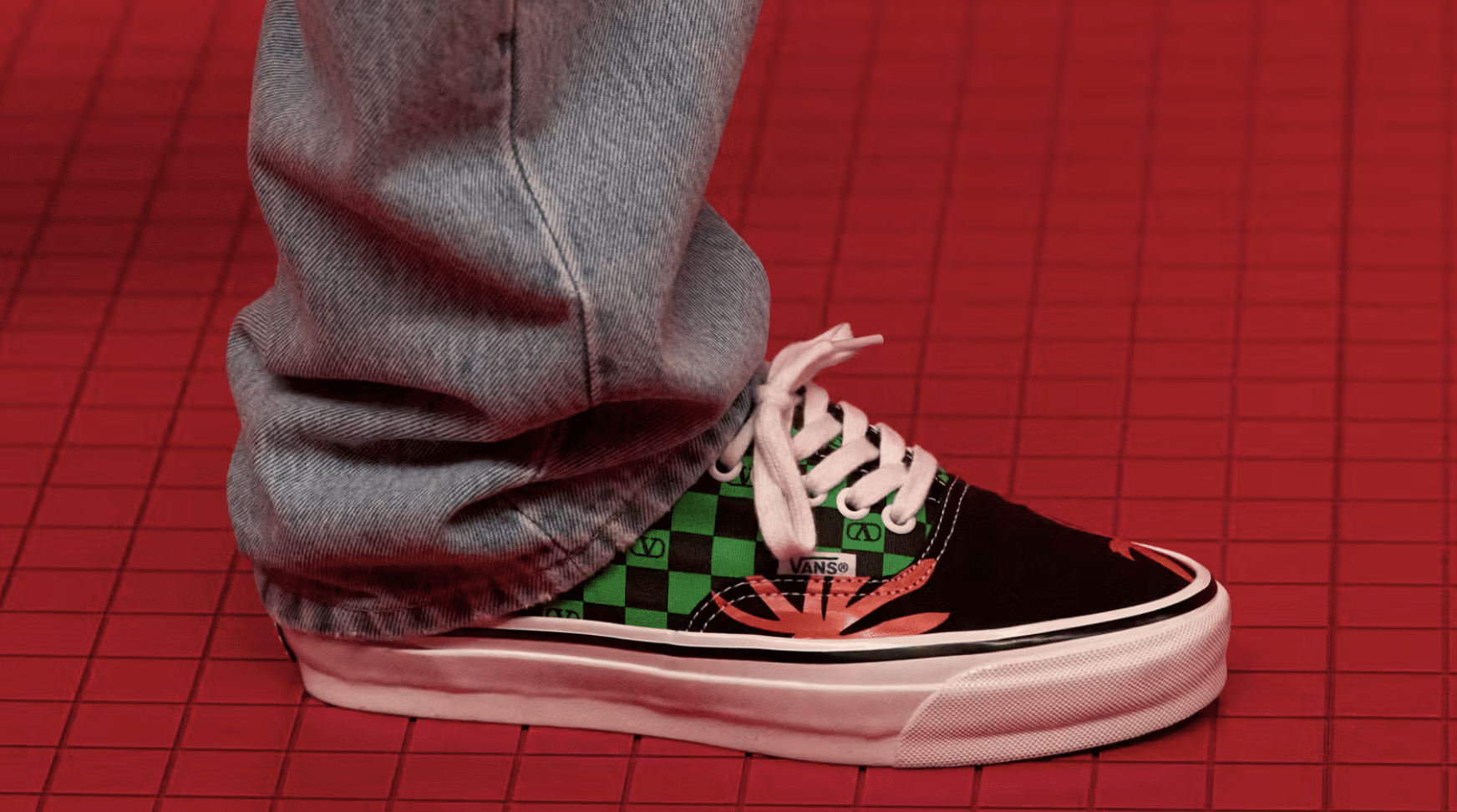
Sure, it is not nearly as egregious as Hidden Valley Ranch’s utterly nonsensical traipses with apparel companies, for example, but it is also not an unsurprising or otherwise terribly compelling partnership that breaks through the noise of a crowded market. In other words, it’s no Miu Miu x New Balance.
Even still, the collab makes some sense. Chances are, the price points for the co-branded footwear will fall in line with Vans’ traditional collab prices (i.e., more expensive than its usual $50-$80 sneakers) than Valentino’s usual offerings. And with this, the collab appears to be one of the latest examples of luxury brands looking to cater to aspirational luxury shoppers by way of more entry-level goods. It is no secret that luxury goods brands are generally unwilling to lower prices of their main offerings and instead, seem to be much more eager to offer up other goods to meet inflation-weary, discretionary-purchase-cautious consumers where they currently are. And so, more luxury branded sneaker collabs and new Louis Vuitton makeup hits the market.
The status of non-competes is a less clear as of this week, with the Trump administration filing motions with the Fifth and Eleventh Circuits to temporarily hold off on deciding appeals of two district court decisions that blocked the FTC’s rule banning non-competes. In the two motions, counsel for the DOJ stated that newly-appointed FTC Commissioner Andrew N. Ferguson “recently stated publicly that he believes the Commission should reconsider its defense of the challenged rule” and said that he will present a decision about that to his colleagues “at some point.”
The filings follow from the Directive Regarding Labor Markets Task Force that Ferguson released on Feb. 26, in which he specifically states that as examples of what may constitute deceptive, unfair and anticompetitive labor practices, include:
> No-poach, non-solicitation or no-hire agreements, where employers agree to refrain from hiring each other’s employees and which can be a per se violation of the competition laws, and
> Noncompete agreements, which employers can use to impose unnecessary, onerous and often lengthy restrictions on former employees’ ability to take new jobs in the same industry after they leave their employment, among other things.
Against this background, the Trump Administration is not expected to completely reverse course when it comes to restricting non-compete clauses.
While employers wait on the potential outcomes of the Trump administration’s moves, including “whether it stops its defense of the rule or ultimately drops the rule altogether,” Ogletree Deakins’ Tobias Schlueter and Zachary Zagger state that “the reality remains that the FTC will maintain some level of scrutiny of noncompete agreements and their potential impact on labor markets—at least in the antitrust context.”