



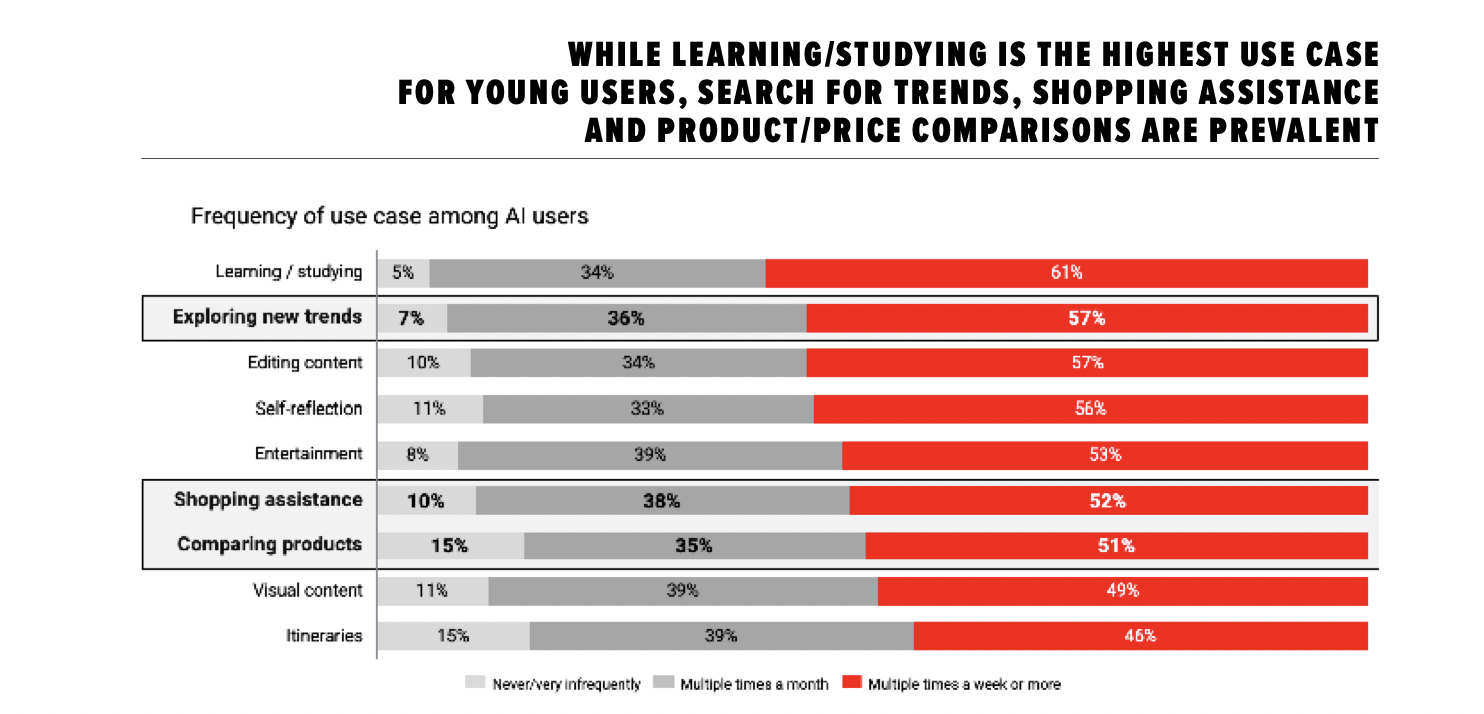
WWD x BCG published their inaugural “Future of Fashion” report this week, mapping how Gen Z and Gen Alpha are rewiring the U.S. fashion market – on track to drive 40% of spend over the next decade. Drawing on ~9,000 survey responses, 50,000+ social posts, and CEO interviews, the study shows youth culture (not brand heritage) now sets the value bar; discovery has shifted to a social flywheel led by creators; and AI is a seismic force, with 40% of young shoppers using it for trends, research, and comparisons.
Winners will trade brand control for creator energy, focus on fundamentals (price, quality, conversion), and retool for agent/AI answer engines, not just search. The playbook: define the next-gen target with clarity and KPIs, embed in youth culture, activate social commerce end-to-end, optimize for AI visibility, and scale high-touch, personalized service at every price point.
Among some of the interesting takeaways …
> Brand heritage no longer guarantees value; youth culture now decides who earns consideration. The report shows that Gen Z/Alpha treat brand legacy as optional – credibility comes from cultural relevance in the moment. Brands that embed in youth scenes (sports/lifestyle, creators, local artistry) and move before a trend crests gain cross-generational halo effects. Speed matters: cultural spikes now rise and fade in weeks, not quarters, so “trend starters” beat “trendsetters.”
> This generation prioritizes products over brands, accentuating fundamentals like price and quality.Distinctive, right-now products outrank house loyalty—especially in performance categories. Conversion hinges on basics: competitive pricing, transparent promotions, and solid quality/fit. Resale potential also factors into value calculus for aspirational buyers, making SKU-level proposition and durability more important.

> AI is transforming fashion shopping and discovery. Nearly 40% of Gen Z already use AI tools for trend discovery, styling, and price comparison – making AI a trusted co-shopper. Virtual try-ons, AI stylists, and personalized recommendations are redefining service expectations, especially among high-spending youth who use these tools daily. To stay visible, brands must optimize for AI-driven discovery, not just traditional search. That means structuring content for machine readability, keeping product data accurate across all channels, and aligning with how users ask questions.
Leading brands are already testing AI search ads and building agent-friendly data systems to ensure their products surface in AI-powered shopping results.
> Leading brands are shifting from brand control to creator energy and activating the social commerce engine. Social has evolved from inspiration to end-to-end commerce; discovery and checkout now collapse into the same moment. Creator-led content outperforms static brand storytelling, with micro-influencers driving authentic connections and real-time virality.
> Operational implications across the stack. Define who in the Next Gen you’re targeting, set KPIs, and build agile teams fluent in AI and youth culture. Rebalance channel mix toward social commerce while preserving margins via efficiency (pricing, loyalty, assortment, cost). Scale high-touch personalization (fit guidance, recommendations, chat styling) at every price point to turn momentary cultural wins into durable relationships.
PepsiCo has unveiled a new corporate brand identity this week, its first in nearly 25 years. The refreshed branding, paired with the “Food. Drinks. Smiles.” tagline, “is not just a new logo,” according to CEO Ramon Laguarta. “It’s who we are and a signal of our transformation: a visible expression of PepsiCo’s evolution and our pivot toward the future.”
There are sustainability elements at play, with Laguarta saying that the new identity, which will roll out across products and facilities beginning January 2026, underscores PepsiCo’s role as a global food-and-beverage leader driven by purpose, innovation, and connection.

Maybe more interestingly, it appears to be an effort to build specific brand awareness. In addition to “boldly reflect[ing] who we are in 2025: a company with expansive reach, aiming for positive impact across the globe, and an unmatched family of beloved food and drink brands,” the new logo aims to further distinguish that parent from its most well-known brand. After all, only 21 percent of consumers can name a PepsiCo brand beyond Pepsi, per Laguarta.
The latest annual report from the UN Global Compact and Accenture delivers a clear signal: sustainability is central to long-term business performance. Drawing on insights from more than 1,000 CEOs worldwide, the report outlines five strategic imperatives for the next era of sustainable leadership: (1) Collaborate on regulation; (2) harness consumer demand; (3) expand access to technology; (4) upskill for the future; and (5) lead with credibility and purpose
The report shows that leaders that embed sustainability into the core of their strategy are building more competitive, resilient businesses. Here’s a closer look at the first two keys …
1. Collaborate on Regulation. CEOs must integrate ESG governance, proactively engage policymakers and cooperate across sectors to shape regulatory environments that enable sustainable growth, both regionally and globally.
CEOs are shifting from compliance-focused mindsets to proactive engagement, recognizing that helping shape the regulatory landscape is now part of the leadership mandate. This means embedding ESG governance at the executive level, engaging policymakers consistently, and working across sectors to address systemic barriers such as infrastructure gaps, financing constraints, and regulatory fragmentation.
Key priorities include:
> Proactive policymaking: 84% of CEOs agree future leaders must stay ahead of evolving global regulations.
> Unified frameworks: Unified global reporting standards can streamline compliance, boost transparency, and unlock sustainable investment.
> Partnerships with impact: The UN Global Compact’s living wage initiative exemplifies how corporate action and local engagement can build momentum for inclusive, bottom-up policy change.
To lead effectively, companies must integrate sustainability into their governance structures, participate in cross-sector and multilateral policy forums, and invest in digital tools that ensure ESG data integrity and build stakeholder trust.
2. Harness Consumer Demand. CEOs must tap into consumer momentum by embedding sustainability into product design, pricing and partnerships to lead in a demand-driven future.
Consumer expectations are shaping product design, pricing, and strategy. In fact, CEOs now place consumer influence above that of governments, investors, or employees. This shift signals the rise of market-driven accountability, where brand equity and growth are increasingly tied to demonstrable sustainability performance. To meet this rising demand, CEOs are prioritizing …
> Value chain collaboration: 97% agree that cross-industry partnerships are essential to meet evolving sustainability expectations.
> AI-powered innovation: Generative AI is accelerating sustainable product development through faster prototyping, testing, and scenario modeling.
> Circular business models: With over 73% of CEOs investing in circularity, designing for reuse, recycling, and regeneration is fast becoming the new baseline.
Consumers are not just seeking eco-conscious products – they want tangible proof of impact. Companies that respond with credible action, not just messaging, will earn long-term loyalty and market relevance.
*Sustainability as Strategy: The New Starting Point
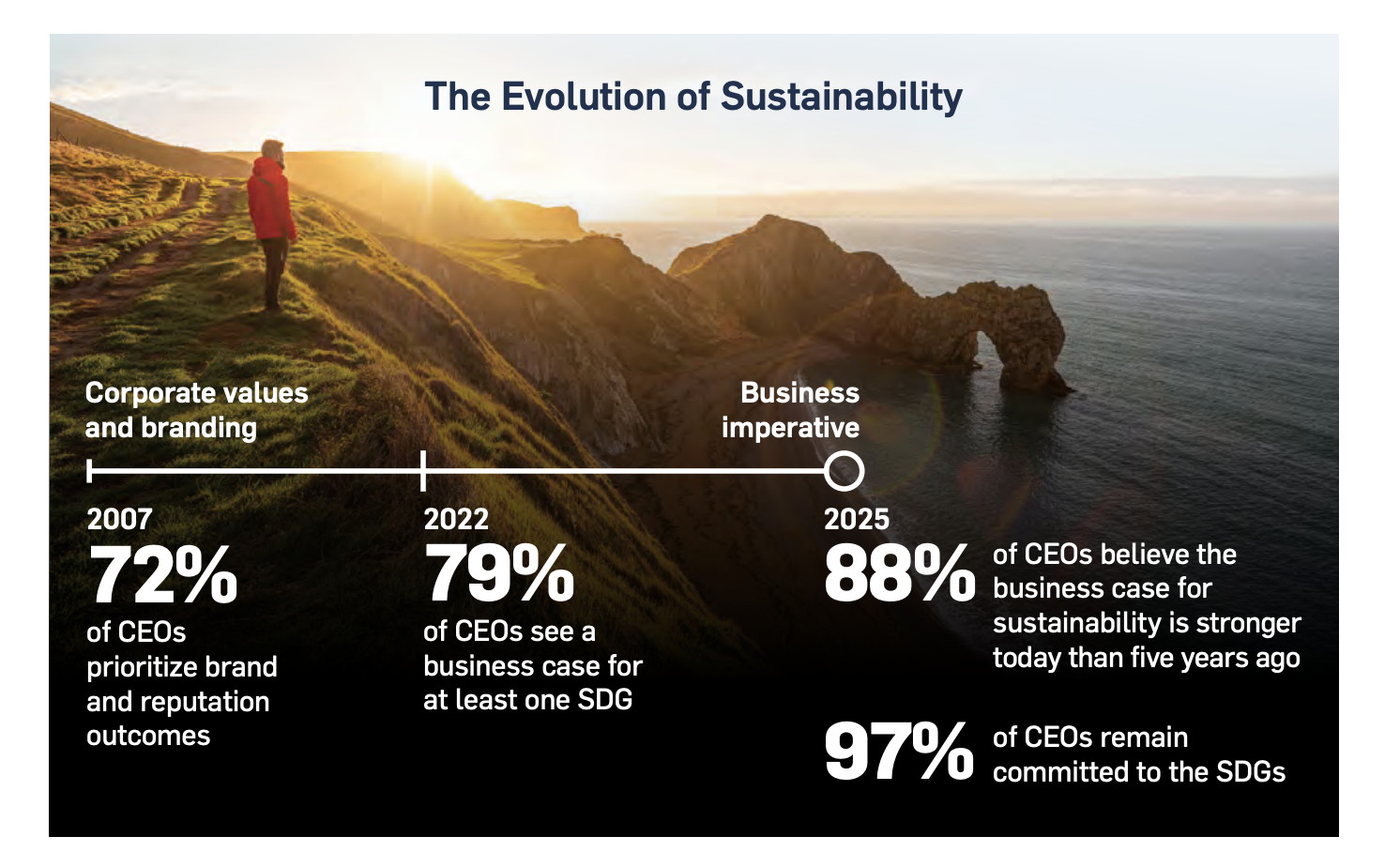
Sustainability is no longer a bolt; it is a strategy starting point, per Accenture. CEOs are shifting from high-level commitments to full-scale integration, embedding sustainability into operations, governance, and decision-making, and this shift is already well underway. 86% of CEOs say sustainability is integrated into their core operations, with leaders like Flix SE CEO André Schwämmlein emphasizing that “sustainability and business objectives can coexist.”
Others echo the view that sustainability is now a business imperative, not a branding exercise. Alejandro Simón, CEO of Sancor Seguros Group, puts it plainly: “Well-managed sustainability is a competitive advantage – a way of mitigating risks, luring talent, gaining clients’ loyalty and ensuring long-term resilience.”
Still, most CEOs agree there’s more work to do: Only 34% believe companies have successfully integrated sustainability over the past 25 years, while 66% expect meaningful progress in the next 25. That means redesigning products, addressing Scope 3 emissions, and embedding sustainability into leadership incentives.
>> And this is more than an operational shift – it’s a cultural transformation. As Jesper Brodin, CEO of Ingka Group (IKEA) and Vice Chair of the UN Global Compact Advisory Board, puts it: “Sustainability is not an add-on – it’s in our DNA.”
This week, eBay and Condé Nast unveiled a multi-year global partnership that positions eBay as the official Pre-Loved Partner across some of the world’s most influential media brands, including Vogue, GQ, Vanity Fair, and Architectural Digest in the U.S., U.K., and Germany. The alliance aims to redefine the role of circular fashion in the global marketplace, making pre-loved not only sustainable, but aspirational.
For retail leaders, this collaboration represents a critical inflection point. Circularity is no longer a peripheral sustainability initiative – it is fast becoming a core expectation among consumers, particularly younger demographics that value authenticity, environmental impact, and cultural relevance. By merging eBay’s resale expertise with Condé Nast’s editorial authority and cultural reach, this partnership accelerates the ongoing mainstreaming of pre-loved fashion at scale.
The implications for retailers are noteworthy. To remain competitive, brands must rethink the full product lifecycle – from design to resale – and engage in ecosystems that support longevity, transparency, and differentiated value. As resale moves from niche to mainstream, this partnership sets a new benchmark for how commerce and content can converge to shape the next era of fashion.
>> Not without legal nuance: The partnership comes as sustainability and circularity-centric regulations, including extended producer responsibility regulations, gain momentum globally, requiring brands to account for the environmental impact of their products across the entire lifecycle. As policymakers tighten expectations around waste, circularity, and corporate accountability, resale and circular models may shift from strategic advantage to regulatory necessity.
In this context, high-profile collaborations like eBay and Condé Nast’s are not just reflective of shifting consumer values and regulatory realities – they can help shape the narrative, normalize new business models, and accelerate industry-wide adoption of more regenerative, future-facing retail strategies.