



Brunello Cucinelli’s shares plunged 17.3% to €85.08 on Thursday and dropped 8.8% in early trading on Friday after short-seller Morpheus Research accused the company of misleading investors about its Russian operations and quietly resorting to discounting that risks diluting its rarefied image. Morpheus, which has taken a short position in the Italian luxury brand, published a three-month investigation citing store visits, trade data, and interviews with former employees. It alleges that despite EU sanctions, Cucinelli continues to operate boutiques in Moscow and supply retailers such as Tsum, while also off-loading excess stock into off-price channels.
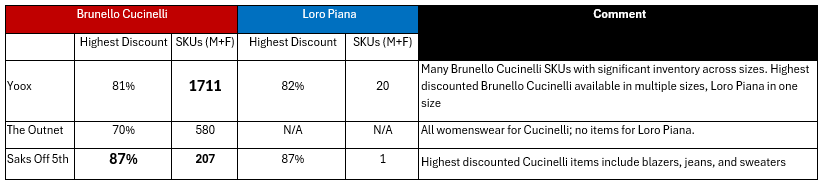
The company forcefully rejected the claims, with CEO Luca Lisandroni calling the report “defaming” and pointing to Italian Customs inspections that found no violations. He stressed that Russia now accounts for just 2% of sales, down from 9% in 2021, and said maintaining a local presence was aimed at paying staff and honoring leases, not expanding operations. Exports to Russia, the company noted, have dropped from €16M in 2021 to €5M in 2024.
Beyond a couple of days of market volatility, the episode underscores how short-seller campaigns can erode confidence in luxury houses by raising doubts about compliance, governance, and inventory discipline – issues that underpin value in a sector built on scarcity and reputation. Lisandroni emphasized that long-term analysts and investors remain supportive, while signaling that Cucinelli may pursue legal action. The sharp reaction in Milan highlights the vulnerability of even well-regarded luxury players to activist short sellers who pair financial bets with allegations of regulatory or reputational risk.
>> Whether Morpheus’s claims prove substantive or opportunistic, markets are quick to discount uncertainty in an industry where credibility is everything.
The FTC has secured a $2.5 billion settlement with Amazon over allegations that it used “dark patterns” to trap millions of consumers in Prime subscriptions. The order requires the e-commerce giant to pay a $1 billion civil penalty and return $1.5 billion to consumers.
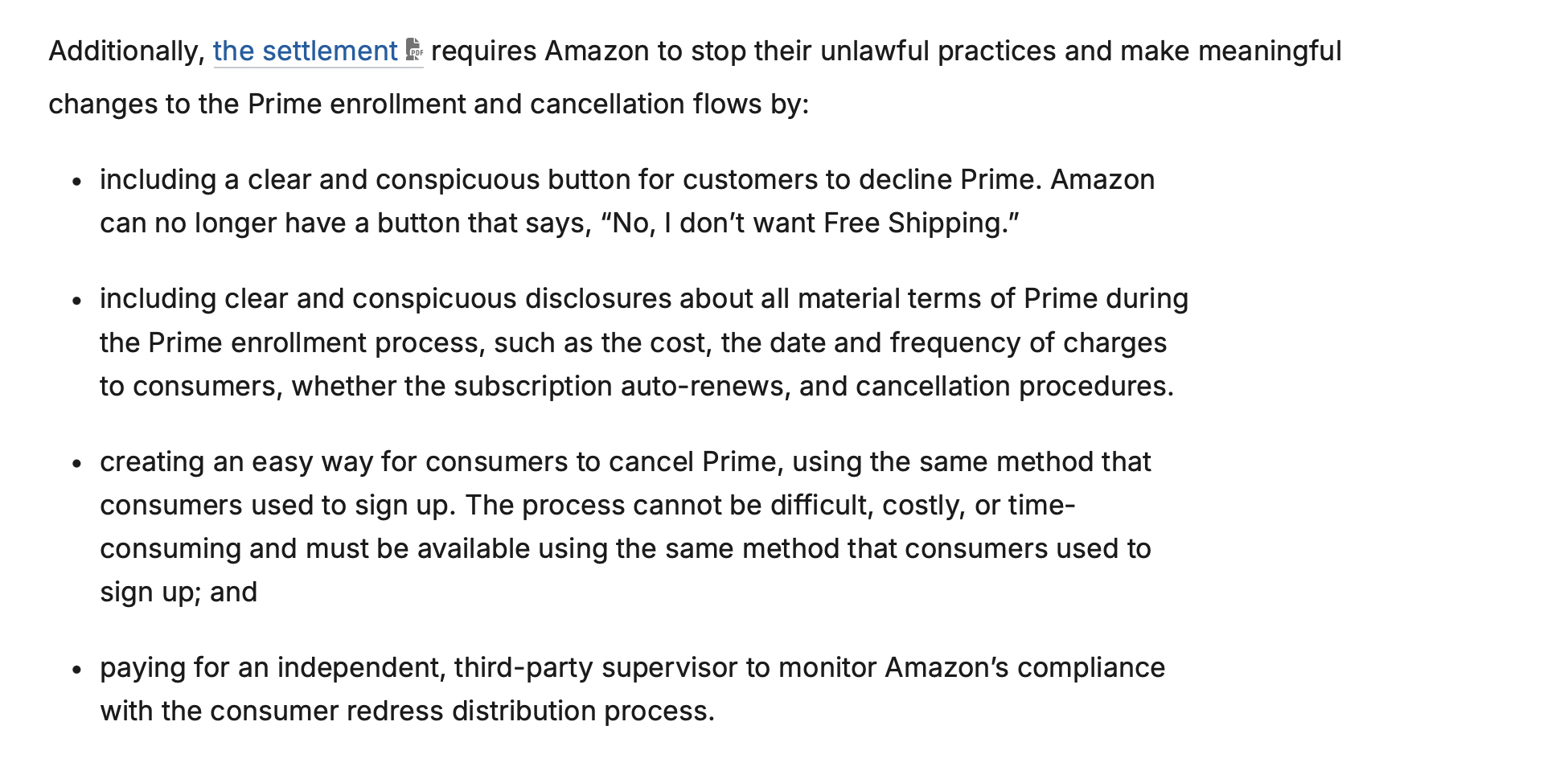
The settlement signals growing scrutiny of manipulative user-interface practices across digital commerce, with the FTC making clear that convenience cannot come at the expense of consumer consent. For companies operating subscription-based models, the order raises the bar on transparency, informed choice, and ease of cancellation – principles that are poised to become baseline regulatory expectations.
The Global Fashion Agenda released its 2025 Fashion CEO Agenda this week, a strategic roadmap designed to help fashion executives embed sustainability at the center of business strategy. Framing the pace of change as “too slow,” the report urges leaders to embrace bold, long-term decisions over short-term cost efficiency and to ground sustainability efforts in measurable progress.
The report reinforces five longstanding sustainability priorities: Respectful and Secure Work Environments, Better Wage Systems, Resource Stewardship, Smart Material Choices, and Circular Systems. For 2025, these pillars are paired with both long-term ambitions and immediate short-term actions, designed to guide brands through a turbulent global climate marked by economic volatility, deregulation, weakened labor protections, and climate urgency.
Key takeaways from the 2025 Agenda include …
> Leadership beyond quarterly gains: The Agenda urges fashion executives to embrace courageous, values-driven leadership that prioritizes long-term responsibility for people and planet over short-term profit maximization.
> Five reinforced priorities as non-negotiables: Respectful and secure work environments, fair and equitable wage systems, responsible stewardship of natural resources, smart material choices, and circular systems are not as optional initiatives but the core pillars around which resilient, future-proof business must be built.
> Tangible commitments over vague pledges: Companies need to move from broad statements of intent to measurable actions, including implementing living wage frameworks across supply chains, ensuring diversity and inclusion at every level, aligning with science-based climate targets, and addressing overproduction as a structural issue rather than an afterthought.
> Material innovation as a climate lever: The report underscores the importance of sourcing low-impact and regenerative materials at scale, while accelerating investments in textile-to-textile recycling technologies. These shifts are essential to decoupling growth from environmental degradation and to advancing a circular economy.
> Systemic change through alignment: Transformation cannot be achieved by individual brands alone. The industry needs sector-wide collaboration, strong regulatory frameworks that level the playing field, and capital investment in both innovation and infrastructure to accelerate change.
THE BOTTOM LINE: The 2025 Agenda positions sustainability not as an add-on but as a central business imperative. Its framing of climate urgency, labor vulnerability, and shifting regulation makes clear that inaction is no longer a neutral choice but a material business risk. The underlying takeaway is that fashion companies cannot afford piecemeal efforts or symbolic pledges – measurable progress, credible collaboration, and long-term alignment will increasingly define competitiveness as the industry races toward 2030.
A new petition in the UK is urging lawmakers to create protections for fashion models amid the rise of AI.
The British Fashion Model Agents Association has launched a petition warning that unregulated use of AI threatens models’ livelihoods and rights. The letter stresses that signatories have never consented to their likeness being used for AI purposes and calls for explicit, voluntary, and uncoerced written consent under clear licensing terms, highlighting the UK’s lack of unified image rights legislation compared to moves in the EU and US. Without swift legal protections, the petition argues that models face exploitation and potential job losses.
Unlike musicians and actors, whose unions have begun to address AI usage in collective bargaining, models in the UK and elsewhere lack specific statutory protection over their image rights. Current frameworks often rely on piecemeal privacy, publicity, and IP laws, leaving a gap that AI exploitation could widen. The petition argues for clear rules that would recognize a model’s likeness as a protected asset, ensuring that digital replicas cannot be used without explicit authorization.
The petition comes amid heightened scrutiny over how AI is reshaping creative industries, from synthetic “AI influencers” to luxury brands experimenting with digital avatars. For the modeling profession, where identity and physical presence are the core value, the absence of tailored legal safeguards leaves talent especially vulnerable to unauthorized digital cloning. Advocates behind the petition hope to push the UK government toward establishing a new framework that balances technological innovation with protection of workers’ rights in fashion.