



The UK’s Advertising Standards Authority (“ASA”) is putting fashion’s green claims back under the microscope, this time via Google ads. In rulings published on December 8, the ASA found that unqualified uses of terms like “sustainable materials,” “sustainable style,” and “sustainable clothing” by Nike Retail, Superdry, and Lacoste were misleading, even where the brands could point to genuine sustainability initiatives. According to the regulator, consumers are likely to interpret standalone “sustainable” claims as absolute – suggesting no environmental harm across a product’s full lifecycle – a standard most mass-produced fashion simply cannot meet.
The decisions underscore a broader enforcement shift: powered by AI-driven ad monitoring tools capable of scanning tens of millions of digital ads each year, the ASA is no longer reliant on complaints and is increasingly scrutinizing paid search and platform advertising that once flew under the radar.

>> The takeaway for brands is clear: vague green language is high-risk and should be approached with caution. Even in space-constrained formats like Google ads, sustainability claims must be precise, qualified, and evidence-backed – and reliance on generative AI to optimize ad copy will not excuse non-compliance.
In a recent legislative updates (from our AI Legislation Tracker), New York Governor Kathy Hochul signed first-in-the-nation laws aimed at curbing the use of AI in advertising and strengthening post-mortem right-of-publicity protections. The measures require advertisers to disclose the use of AI-generated synthetic performers and mandate consent from heirs or executors before a deceased individual’s name, image, or likeness can be used for commercial purposes.
Framed as consumer-protection and labor safeguards for an industry increasingly shaped by generative technology, the laws place New York at the forefront of AI transparency and posthumous publicity rights, earning praise from lawmakers and SAG-AFTRA as the lines between reality, performance, and digital fabrication continue to blur.
Requires advertisers and content creators to make a conspicuous disclosure when a commercial advertisement uses an AI-generated “synthetic performer.”
> Broad Scope of Coverage: Applies to anyone involved in producing or creating advertisements distributed in New York, including brands, agencies, and production partners.
> Exceptions: Excludes audio-only ads, AI used solely for translation, and promotional materials for expressive works where the synthetic performer appears consistently in the underlying work.
> Civil Penalties for Noncompliance: Violations carry a $1,000 civil penalty for a first offense and $5,000 for subsequent offenses.
> Delayed Effective Date: Takes effect June 9, 2026, giving advertisers a limited runway to update workflows and disclosure practices.
> Implications: Likely to force brands to scrutinize agency practices, influencer content, and AI vendor tools used in creative production, and likely to influence similar bills in states such as California, particularly in advertising and digital media regulation.
Requires prior authorization from heirs or executors for the commercial use of a deceased individual’s name, image, voice, or likeness.
> Expanded Coverage for Digital Replicas: Specifically restricts the use of AI-generated digital replicas of deceased performers in audiovisual works, sound recordings, and live musical performances.
> Defined Classes of Protected Individuals: Applies to “deceased personalities” and “deceased performers” domiciled in New York at the time of death.
> Damages: Provides for statutory damages of $2,000 or compensatory damages (including profits), with the possibility of punitive damages.
> Immediate Effectiveness: Became effective upon signing on Dec. 11, 2025.
> Implications: Updates existing protections to address AI-driven resurrection, cloning, and replication of deceased individuals, and raises due diligence stakes for studios, brands, and estates managing archival footage, legacy contracts, and AI-enabled remastering.
In another legislative update, New York has set a national precedent on “surveillance pricing.” Effective November 10, the state’s new Algorithmic Pricing Disclosure Act requires businesses to clearly disclose when a price offered to a New York consumer is generated by an algorithm using that consumer’s personal data. >> More about that here.
The global luxury industry is entering a more sobering, more selective phase. According to the 24th edition of Bain & Company and Fondazione Altagamma’s annual Luxury Study, global luxury spending reached an estimated €1.44 trillion in 2025 – effectively flat to slightly down compared to 2024 – marking a continuation of the post-pandemic normalization that began last year.
While the sector remains structurally larger than it was pre-Covid, the data underscores a decisive shift: growth is no longer broad-based, aspirational consumers are retreating, and only brands with clear differentiation, disciplined pricing, and cultural relevance are managing to pull ahead. Key points from the study include …
> Global luxury spending stalled: Overall luxury sales declined by 1% to 3% at current exchange rates in 2025, though remained 12% to 14% above 2019 levels, signaling normalization rather than collapse.
> Regional divergence persists: The Americas stabilized, Europe and Asia declined, and emerging regions – including Southeast Asia, the Middle East, Latin America, and India – are increasingly positioned as the next growth engines. 
> Experiences outperform products: Luxury hospitality, dining, wellness, and travel continued to grow, while experience-based goods (cars, art, yachts) and many product categories softened, reflecting shifting consumer priorities.
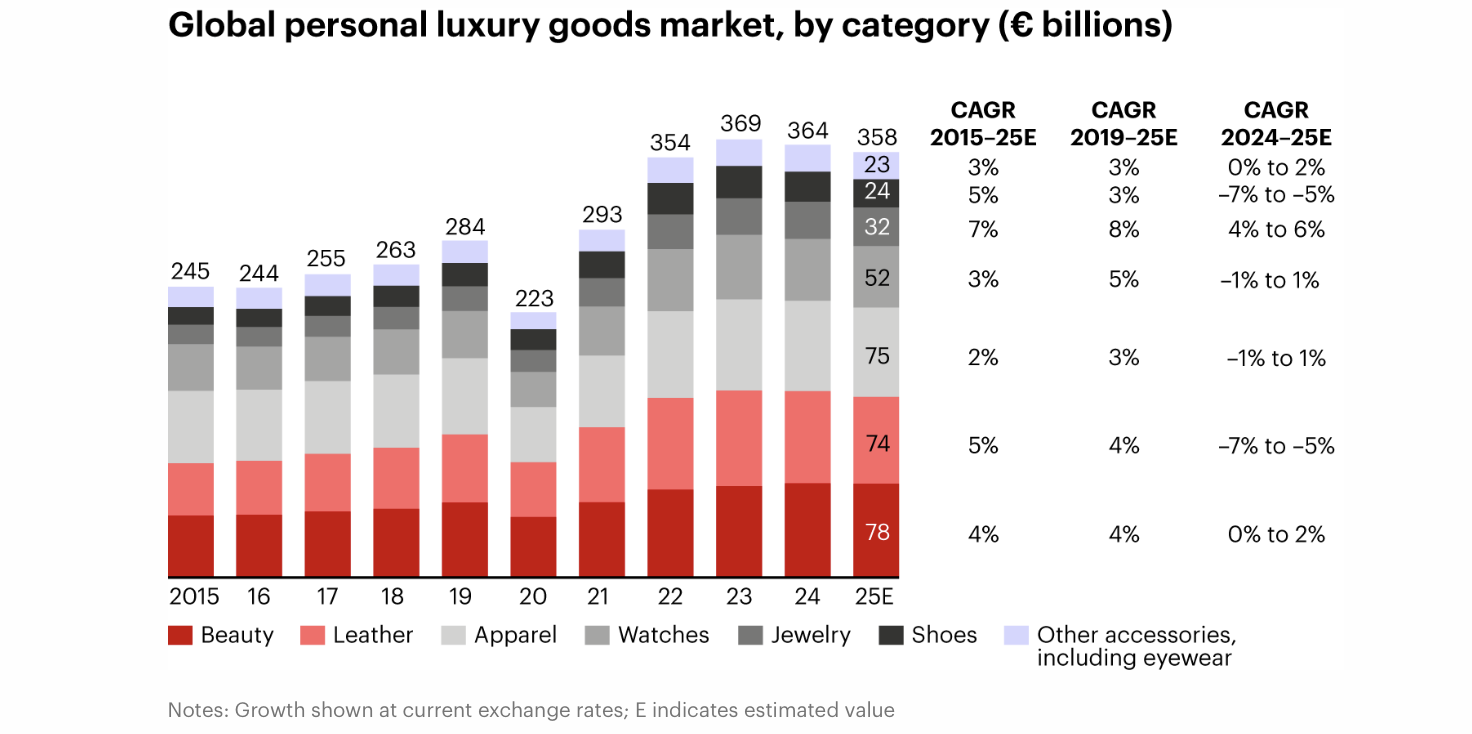
> Personal luxury goods held steady – but fragile: Core personal luxury goods slipped about 2% to €358 billion, flat at constant exchange rates, with modest improvement in the second half of the year.
> Jewelry shines, leather struggles: Jewelry was the standout category, while leather goods and footwear continued to contract sharply due to price fatigue and perceived creative stagnation.
> The luxury customer base is shrinking: Roughly 20 million consumers exited the luxury market in 2025, driven largely by aspirational buyers trading down, buying less frequently, or redirecting spending toward experiences and secondhand luxury.
> Polarization is intensifying: Only 40% to 45% of brands grew in 2025, with specialist players significantly outperforming generalists; about half of €5 billion-plus luxury groups reported revenue declines.
> Margins are under pressure: Operating margins fell to 15% to 16%, down sharply from 21% in 2022, erasing roughly 20% of industry profits amid inflation, tariffs, markdowns, and rising operating costs.
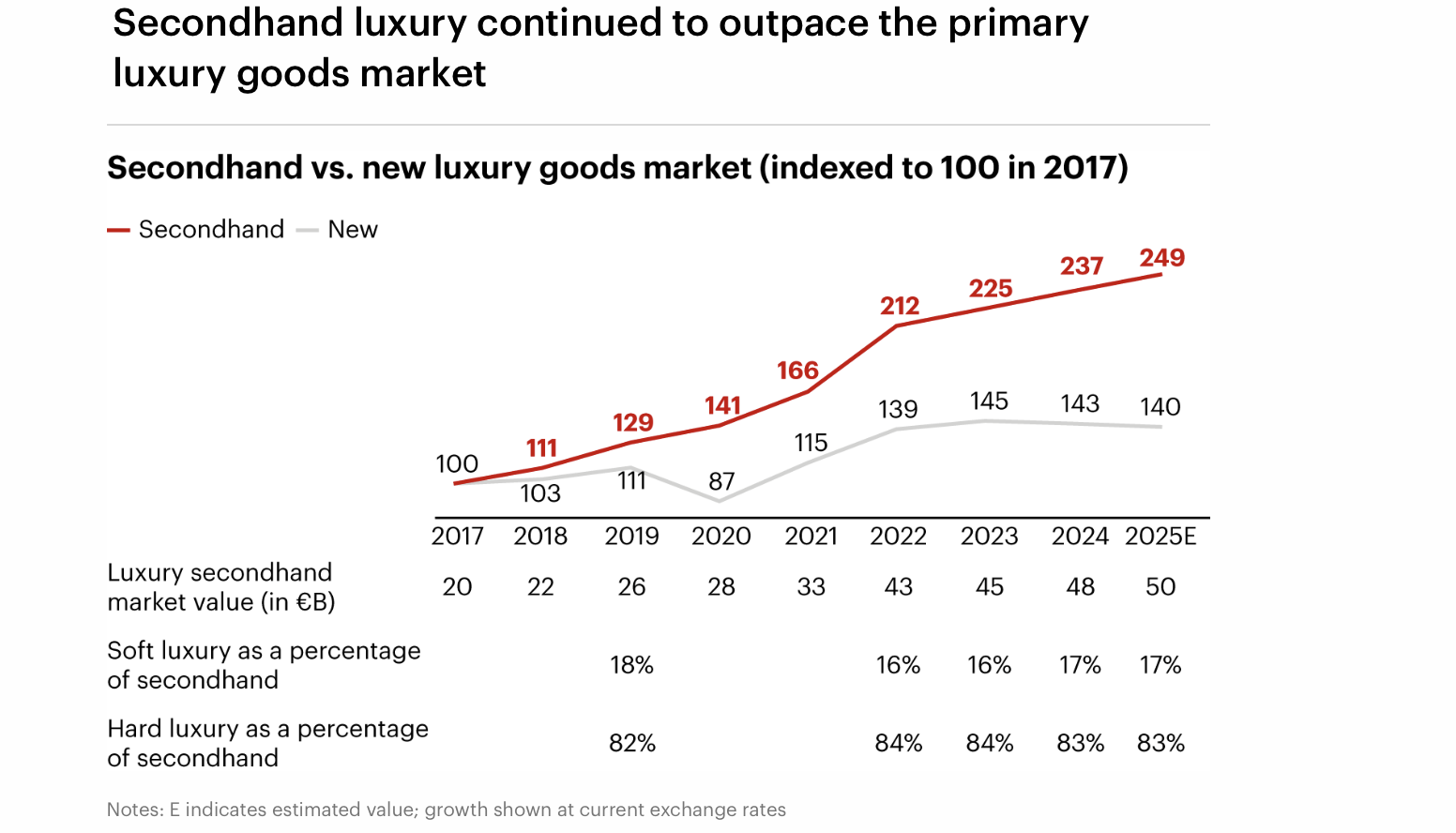
> Outlets and secondhand gain ground: Outlet stores outperformed full-price retail, and the secondhand luxury market grew to an estimated €50 billion, outpacing sales of new luxury goods.
THE TAKEAWAY: Luxury is no longer buoyed by price elevation alone. Bain’s findings point to an industry at an inflection point: one that must pivot from scale-driven growth to precision-led strategy. Brands that recommit to creativity, product quality, cultural relevance, and disciplined execution – while resisting overreliance on exclusivity or relentless price hikes – are best positioned to recover momentum in 2026 and beyond. Those that fail to reset risk further erosion, not just of margins, but of consumer trust and long-term desirability.
The U.S. holiday returns season is getting an AI upgrade. UPS-owned reverse logistics firm Happy Returns is deploying a new AI tool, Return Vision, to help combat fraudulent retail returns amid what it says is a surge in holiday-season return fraud, which accounts for roughly one in every ten refunds and costs U.S. retailers about $76.5 billion annually, according to Reuters. The AI system flags suspicious returns by analyzing patterns, such as unusually early refund requests or linked email addresses, and comparing the returned items to images of what was originally purchased, before sending potential fraud cases to human auditors for final review.
>> Less than 1 % of returns in the Happy Returns network are flagged, and about 10 % of flagged cases are confirmed as fake, with an average value of around $261.
While the technology is aimed at reducing losses from swapped or counterfeit items, it does not yet address other issues such as “wardrobing,” where customers use products before returning them, underscoring that AI is a growing but still imperfect tool in the fight against retail fraud.