
France has taken another step toward becoming the first major economy to create a regulatory framework aimed specifically at regulating ultra-fast fashion. After more than two years of revisions and negotiations, the ultra-fast fashion focused law cleared its final parliamentary hurdle on June 29 when the Senate approved the final negotiated text that will impose environmental penalties, prohibit advertising, restrict influencer promotions, and create new consumer-facing obligations for companies, such as Shein, Temu, and AliExpress.
Although the bill still requires presidential promulgation before becoming law (and certain provisions could face scrutiny under European Union law), it offers one of the clearest indications to date of how governments are beginning to regulate ultra-fast fashion. Rather than applying broadly across the apparel industry, the legislation targets a specific retail model characterized by rapid product turnover, ultra-low prices, and high-volume online sales.
Moving Beyond Disclosure
Perhaps the bill’s most significant feature is that it moves beyond sustainability reporting and disclosure requirements and introduces financial penalties aimed at changing the economics of ultra-fast fashion itself. Those penalties stem from one of the legislation’s defining features: rather than regulating fast fashion broadly, lawmakers narrowed the bill to target so-called “ultra-fast-fashion” platforms.
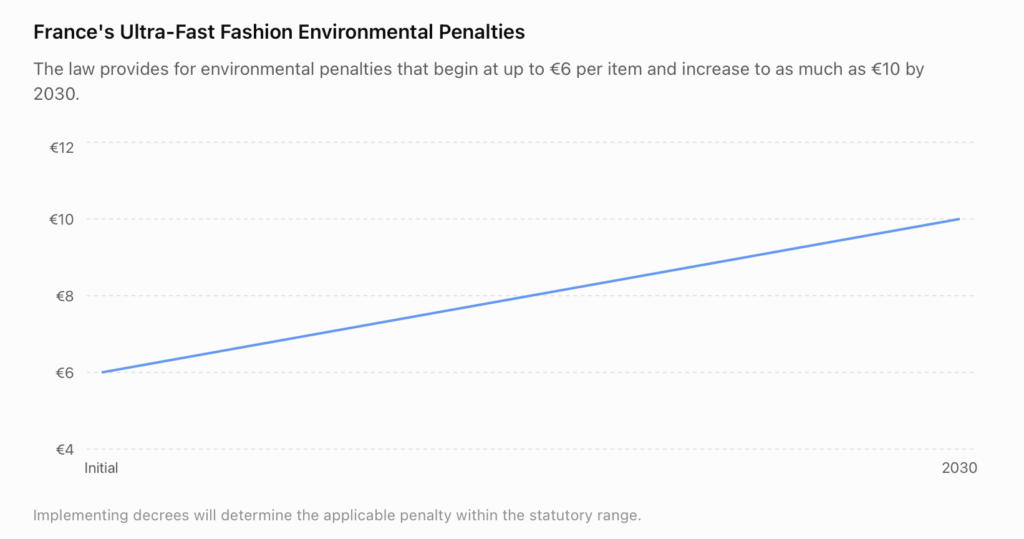
In practice, that means companies such as Shein, Temu, and AliExpress are expected to bear the brunt of the new requirements, while European retailers including Zara and H&M were largely left outside the law’s scope. Under the bill, covered companies will face per-item environmental charges beginning at relatively modest levels before increasing over time, reaching as much as €10 per product by 2030, subject to statutory limits based on the product’s pre-tax price.
The legislation also will prohibit advertising by qualifying ultra-fast-fashion companies, ban influencers from promoting those businesses, require platforms to display messages encouraging consumers to repair, reuse, and recycle clothing, and direct a portion of collected penalties toward textile collection and recycling initiatives.
Taken together, the measures reflect an effort to influence both corporate behavior and consumer demand, rather than relying solely on disclosure obligations or voluntary sustainability commitments.
Potential Legal Challenges Ahead
The bill’s advertising restrictions are likely to become one of its most closely watched legal features. Beyond prohibiting advertising by qualifying ultra-fast-fashion companies, the legislation also bars influencers from promoting those businesses – a provision that, if ultimately upheld, could disrupt one of the industry’s favored customer acquisition channels. Social media creators have played a significant role in the rapid growth of platforms such as Shein and Temu, helping normalize “haul” culture and driving demand through affiliate marketing, discount codes, and product recommendations.
Whether those restrictions ultimately survive, however, remains an open question. The European Commission has reportedly questioned whether limits on advertising by online platforms are compatible with EU law governing digital services and cross-border commerce. Shein has similarly argued that aspects of the legislation appear inconsistent with the European legal framework applicable to e-commerce businesses.
Those questions may ultimately determine not only how much of the legislation can be implemented once the bill becomes law, but also whether France’s effort to regulate ultra-fast fashion through marketing restrictions can serve as a model for other jurisdictions.
More Than an Environmental Measure
Beyond its individual provisions, the legislation signals a broader shift in how governments may approach ultra-fast fashion. Historically, fashion regulation has focused on product safety, labor standards, supply chain transparency, and environmental disclosures. France’s legislation instead targets the commercial characteristics of a particular retail model – namely, companies that rapidly introduce enormous volumes of inexpensive products while relying heavily on digital marketing and frequent consumer purchases.
That distinction could prove significant. Rather than regulating apparel generally, France is attempting to regulate a category of business defined by its operating model.
Whether other jurisdictions follow that approach remains to be seen. But as regulators across Europe continue to scrutinize online marketplaces over issues ranging from sustainability and customs compliance to consumer protection and product safety, France’s legislation may offer an early blueprint for how governments seek to address ultra-fast fashion going forward.
THE BOTTOM LINE: For brands, retailers, and marketplace operators, the bill is noteworthy not simply because it targets Shein and Temu, but because it reflects an emerging willingness by lawmakers to regulate the structure of retail business models – not just the products they sell.
Share