



> Italy is moving to impose a tax on low-value parcels shipped from non-EU countries – aimed largely at ultra-cheap imports from platforms like Shein and Temu – in a push to protect its fashion sector from a flood of low-cost goods, mostly originating from China. Industry Minister Adolfo Urso said the measure will take effect by year’s end, mirroring an EU proposal to levy duties on packages under €150. The move comes as Europe processed 4.6 billion low-value parcels in 2024, nearly double the previous year.
> In the EU, finance ministers have agreed to accelerate the end of customs duty exemptions for low-value packages shipped into the bloc with the aim of the ban taking effect “as early as possible in 2026.” The move, originally planned for 2028, comes in response to a surge of inexpensive shipments, largely from China, which has prompted criticism from European businesses and pushed policymakers to tighten the timeline.
> A similar shift has been under way in the U.S., where Trump put an end to the tax loophole for packages under $800 in August. The swift stop of the trade tactic – long used by Shein, Temu, and other platforms – was expected to significant impact import flows. DHL spoke specifically to this point in an earnings call on Nov. 6, with CFO Melanie Kreis saying that “the very low-value B2C stuff has seen the impact, partially also because customers are then changing to different forms of transporting B2C into the U.S., but we have seen more resilience on the B2B side.”
DHL Group CEO Tobias Meyer added that the shipping giant does not expect a rebound in direct-to-consumer parcel traffic even if the Supreme Court blocks Trump-era tariff powers, noting that “there are other legal grounds that the president could use to impose tariffs.”
While the end of the loophole subjects packages to greater Customs scrutiny (at least in theory), it is worth noting that a number of recent busts, including seizures of luxury watches, which were destined for residential addresses, does not suggest that the stream of fakes being sent to the U.S. is slowing.
Finally, the U.S. and Switzerland announced a new trade deal on Friday that slashes tariffs on Swiss goods from 39% to 15%, paired with a pledge by Swiss companies to invest $200 billion in the U.S. by 2028, an agreement officials say will ease tensions, boost American manufacturing, and stabilize bilateral trade.
The news comes on the heels of Richemont head Johann Rupert meeting with Trump last week to discuss the impact of tariffs. Execs. from MSC, Rolex, Partners Group (PGHN.S), Mercuria, and MKS also recently met with Trump, as did Swiss economy minister Guy Parmelin and chief trade negotiator Helene Budliger Artieda.
The EUIPO has released its first cross-EU study examining how influencers understand and use intellectual property, painting a picture of an industry that drives significant economic activity but remains structurally under-protected. While 92% of influencers earn income from their content, only 18% hold registered IP rights, leaving the vast majority of creators commercially exposed in an environment defined by fast-growing enforcement needs and rising AI-related risks.
Among some of the EUIPO’s key findings …
> Low IP registration despite high commercial activity: Just 18% of influencers hold registered rights, even though most run full-scale businesses – 33% operate their own brand and 55% run online stores. The study suggests a widening gap between creator-led commerce and formal brand protection mechanisms.
> High compliance norms, but knowledge gaps remain: An overwhelming majority say they avoid promoting counterfeit goods (94%) and pirated content (93%), and 92% verify brand legitimacy. Yet knowledge of IP rights and enforcement pathways remains inconsistent across markets.
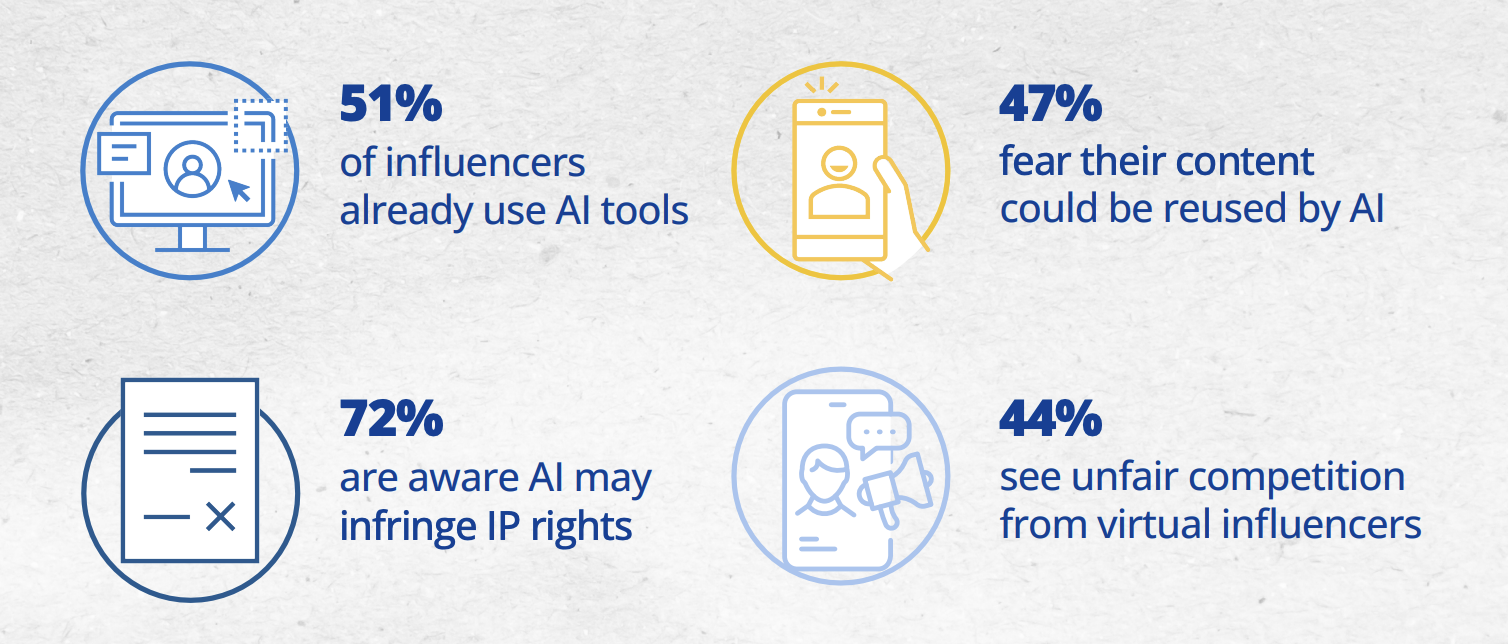
> AI intensifies legal uncertainty: 72% of influencers already use AI tools, but 51% fear their content may be reused by AI, and 44% recognize that AI-generated content can infringe IP rights. Nearly half (47%) see “virtual influencers” as emerging unfair competition, highlighting the regulatory lag between technological change and creator protections.
> IP ownership correlates with business maturity: Influencers who do hold IP rights tend to have more advanced business operations, reinforcing the legal-economic link between brand protection, scalability, and trust.
THE BOTTOM LINE: The study frames influencers as “entrepreneurs and educators,” but underscores a pressing policy gap: creators are building commercial brands without the foundational IP safeguards that traditional businesses rely on.
In a separate IP Pulse report released this week, the WIPO surveyed 35,500 respondents aged 18-65 in 74 countries to gauge “global recognition of IP’s critical role in protecting innovation and creativity.” Here are the takeaways in a nutshell …

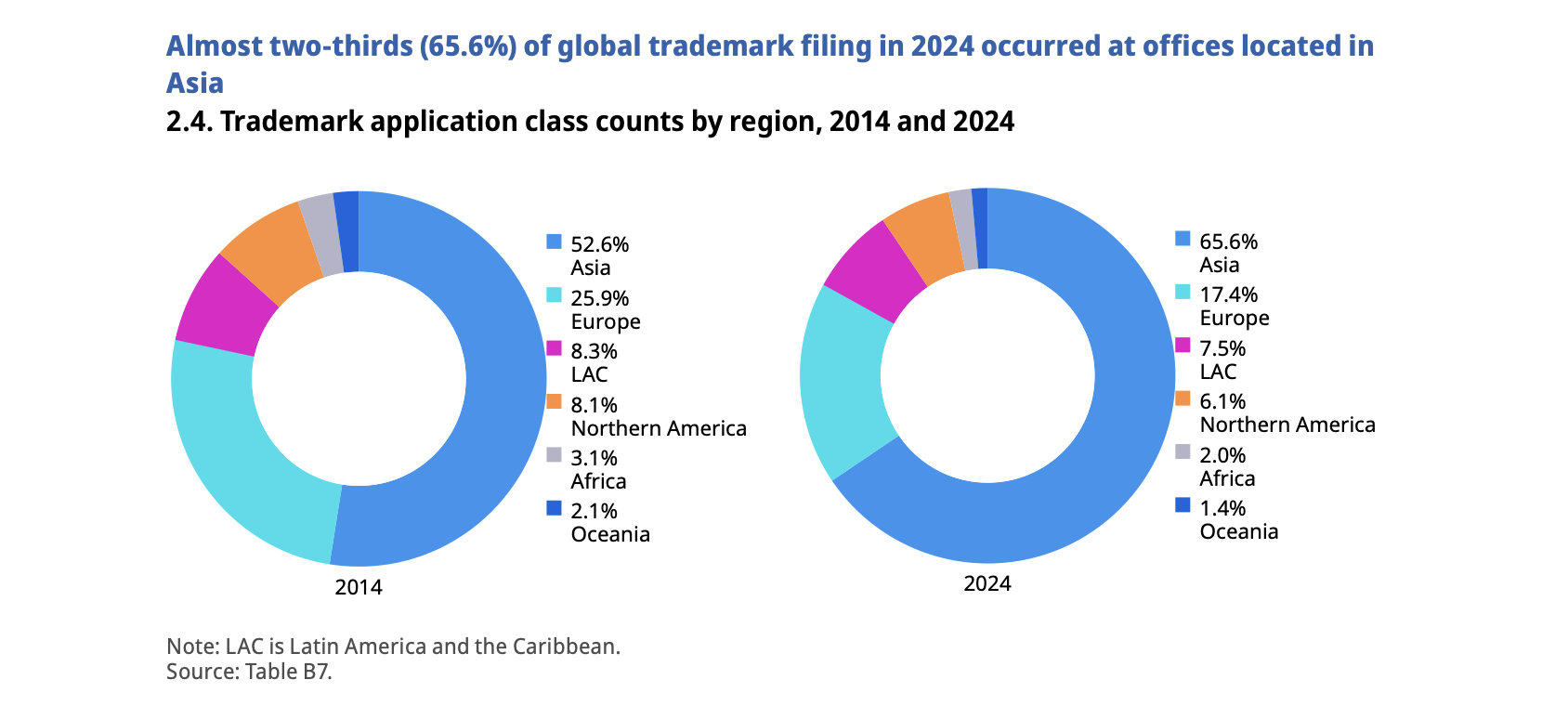
The WIPO also released its annual Indicators report this week, which highlights intellectual property activity around the world. A few trademark-centric stats …
> The office of China maintained its position as the world’s most active office in terms of trademark filing in 2024, despite experiencing a 2.9% decline compared to the previous year.
> China’s remarkable increase in filing becomes clear when comparing relative volumes: what for China was nearly three times the US filing level in 2010 had grown to almost nine times by 2024. This surge stems primarily from the high volume of domestic applications filed by residents of China.
> Distinct patterns are evident in resident versus abroad filing preferences. China-based applicants demonstrated a strong domestic focus in 2024, with 92.9% of their trademark filing taking place within China and only 7.1% destined for protection abroad. Still, China-based applicants emerged as the dominant source of foreign trademark filing across the top offices in 2024, leading non-resident filing at 12 of the other 19 top offices.
Speaking of trademarks … More than 300 foreign companies, including some of the world’s most recognizable consumer brands, are now seeing their trademarks come under threat in Russia, as the country’s economic isolation intensifies following its 2022 invasion of Ukraine. While many U.S. and European companies exited the Russian market but kept their trademark portfolios intact in hopes of an eventual return, Russia’s “use it or lose it” rule allows any unused mark to be canceled after three years and reassigned to a new applicant for a fee of under $1,500.
A Bloomberg review of Russian filings shows that several global brands, among them Victoria’s Secret, Ericsson, and Nokia, have already lost trademark rights due to successful cancellation claims. Others – like Giorgio Armani, Calvin Klein, Amazon, and Sheraton – now face similar challenges as a surge of opportunistic filings arrives ahead of the three-year deadline.
Trademark experts warn that the wave of cancellations could make it virtually impossible for many companies to re-enter the Russian market in the future. Rospatent, Russia’s patent office, has reported a spike in defensive filings, with more than 15,500 trademark applications submitted in 2024, alone.
A Munich regional court has issued one of Europe’s most significant AI–copyright rulings to date, finding that OpenAI’s ChatGPT infringed German copyright law by reproducing lyrics from nine songs, including works by Herbert Grönemeyer. The case, brought by rights society GEMA, represents a major win for creators challenging AI training on copyrighted material.
The court held that OpenAI violated copyright both by training its models on protected lyrics – deeming the model’s internal memorization itself an infringement – and by enabling ChatGPT to reproduce those lyrics in response to prompts. It rejected OpenAI’s position that users, not the developer, should be liable for any infringing outputs.
Judge Elke Schwager ordered OpenAI to pay damages to GEMA, without disclosing the amount, underscoring that unlicensed music use in AI training may have direct financial consequences. GEMA called the ruling a precedent-setting moment for Europe, with CEO Tobias Holzmüller stressing that “the internet is not a self-service store.” The decision is likely to shape how EU courts interpret AI training under copyright law as the EU AI Act and DSM Directive evolve.
The case comes amid mounting global pressure on AI companies, with rights holders from Bollywood to Nashville pursuing similar claims over unauthorized use of recordings and lyrics. OpenAI said it disagrees with the ruling and is weighing whether to appeal, but the decision firmly situates Europe at the center of the legal debate over how AI systems source and reproduce copyrighted material.