



Banana Republic is making a strategic return to its origins. The Gap Inc.-owned retailer has launched Banana Republic Archive, a platform that blends commerce and curation by spotlighting vintage pieces from the 1970s through the 1990s. The initiative, which is being touted as a new destination for vintage pieces, arrives with a capsule collection curated by stylist and archivist Marcus Allen, featuring 70 hand-selected garments – from a leather aviator jacket to a 1992 yellow raincoat.
At the same time, Banana Republic announced its acquisition of Abandoned Republic, the long-running fan-built archive of catalogs, advertising ephemera, and brand memorabilia maintained by Robyn Adams. By absorbing the site into its official platform, Banana Republic has effectively converted a community-led act of preservation into a proprietary brand asset. The move underscores how heritage labels are increasingly formalizing archival materials – not only to strengthen authenticity and storytelling, but also to reassert control over their histories at a time when resale and vintage are shaping luxury consumption.
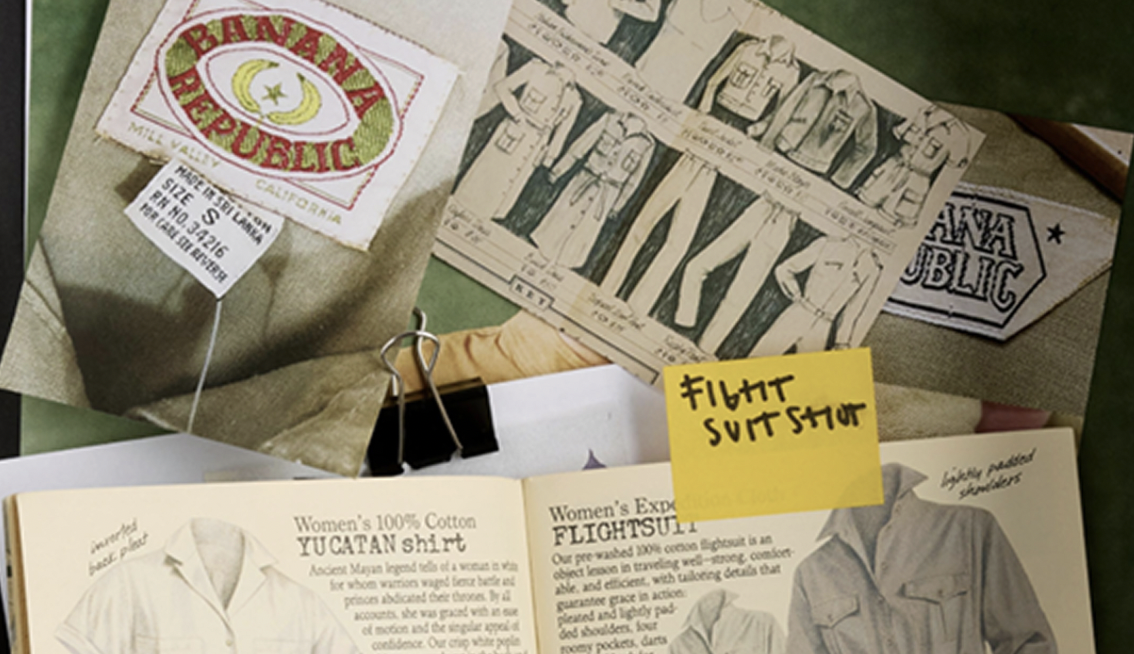
In marrying Allen’s curated capsule with the institutionalization of Abandoned Republic, Banana Republic Archive encapsulates a broader industry trend: heritage brands, including those in the mid-market, reclaiming their own histories to compete in an era where resale, authenticity, and storytelling increasingly define value. For Banana Republic, the Archive functions as both a commerce channel and brand museum – an e-commerce destination where vintage garments are authenticated, contextualized, and resold under the brand’s own authority. This vertical integration of vintage resale is more than aesthetic. It allows Banana Republic to:
> Control the secondary market narrative by guaranteeing authenticity and provenance;
> Monetize nostalgia in a way that aligns with brand messaging; and
> Reinforce creative legitimacy by positioning archival materials as a foundation for design and storytelling.
It is a model that other mid-market entities are likely to adopt (if they have not already). As heritage continues to function as a valuable form of intellectual property, archives are being reimagined not as static repositories but as dynamic economic and cultural engines.
>> THE TAKEAWAY: The launch of Banana Republic Archive makes clear that this is not only about nostalgia but about commerce, with limited drops of vintage pieces leveraging scarcity, provenance, and sustainability to tap into the booming resale market – a model that other mid-market and legacy labels, from J.Crew to Levi’s, may adopt to monetize their back catalogs while reinforcing cultural legitimacy.
The Crux of the Cucinelli Mess
Brunello Cucinelli’s Russian business has become a legal flashpoint. The Italian luxury house emphasized this week that its ongoing activities in Russia comply with European Union sanctions, which bar most luxury exports above €300 since the 2022 invasion of Ukraine. While its standalone stores in the country have remained shuttered, the company continues limited operations – selling goods that were shipped before sanctions took effect, or items priced below the export ceiling but marked up at retail in line with market practice.
The arrangement highlights a gray area in sanctions compliance: companies may still generate revenues from pre-sanctions stock and lower-valued transfers, provided they respect EU thresholds. Critics – led by a short-seller that recently accused Cucinelli of misleading investors – suggest that such models could obscure the true extent of exposure to Russia. Cucinelli has rejected these claims, likening its Russian business to a “candle” slowly burning down as inventory depletes.
From a legal perspective, the matter underscores the complexity of sanctions enforcement for luxury brands, which must navigate price-cap mechanics, resale markups, and reputational scrutiny while ensuring internal controls demonstrate strict compliance. The controversy also signals a wider challenge for European luxury groups: balancing sanctions adherence with transparency obligations to investors and regulators in markets where legacy stock and multi-brand partnerships remain active.
The American Apparel & Footwear Association (“AAFA”) is calling for a handful of big-name platforms to be included on this year’s list of notorious counterfeit markets. In a letter to the U.S. Trade Rep. this week, AAFA President and CEO Stephen Lamar argues that this year’s version of the Notorious Markets List should include Meta’s Facebook and Instagram platforms, Shopee, and Alibaba’s AliExpress and Taobao for enabling large-scale trafficking in counterfeits.
Representing 1,100+ brands and 3.6 million U.S. workers, AAFA cites persistent CBP seizures, consumer safety risks (including toxic substances found in fakes), and the explosive growth of e-commerce and AI-driven schemes across a “digital devalue chain” (dupe influencers, fraudulent ads, hidden links, fake sites).
Among the points waged by the AAFA was a focus on “dupes,” with the group highlighting …
> Dupe influencers proliferating on Instagram: One AAFA member flagged 250 dupe influencer profiles for removal between January-June 2025, noting increased prevalence in Latin America and the U.S. compared to 2024
> Regional reach of dupe influencers: Another brand reported 40+ dupe influencers with 209,000 followers collectively across Brazil and Mexico
> Instagram as a hub for dupe culture: AAFA members describe Instagram as a “true safe haven for repeat offenders and dupe culture,” pointing to repeat infringers and failures to remove infringing posts
> Facebook Marketplace and “dupe culture” demand: One member noted its branded bag became popular with influencers and Gen Z, who actively promote “dupe culture,” particularly in Latin America where demand for “affordable dupes” is driving counterfeit sales
> Dupe products misleading consumers: AAFA reported cases where counterfeit or dupe products used stolen influencer-style videos, affiliate images, and brand campaign content to mimic legitimate product marketing and deceive buyers.
The group argues that prior approaches are no longer sufficient and calls for USTR to also consider domestic platforms where evidence warrants inclusion. AAFA presses marketplaces to implement real seller verification, remove repeat offenders, curb ad fraud, and use brand-provided signals proactively – warning that profit-driven growth without protections harms rights holders, workers, and consumers alike.
In other trade news … leading trade associations representing the U.S. textile, apparel, footwear, and retail industries – including AAFA, FDRA, NRF, OIA, RILA, and USFIA – sent a joint letter to congressional leaders this week urging the immediate reauthorization of key trade preference programs. The letter highlights the urgent need to renew the African Growth and Opportunity Act (AGOA) and Haiti’s HOPE/HELP initiatives, both of which recently expired.
The groups warn that the lapse has disrupted supply chains, hurt U.S. cotton and textile exports, undermined American jobs, and ceded ground to Chinese competitors. They emphasize that AGOA and HOPE/HELP enjoy strong bipartisan support, directly sustain 3.6 million American workers, and provide vital economic stability to Sub-Saharan Africa and Haiti. The organizations are calling on Congress to act swiftly, including retroactive restoration, to secure these trade programs that serve both U.S. strategic and economic interests.