

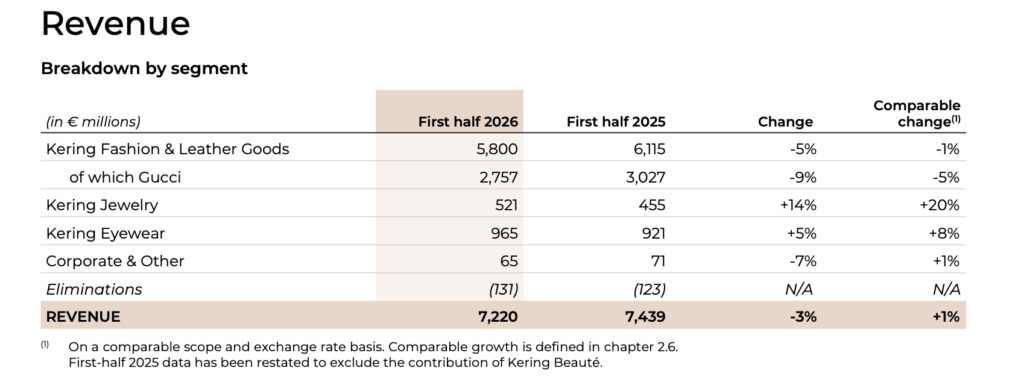
In its newly-released first-half report, Kering stated that the “decisive measures” it has taken to reinforce its brands, simplify its organization, and improve effectiveness across the Group are beginning to pay off. The group reported revenue of €7.2 billion for the six months ended June 30, down 3 percent (on a reported basis) from the same period last year. Recurring operating income remained essentially flat at €921 million, while net income attributable to the Group fell 60 percent to €189 million.
After comparable revenue was stable in the first quarter, Kering posted 2 percent comparable growth in the second quarter, which the company described as its first return to growth in three years. Fashion and Leather Goods revenue fell 1 percent on a comparable basis for the half, including a 5 percent decline at Gucci, while Kering Jewelry and Kering Eyewear grew 20 percent and 8 percent, respectively.
Beyond the financial results, the filing also reveals how Luca de Meo is beginning to reshape Kering’s business, from a sweeping beauty partnership with L’Oréal to the centralization of key functions across the Group.
The Gucci Beauty Transition
The biggest strategic development in the report centers on Kering’s new partnership with L’Oréal and the transition of Gucci’s beauty business away from Coty. Kering confirmed the completion of its strategic transaction with L’Oréal on March 31 following the necessary regulatory approvals. The deal included L’Oréal’s acquisition of Kering Beauté, including the Creed fragrance house, as well as beauty and fragrance licenses for Kering brands. As a result, Kering Beauté is now treated as a discontinued operation, with Kering restating its first-half 2025 figures to exclude the business.
Kering also disclosed that Gucci and L’Oréal entered into a 50-year exclusive beauty license on July 7. Scheduled to take effect in mid-2027, one year earlier than previously planned, the agreement is intended to strengthen Gucci’s desirability and brand value while unlocking new growth opportunities.
Ending Gucci’s existing Coty license ahead of schedule comes at a significant cost. According to Kering, Coty will receive approximately $400 million, with $250 million expected to be paid in 2026 and up to $150 million in 2027. Selected inventories will be acquired in addition to that amount. The filing does not expressly identify which party will make the Coty payments.
L’Oréal, meanwhile, agreed to reimburse Kering for transition costs equal to roughly 70 percent of the costs associated with redeeming Coty’s license rights and acquiring inventory. In return, Kering will oversee an orderly transition of the existing licensing arrangement.
The transaction is already reflected in Kering’s financial statements. First-half free cash flow from operations included €300 million related to what Kering calls the “Gucci Beauty agreement.”
Kering Centralizes Operations and AI Oversight
Kering created Group-level centers of excellence for Industry and Client. The Industry division integrates purchasing, manufacturing, supply chain, quality, and research and development, while the Client division covers functions across the customer value chain. Relevant house teams will report functionally to those central divisions.
Worth noting: Kering also elevated artificial intelligence within its executive leadership structure, appointing Pierre Houlès as Chief Digital, AI and IT Officer and adding him to the Executive Committee.
Store Rationalization Continues
Kering continued to shrink its directly operated retail network to 1,635 directly operated stores as of June 30, following 84 net closures during the half. Its financial notes link €41 million in impairment charges primarily to distribution-network streamlining at Gucci, Saint Laurent, Balenciaga, and McQueen. Restructuring costs and other non-recurring expenses also reflected organizational changes and costs associated with store closures. The restructuring also had a visible impact on Kering’s balance sheet. Net debt fell from €8 billion to €3.3 billion, with free cash flow supported by real-estate transactions and the €300 million Gucci Beauty item.
THE BOTTOM LINE: In addition to the financial figures for the first half of the year, Kering’s filing offers one of the clearest indications yet of how Luca de Meo intends to reshape the Group. Alongside a return to modest growth, the report outlines a new approach to beauty licensing, greater centralization of key business functions, and a continued effort to simplify Kering’s operations. The Gucci-Coty-L’Oréal transition is particularly notable, offering a rare glimpse into both the economics and mechanics of transferring a long-term luxury trademark license.
Share