

A decade ago, few would have predicted that a Chinese jeweler founded by a former livestock bureau official would become one of the most closely watched names in global luxury. Yet today, Laopu Gold has become shorthand for both the promise – and the questions – around whether Chinese brands can truly redefine the global luxury market.
Since its IPO in Hong Kong in June 2024, Laopu’s stock has surged more than 2,300 percent, lifting its market capitalization above $21 billion. With just 38 stores generating $3.18 billion in annual revenue, boutiques alongside luxury stalwarts like Louis Vuitton and Hermès in Beijing’s SKP mall and Singapore’s Marina Bay Sands, and rising spending by the brand’s most engaged clients, Laopu has been coined “the Hermès of gold” thanks to rising demand and its premium pricing and is being positioned alongside the likes of Cartier.
The story behind the brand is striking. In a matter of 16 years, the company has risen to global fame by successfully weaving Chinese cultural heritage into a modern luxury framework, adopting a scarcity-driven retail strategy, and relying on a digital-first marketing model powered by micro-influencers on Chinese social media site, Xiaohongshu.
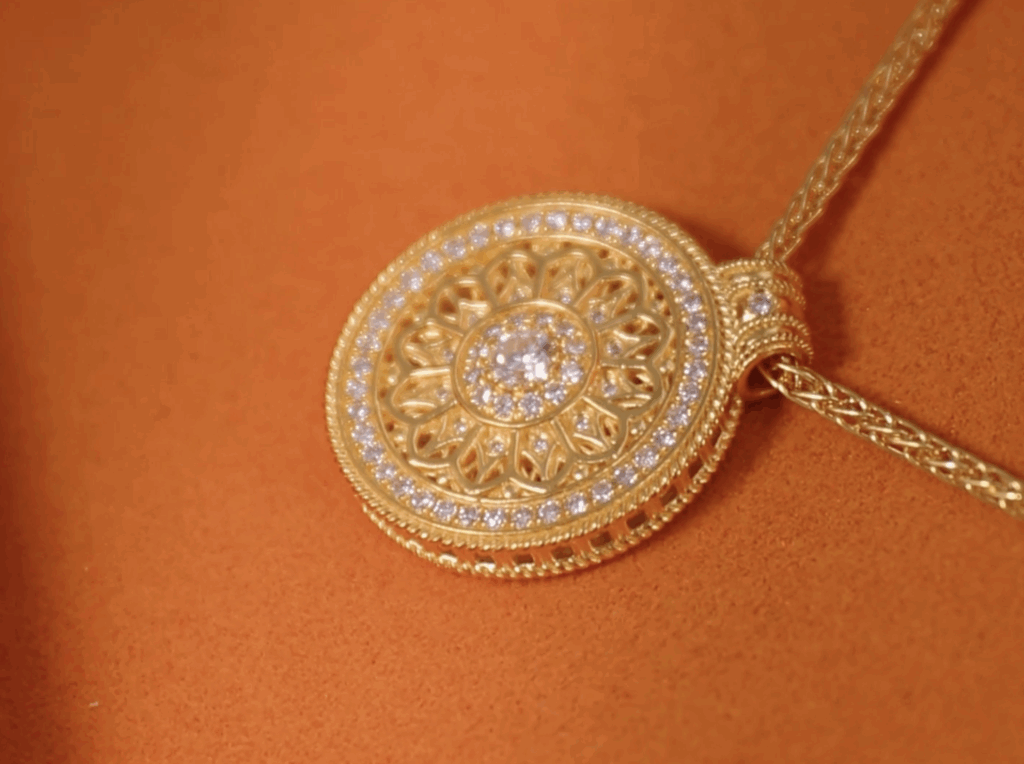
Rather than drawing prestige from Parisian ateliers or Italian craftsmanship, the brand grounds its narrative in Tang- and Song-era aesthetics, dragons and phoenixes, and traditional filigree. Its innovation lies in making heritage pieces wearable in daily life: butterfly pendants styled with T-shirts, gourd-shaped charms in the office, tassel pieces for social occasions.
At the same time, the company has avoided the explosion in livestream commerce that many brands have benefitted from, and instead, has cultivated cachet on the Xiaohongshu platform. This digital-first model, combined with stores in Asia’s most prestigious malls and Western-style luxury tactics like VIP salons, fixed pricing, and an emphasis on design over raw material, has secured access to affluent consumers.
The Numbers Behind the Shine
The financial performance matches the narrative. In the first half of 2025, revenue rose 251 percent to 12.35 billion yuan ($1.72 billion), while net profit increased 286 percent to 2.27 billion yuan. This built on 2024’s full-year gains of 167 percent in revenue and 253 percent in profit. By contrast, global luxury houses like Richemont reported double-digit sales declines in China.
“Rather than focusing on the weight of gold,” notes HSBC’s Erwan Rambourg, “Laopu is about design. It is a hybrid that is clearly gaining traction.” Richemont CEO Nicolas Bos has praised it as “a fantastic example” of a Chinese company rooted in heritage while adopting “the codes of international luxury.”
The Uncomfortable Truths
Laopu’s dazzling growth may be more nuanced than meets the eye. “On paper, it looks like the birth of China’s first true homegrown luxury jewelry house,” says Carrie Zhao. “But here’s the uncomfortable truth: Laopu has no pricing power beyond gold – unlike Cartier, which sells meaning and creativity, it remains tied to the daily movement of gold prices, and luxury cannot be pegged to commodities.” Beyond that, the company “has no cultural universality,” per Zhao. “Its storytelling is deeply rooted in Chinese imperial motifs, raising doubts about whether it can resonate globally beyond diaspora pride.”
Against that background, Laopu Gold is both “a breakthrough and a warning sign,” as it shows China’s “capacity to elevate cultural heritage into premium positioning, but to stand beside Cartier or Hermès, it must evolve from gold retailer with heritage craft into a global author of cultural meaning.”
These critiques existing alongside some other structural hurdles for the fast-rising jewelry-maker. Laopu’s gross margins – about 41 percent – are well below the 60–80 percent typical of luxury maisons, for instance. Repeated price hikes preserve exclusivity but raise questions about sustainability. For China’s wealthiest consumers, Laopu is aspirational for the middle class, not yet a peer to Chanel or Hermès. Rising gold prices and lower-cost imitators may add further headwinds.
The Bigger Question
Laopu Gold embodies the crossroads of China’s luxury experiment. Its meteoric rise demonstrates the country’s ability to elevate heritage into premium positioning, but it also highlights the limits of commodity-tethered luxury and culturally specific storytelling. Laopu is both proof of concept and cautionary tale. It signals that the next generation of aspirational brands may indeed come from Beijing rather than Paris or Milan – but whether they can redefine luxury on a global stage remains an open question.
Share