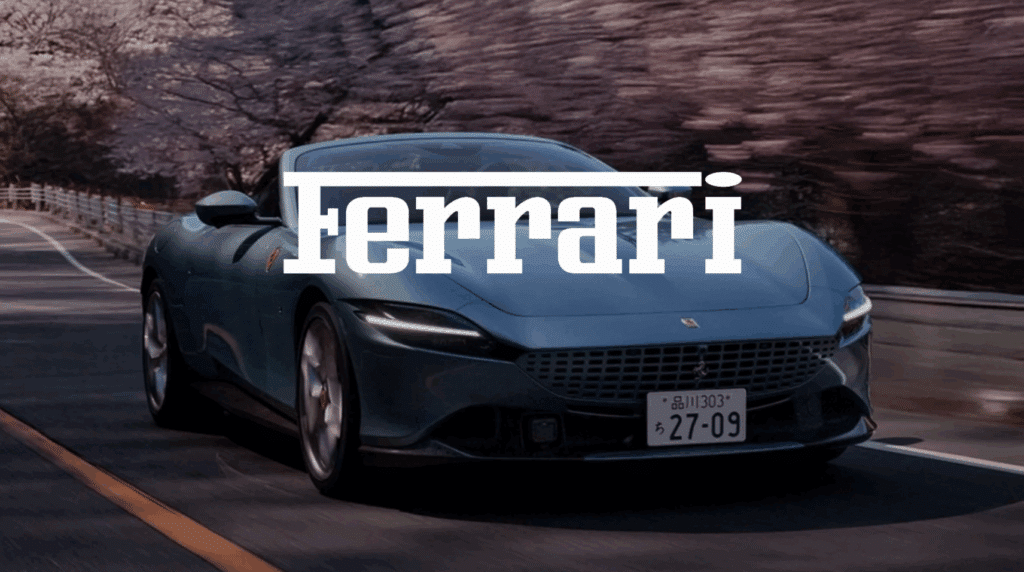
Ferrari began as a racing team, not a consumer brand. Founded in 1929, it did not produce a car under its own name until 1947, but the formula emerged early: racing demonstrated the engineering, and road cars funded the racing team. The Cavallino Rampante – Ferrari’s prancing horse logo – evolved into both a performance emblem and a core piece of brand equity. Over time, Ferrari used limited production to build pricing power and translated racing victories into global recognition.
Origins, Symbol & the First Ferrari
In 1929, Enzo Ferrari founded Scuderia Ferrari in Modena to run race cars for private drivers, mostly using Alfa Romeo machinery. When he left Alfa in 1939, a four-year ban prevented him from using his own name in competition, so he established Auto Avio Costruzioni. Its first car, the AAC Tipo 815, entered the 1940 Mille Miglia with a clear ambition, to show Ferrari could challenge Alfa even without the Ferrari name on the car. After the war, he rebuilt his team in Modena, setting the stage for the first true Ferrari in 1947.
Around this time, Ferrari adopted the Cavallino Rampante – the prancing horse symbol – based on the personal emblem of WWI pilot Francesco Baracca, with permission from Baracca’s family. This symbol later became the official Ferrari logo and now appears on everything from its road cars and race cars to licensed merchandise.
The first car to carry the Ferrari name appeared in 1947. The 125 S, built by hand and powered by a compact Gioachino Colombo–designed V12, debuted at Piacenza that May but failed to finish. However, two weeks later, it delivered Ferrari’s first victory at the Grand Prix of Rome. From the start, racing served as the company’s test bench, demonstrating its power and engineering, and sales of road cars has continued to fund the competition program that defines the brand.
Racing DNA, Early Icons & the Road-Car Myth
Ferrari entered the inaugural Formula One season in 1950 and scored its first F1 win with José Froilán González at the 1951 British Grand Prix. Alberto Ascari then took back-to-back Drivers’ titles in 1952 and 1953. Over time the Scuderia amassed a record 16 Constructors’ and 16 Drivers’ Championships, embedding the prancing horse as F1’s most decorated team.
In sports cars, the early 1960s cemented the mythology – the 250 GTO (1962) dominated GT racing and evolved into perhaps the most storied collectible Ferrari, proof that competition pedigree and design purity compound value.
But racing ambition required capital. In 1969, Fiat acquired 50 percent of Ferrari, a stake structured with options that allowed Fiat to take control upon Enzo Ferrari’s death. During these years, Ferrari shaped its road-car identity with Pininfarina, translating racing influence into production design through proportion, aerodynamics, and engine sound. The phase culminated in the F40 in 1987, the last model Enzo personally approved and a defining pre-digital performance benchmark. After Enzo passed away in 1988, Fiat announced it had increased its holding to 90 percent, with the remaining 10 percent staying with Piero Ferrari, Enzo’s son.
F1 Theatre & Global Brand Power
Ferrari’s cultural presence is tied directly to its Formula 1 eras. The 1970s championships with Niki Lauda established the modern Scuderia mindset, and the 1999–2004 run under Michael Schumacher, Jean Todt, Ross Brawn, and Rory Byrne delivered six straight Constructors’ titles and five consecutive Drivers’ crowns for Schumacher. A final Drivers’ title came with Kimi Räikkönen in 2007, along with Constructors’ championships in 2007 and 2008. Each era reinforced the same story, relentless development, strict factory discipline in Maranello, and the spectacle of rosso corsa on the grid.
In an industry where performance and construction drive both results and brand power, trade secrets are critical. In 2007, Ferrari took McLaren to court after discovering that a senior McLaren engineer had obtained confidential Ferrari design documents. The International Automobile Federation (FIA) fined McLaren $100 million and stripped the team of all their constructors’ points from the previous season. Ferrari withdrew its lawsuit against McLaren and donated portions of its payments to charity, but elected to continue its legal action against former Ferrari employee Nigel Stepney for his role in leaking the Ferrari design secrets.
Ferrari has consistently converted race credibility into road-car sales. After F40 came F50 (1995) and Enzo (2002). In 2013, the LaFerrari introduced hybrid technology to Ferrari’s top-tier models. In 2019, the SF90 Stradale became the brand’s first plug-in hybrid for regular production. In 2022, Ferrari launched the Purosangue, its first four-door model, which was designed to offer grand touring comfort while keeping the brand’s signature proportions and engine sound.
Around the hardware, Ferrari runs a modern luxury model: customization programs and limited production that support higher prices, reinforce exclusivity, and give customers more control over specification without diluting brand standards.
Ferrari’s separation from Fiat Chrysler Automobiles began in 2015, when the company listed on the NYSE under the ticker RACE. The full spin-off was completed in January 2016, with shares also starting to trade in Milan. The holding is incorporated in the Netherlands with its corporate center in Maranello, a structure designed to fund product and racing while preserving identity, control, and long-run discipline.
Return to Le Mans & Results that Matter
After 50 years, Ferrari’s return to top-tier endurance racing in 2023 delivered immediate results: the 499P Hypercar won Le Mans for the first time since 1965, followed by victories in 2024 and 2025. The run demonstrated that the company’s technical program can still compete at the highest level after decades away from the category.
From a Modena race team to a listed performance manufacturer, Ferrari now runs a disciplined product and brand strategy: focus on engineering, keep volumes tight, expand customization without eroding standards, and let motorsport validate the technology rather than define the entire narrative.
This piece was prepared in collaboration with Jamie Zwirn and Emilie Mentrup.
Share