

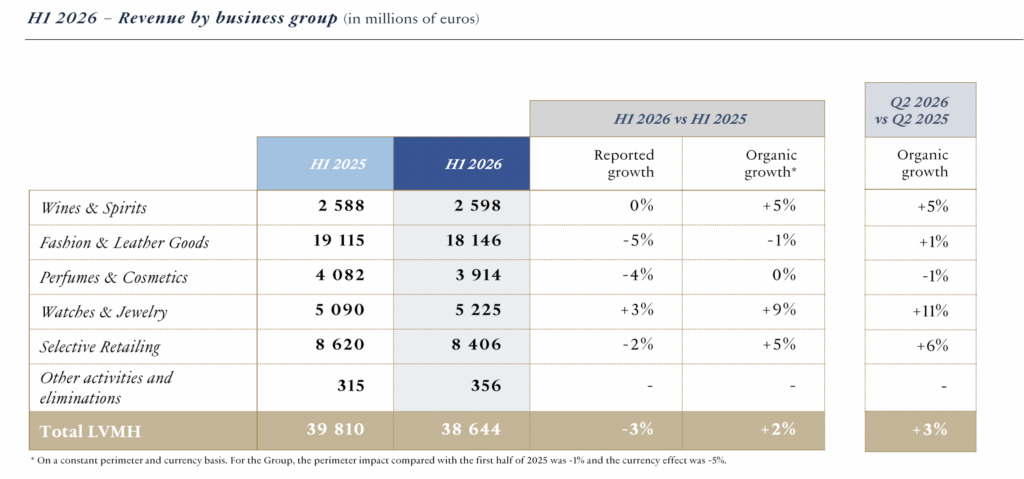
LVMH says it demonstrated “its solidity and effective strategy” in the first half of 2026 despite an uncertain geopolitical and economic environment. The French luxury goods group reported revenue of €38.6 billion for the six months ended June 30, down 3 percent on a reported basis compared to the same period last year but up 2 percent on a constant consolidation scope and currency basis. Profit from recurring operations totaled €8.7 billion, down 4 percent year-over-year, while net profit attributable to the Group remained essentially stable at €5.7 billion. The company said unfavorable exchange-rate movements reduced profit from recurring operations by €686 million.
While Fashion & Leather Goods revenue declined 5 percent on a reported basis (and 1 percent organically) in the first half, the division returned to organic growth in the second quarter. LVMH attributed that acceleration in part to the success of Jonathan Anderson’s first designs for Christian Dior, alongside strong performances from Loro Piana, Rimowa, and its U.S. business.
Beyond the earnings, the filing offers a window into how LVMH is positioning its brands for long-term growth.
Creative Leadership in the Spotlight
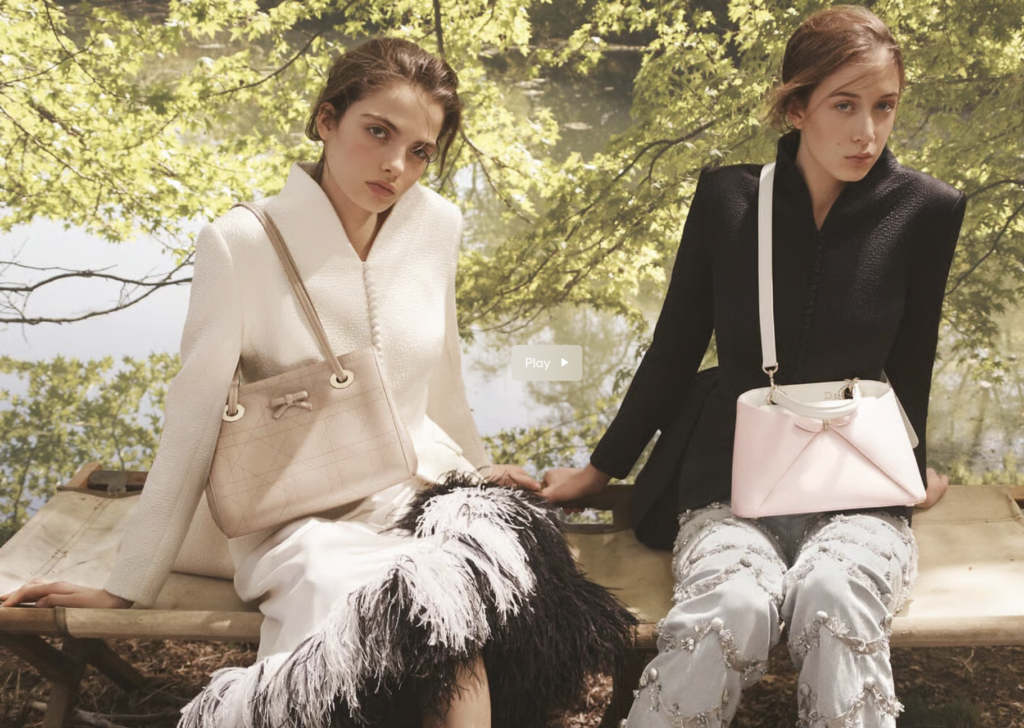
LVMH devotes significant attention in its recent report to creative appointments. The Group directly links Jonathan Anderson’s arrival at Christian Dior Couture to the house’s accelerating growth, citing the “excellent start” of his first collections and describing the Cigale bag – inspired by an archival Christian Dior design – as a “major success.” It also highlights Michael Rider’s debut menswear collection for Celine, Maria Grazia Chiuri’s first collection for Fendi, “new creative momentum” at Loewe under Jack McCollough and Lazaro Hernandez, and Sarah Burton’s continued work at Givenchy.
Heritage Brands Drive Product Strategy
Rather than emphasizing entirely new product categories, LVMH repeatedly spotlights to established designs, house codes, and iconic products of its brands in a nod to the value of these heritage houses. Louis Vuitton celebrated the 130th anniversary of its Monogram with new interpretations of signature bags including the Speedy, Keepall, Noé, Alma, and Neverfull. Dior revisited archival designs through the Cigale bag, Fendi introduced another edition of the Baguette, Loewe reinterpreted the Amazona for its 180th anniversary, and Berluti highlighted continued demand for longstanding footwear styles.
The emphasis on heritage products is also reflected in LVMH’s balance sheet. The company reported brands with a net carrying value of approximately €21.2 billion as of June 30, 2026, and states that brands and goodwill represent a significant portion of its segment assets.
Family Control Remains Firm
The filing also offers the latest snapshot of LVMH’s governance. The structure also remains largely unchanged, with Bernard Arnault continuing in his role Chairman and Chief Executive Officer, all four of his children serving on the Board of Directors, and Antoine and Delphine Arnault serving as members of the Executive Committee. As of June 30, the Arnault family group held 50.21 percent of LVMH’s share capital and 66.39 percent of the voting rights exercisable at shareholder meetings, underscoring the family’s continued control of the luxury group.
Portfolio Changes Continue
On the M&A front, LVMH confirmed that it entered into an agreement in May to sell Marc Jacobs to WHP Global, although it disclosed neither the transaction terms nor the rationale for the divestiture. Separately, the Group continued reducing its exposure to DFS by selling businesses in Hong Kong and Macao, interests in partnerships in Japan and Indonesia, and signing agreements covering airport concessions in Los Angeles, San Francisco, and Okinawa.
Currency and Geopolitics Remain Key Headwinds
Finally, currency movements reduced Group revenue by five percentage points, with the weakening of the U.S. dollar, Japanese yen, and South Korean won weighing on reported results. LVMH also cited geopolitical conditions and trade tensions affecting Wines & Spirits, while noting that the conflict in the Middle East impacted Fashion and Leather Goods. At the same time, the company reported improving cognac demand in China, stronger champagne sales in Europe, and a return to organic growth in Fashion and Leather Goods during the second quarter.
THE BOTTOM LINE: Beyond the numbers, LVMH’s latest filing shows where the company continues to place its strategic emphasis. Creative leadership, heritage products, and brand assets feature throughout the report, alongside disclosures about governance and portfolio management. Together, they offer a clearer picture of how the world’s largest luxury group is thinking about long-term value as it navigates a more challenging operating environment.
Share