



Wharton marketing professor Z. John Zhang explained this week how luxury brands may actually benefit from the existence of counterfeits. Speaking on Knowledge at Wharton’s “Future of Retail” podcast, Zhang said that knockoff goods can reshape consumer behavior in surprising ways.
“You would think that the existence of a counterfeit should be really bad for the authentic brands, but when you look into it, it turns out that’s not necessarily the case. In some cases, in fact, because of the change in the consumer behavior, the luxury brands may actually benefit from the existence of counterfeits,” Zhang noted.
He described how counterfeit goods push wealthy consumers to adopt a “maximalist luxury strategy” – buying and displaying more authentic luxury products to stand out. “If I’m the wealthy person, I still want to stand out, and the way to stand out is to stack the deck. Make sure that you buy a lot more luxury goods and put them on display, so that the other people just cannot mimic that,” he explained.
This changes how luxury companies think about production and strategy: “The existence of counterfeit goods, in fact, will fragment the market. You have people who pursue minimalist luxury … you also have people who pursue the maximum luxury … which means that as luxury brands, you need to become aware of all those trends and accommodate the change in consumer behavior.”
>> TL/DR: Zhang argues that counterfeits can actually boost luxury brands by pushing wealthy consumers to buy and flaunt more authentic goods, reshaping market strategies around “maximalist” versus “minimalist” luxury behavior.
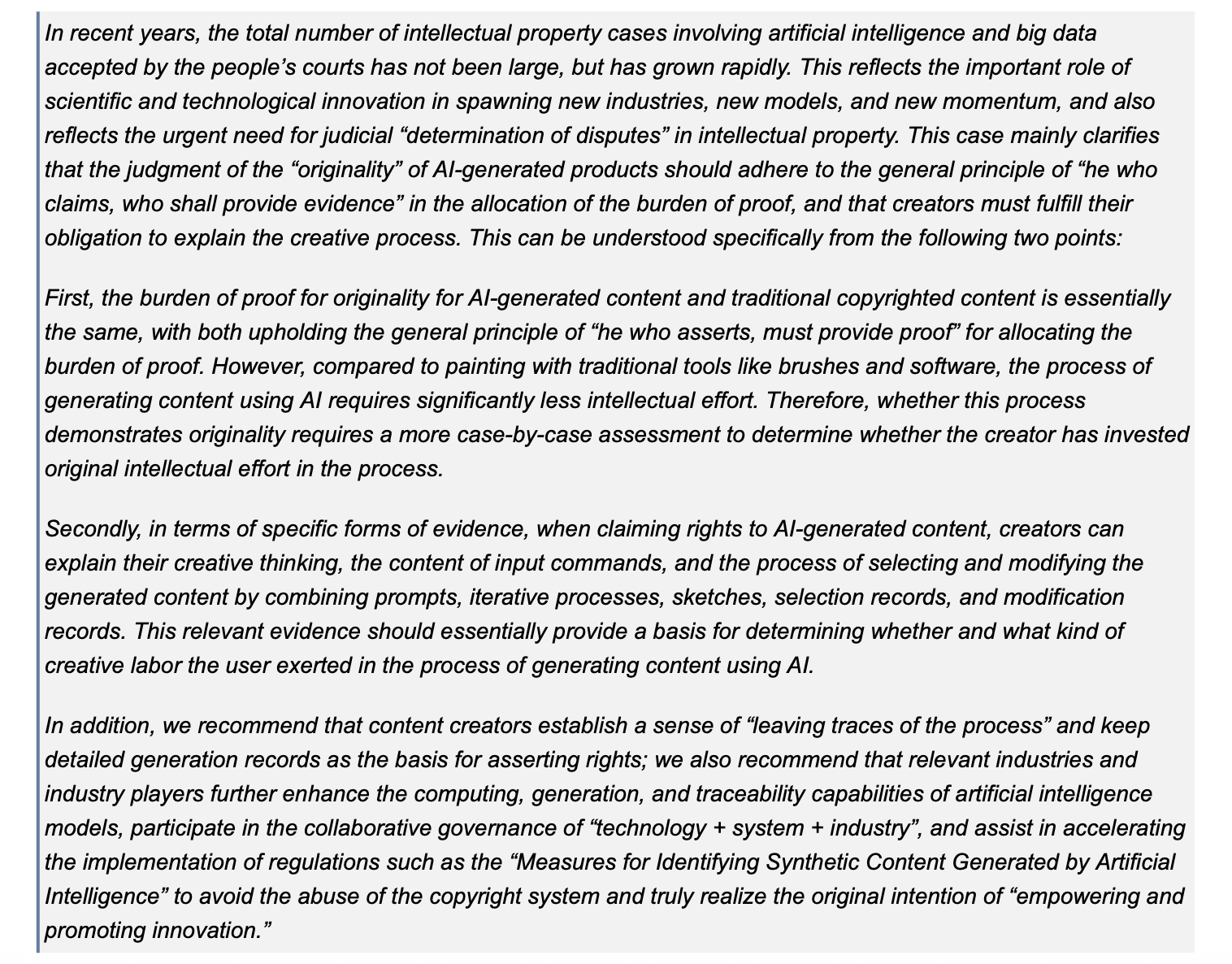
In a closely watched decision, the Beijing Internet Court has clarified that AI-generated images may qualify for copyright protection, but only if the claimant can prove genuine creative involvement. The case centered on a dispute over an AI-created “Cat Crystal Diamond Pendant” image, where the plaintiff alleged infringement by a business partner. While acknowledging that copyright can attach to AI-assisted works, the court ruled against the plaintiff for failing to provide contemporaneous prompts or records of his creative process, relying instead on after-the-fact reproductions.
The ruling highlights a critical evidentiary threshold: authors must document their prompts, selection process, and modifications to demonstrate originality. By applying the long-standing principle of “he who asserts, must provide proof,” the court emphasized that AI-generated works are not exempt from traditional standards of authorship and originality. For creators, the message is clear: leave a trail of evidence or risk losing rights.
The critical section of the Beijing Internet Court Judge Wang Yanjie’s decision, as highlighted by Schwegman, Lundberg & Woessner’s Aaron Wininger …
Despite trade tensions and slowing growth for much of the economy, luxury brands remain buoyed by demand from high earners. At Semafor’s Business of Luxury event in New York, executives said tariffs are eating into margins and complicating supply chains, but the wealthiest consumers continue to spend freely.
Speaking of the impact of tariffs …
> Fashion brand Veronica Beard, which once relied on China for 60% of its production, has already brought that number down to 30% for new styles debuting in November, and aims to as low as 10% by the spring, President Stephanie Unwin said. “We have seen no slowdown at this point,” she said.
> Tariffs are making it harder to sell a European watch on consignment in the U.S. (When a watch is imported on consignment — meaning the seller ships it to a U.S. dealer or auction house to be sold on their behalf — customs duties and tariff surcharges must be paid upfront before the piece can legally enter the market. For high-value items like Swiss or German timepieces, even modest percentage increases translate into thousands of dollars added to the landed cost.) Even still, buyers who want to purchase a watch on auction from Europe will “just figure it out,” Sotheby’s Global Head of Watches Geoff Hess said.
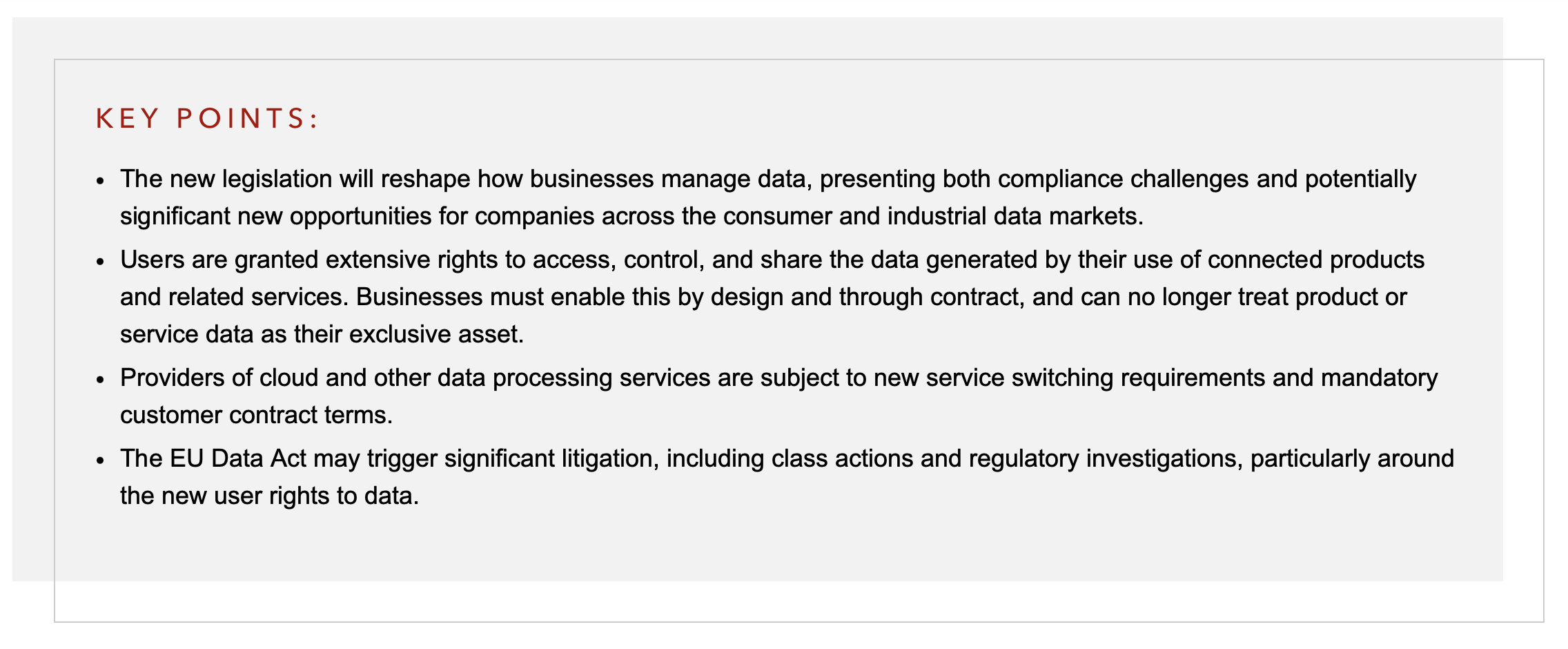
The EU’s Data Act is now partially in force, and its implications for retailers – especially those selling connected products – are significant. As of September 12, manufacturers and service providers must give consumers access to data generated by smart devices, from wearables to home appliances, and allow that data to be shared with third parties at the consumer’s direction. The scope is broad, covering not only automotive companies offering connected vehicles and in-car digital services, but also retailers and brands selling private-label connected goods, such as fashion with smart fabrics or IoT-enabled home products.
>> It also extends to digital and after-sales service providers, including those managing delivery tracking, returns, repairs, and loyalty programs built on customer usage data.
For retailers, the law raises both compliance costs and new opportunities: companies must implement systems for secure, interoperable data sharing, but they may also leverage greater access to customer insights to strengthen loyalty and personalized services. The law also tightens rules around contract terms with smaller partners and suppliers, pushing for fairer data-sharing arrangements, and sets the stage for increased cloud portability to prevent vendor lock-in.
With phased obligations stretching to 2027, retailers will need to adjust both their supply chains and digital strategies to remain competitive in a market where transparency, interoperability, and customer control over data are no longer optional.
>> A few key EU Data Act takeaways from Latham & Watkins …
>>> Here is our Running Tracker of Retail-Focused Legislation.
California’s sweeping climate disclosure mandates cleared another hurdle this month. On September 11, the U.S. District Court for the Central District of California declined to block SB 253 and SB 261 while an appeal moves forward. The statutes require companies to disclose greenhouse gas emissions and climate-related financial risks, with SB 261’s first reporting deadline looming on January 1, 2026.
The court had previously denied a preliminary injunction in August, and while the plaintiffs have taken their challenge to the Ninth Circuit, the district court has now paused further proceedings until the appellate court weighs in. For businesses, the stay offers no reprieve: companies subject to SB 261 must continue preparing to report climate risks, and those covered by SB 253 are already eyeing a June 2026 compliance date (proposed by CARB staff) outlined in state planning documents.
One of the takeaways from a recent Burges Salmon ESG and M&A update: “Strong ESG credentials are increasingly making businesses more attractive acquisition targets. Investors recognize that poor ESG integration can lead to operational inefficiencies, regulatory penalties, and reputational damage. A 2024 Deloitte survey found that 72% of corporations had opted not to proceed with an acquisition due to concerns over a target’s ESG performance. As such, ESG-aligned strategies are now seen as essential for maintaining competitive advantage and safeguarding long-term value.”