

As concerns over AI-generated content continue to mount, Taylor Swift is taking new steps to protect one of the most commercially valuable assets in the entertainment and retail industries: her likeness. In trademark applications filed with the U.S. Patent & Trademark Office on April 24, Swift’s company, TAS Rights Management, is looking to register two short voice clips – “Hey, it’s Taylor Swift” and “Hey, it’s Taylor” – as well as a specific Eras tour performance image, which depicts the singer performing with a pink guitar in a multicolored bodysuit.
While trademark filings tied to celebrity names, taglines, and logos are commonplace, Swift’s newest trademark applications (lodged by Venable’s Rebecca Liebowitz) fit into a more specific – and increasingly relevant – category. They are efforts to use trademarks to protect one’s likeness. More notably, they offer an early look at what a legal playbook for protecting identity in the AI era may begin to take shape.
Likeness as a Trademark Asset
The use of trademark law to protect a person’s image is not new. However, it has gained traction in recent years, particularly among models seeking stronger and more easily enforceable rights than those offered by traditional publicity or image rights. As TFL previously reported, European IP bodies have recognized that portrait images can function as trademarks if they meet the distinctiveness requirement, with the Board of Appeal of the EUIPO finding that the faces of models, including Yasmin Wijnaldum and Rozanne Verduin, are capable of serving as source identifiers.
The appeal of using trademark protection to safeguard likeness is clear. Unlike the right of publicity and other likeness-based rights, which vary by state and are often applied after the fact, trademarks can be licensed, assigned, and enforced within a more consistent and predictable framework, making them particularly attractive in commercial settings. In that sense, trademark law offers a more forward-looking approach to addressing unauthorized uses of identity.
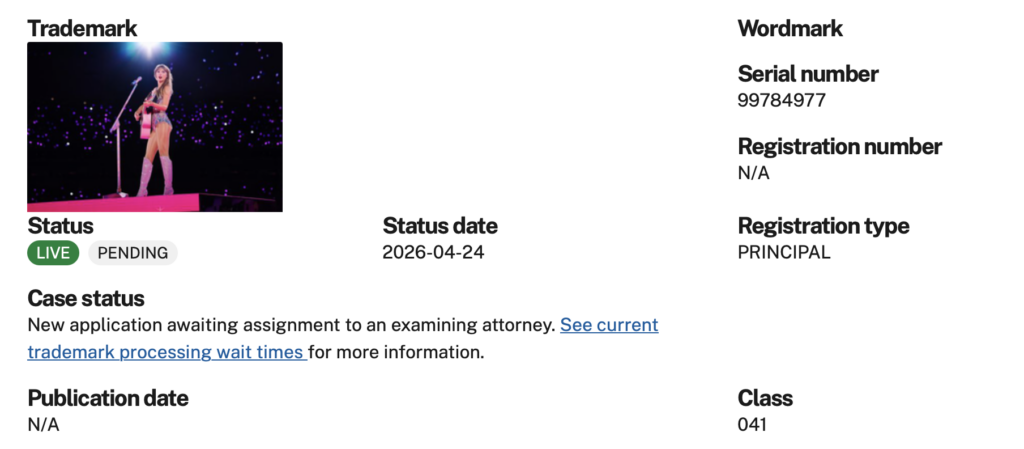
Swift’s filings – which cover the provision of “information in the field of music and entertainment” – reflect that reality. The clearly defined vocal and visual elements embodied in the marks may provide a more practical basis for identifying and challenging unauthorized uses than broader, more fact-dependent likeness claims, particularly as AI-generated content becomes more prevalent.
The flip side, of course, is that the level of specificity that comes with these marks may limit the scope of trademark protection to uses of the marks themselves or confusingly similar variations (though Swift could still bring parallel trademark and right of publicity claims in a hypothetical suit in response to unauthorized uses of her likeness).
Against that backdrop, Swift’s approach can be seen as one of the most expansive efforts to date to bring both visual and auditory elements of likeness under the umbrella of trademark protection, while also laying the groundwork for a more forward-looking strategy – one that focuses on establishing trademark rights in (and registrations for) specific, defined elements, rather than relying solely on reactive enforcement after misuse occurs.
THE BIGGER PICTURE: Whether Swift’s applications ultimately result in registrations remains to be seen. Sound marks, in particular – which have traditionally been the domain of corporate branding – face a high bar. And questions around distinctiveness and use will likely shape the outcome.
Still, the filings underscore a broader point: as the commercial value of identity continues to grow – and as technology makes it easier to replicate – artists, models, athletes, and other public figures are exploring new ways to secure control over how they are represented. That effort is not limited to Swift; recent filings by Matthew McConaughey and trademark activity by athletes, such as Kylian Mbappé, who has sought to register his signature goal celebration as a logo, similarly reflect a broader push to bring recognizable elements of identity within the scope of trademark protection.
If nothing else, Swift’s filings may serve as an early blueprint for how talent can adapt existing intellectual property tools to the realities of the AI era – defining, in practical terms, what it means to protect likeness at scale.
Share