


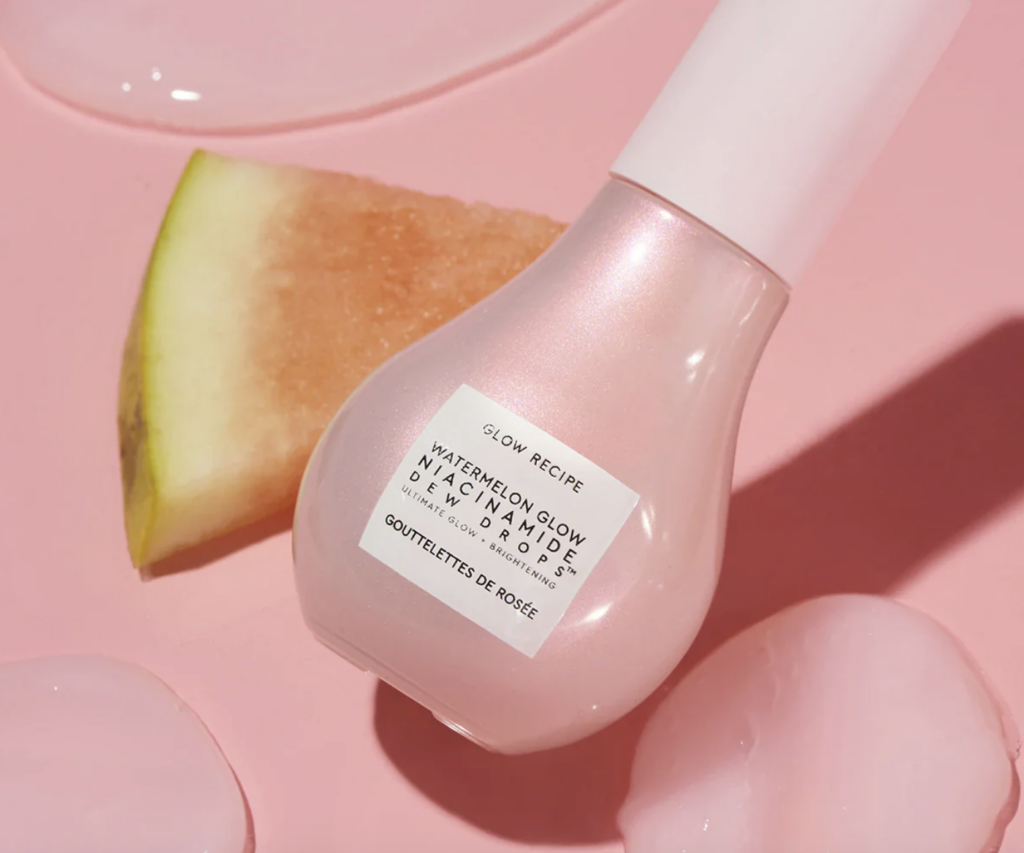
Glow Recipe has filed an amended complaint against MCoBeauty, accusing the beauty brand of copying the packaging and marketing cues of its bestselling Dew Drops serum to drive sales of a competing product. The case – which is playing out in federal court in New York – centers on an evolving issue in the beauty market: how far “dupe” strategies can go before they begin to infringe the visual and marketing cues that signal a product’s source.
Rather than focusing narrowly on the alleged similarity of the companies’ product packaging, Glow Recipe goes broader, positioning MCoBeauty’s conduct as a coordinated effort to replicate the elements that make its Dew Drops recognizable in the market – from product design and naming to marketing and search visibility.
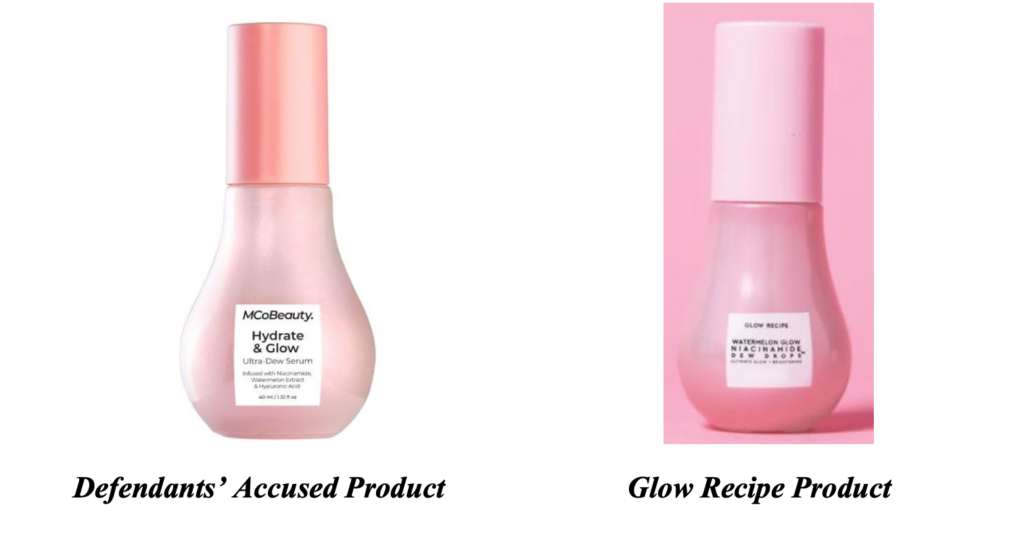
The Case in Brief: Filing suit in the Southern District of New York in June 2025, Glow Recipe alleges that MCoBeauty’s Hydrate & Glow Ultra-Dew Serum infringes its Watermelon Glow Niacinamide Dew Drops trademarks and trade dress and constitutes false advertising and unfair competition. Glow Recipe maintains that MCoBeauty copied the look and feel of its serum, a top-selling product since its 2020 launch, and is selling the accused product through online channels and major retailers in the U.S.
Pushing Beyond Product Packaging
In an amended complaint on April 24, Glow Recipe expands its trade dress theory, alleging that the similarities extend beyond packaging to include MCoBeauty’s use of “dew”-centric naming, social media marketing, and keyword advertising tied to its brand. Taken together, Glow Recipe argues that these elements create a likelihood of consumer confusion.
More fundamentally, the amended complaint reflects an effort to show that multiple forms of similarity, when used together, create a likelihood of consumer confusion under trademark law …
> Aggregating Similarities into a Single Claim: Glow Recipe’s theory begins by combining the features used in MCoBeauty’s accused product and marketing that are not necessarily protectable on their own. A pink bottle, “dew”-focused naming, comparison-style social media posts, and keyword advertising are not necessarily protectable in isolation. By citing their combined use, Glow Recipe argues that these similarities work together to create a likelihood of consumer confusion.
> Shifting the Focus to Consumer Experience: That approach shifts the analysis away from a side-by-side comparison of the products and toward how consumers actually encounter them in the market. Instead of asking whether the products look alike, Glow Recipe directs attention to the point of discovery. Glow Recipe alleges that confusion arises when consumers encounter the product online or in-store and are drawn to it because it resembles Glow Recipe’s.
> Claiming Control Over Recognition: At a broader level, Glow Recipe’s theory extends beyond product design to the cues that make its products recognizable in the market. By pointing to overlapping naming, marketing, and search placement, it argues that MCoBeauty is using the same signals consumers associate with Dew Drops to capture demand.
> Targeting the “Dupe” System: The relief sought reflects that theory. Glow Recipe is challenging not only the accused product, but the broader use of similar packaging, naming, and marketing, while also pursuing damages and an accounting of profits tied to the alleged conduct.
Taken together, Glow Recipe’s theory shifts the focus from individual elements to overall presentation and whether it creates a likelihood of confusion as to source or affiliation. That move is significant because many of the features at issue may appear generic on their own and difficult to protect, but when combined, can be argued to form a recognizable commercial impression.
At the same time, this theory runs up against a key limitation in trade dress law: Courts have been reluctant to extend protection where the underlying features are common or functional, even when considered together, as seen in a recent loss for Sol de Janeiro, with a court finding that similar packaging features were too functional and common to warrant trade dress protection.
THE BOTTOM LINE: This case shows that similarity in design may be defensible on its own, but when combined with overlapping naming, marketing, and search strategy, it raises a more fundamental constraint: whether a competitor is replicating not just the product, but the cues that make it recognizable to consumers.
The case is Aramara Beauty v. MCO Beauty PTY Limited, 1:25-cv-04808 (SDNY).
Share