

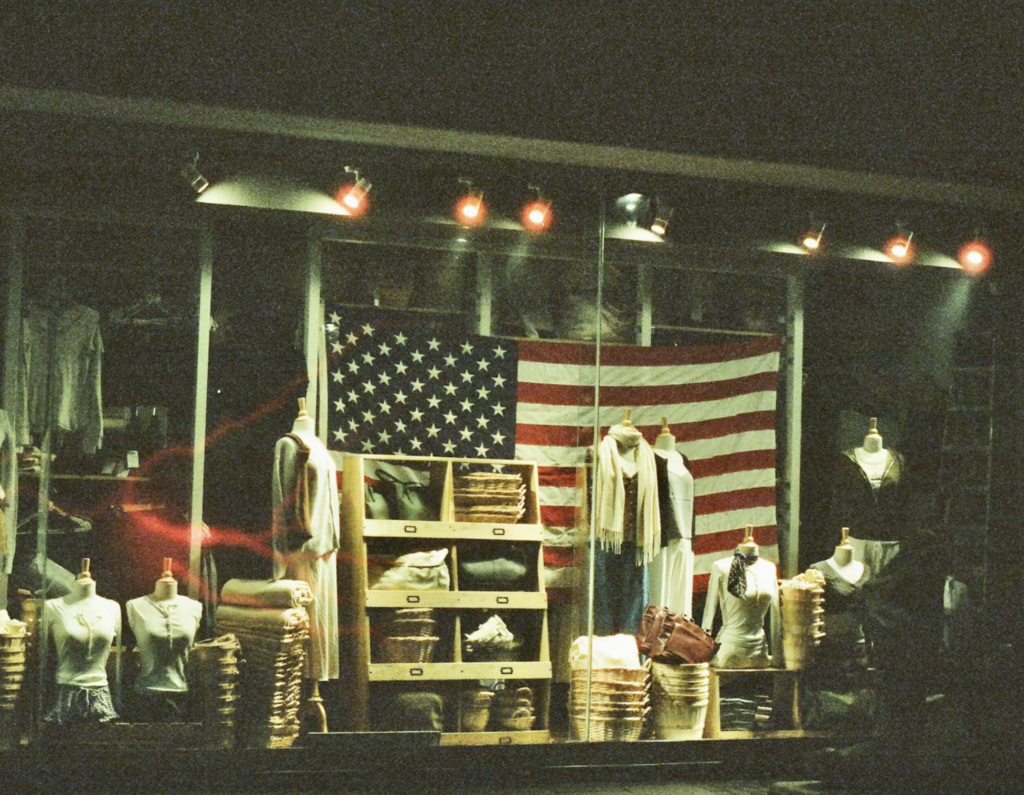
As the U.S. marks its 250th anniversary, the American flag occupies a unique place in fashion. It appears everywhere from luxury collections and streetwear offerings to fast fashion and novelty apparel, even as it remains one of the country’s most recognizable national symbols. Legally, the flag occupies an equally unusual position: it belongs to everyone and no one at the same time. U.S. intellectual property law and the First Amendment have created a framework that largely prevents exclusive ownership while allowing virtually anyone to incorporate the flag into fashion and other forms of expression.
Flag fashion feels unremarkable today, but just 50 years ago, wearing the Stars and Stripes could result in arrest or fines. Political activist Abbie Hoffman, for instance, was arrested in 1968 for wearing a shirt resembling the American flag during a protest. He was charged under the since-repealed federal flag desecration statute, which prohibited the mutilation, defacement, or physical defilement of the American flag. In the years that followed, others were arrested, fined, or prosecuted under various state flag desecration laws for wearing the flag on clothing or displaying altered versions of it.
Although federal law still prohibits the flag’s use on apparel, costumes, athletic uniforms, and certain embroidered accessories, and President Donald Trump issued an executive order last year calling for greater enforcement against flag burning and desecration, most legal scholars view these restrictions as constitutionally unenforceable. Today, courts and legal scholars recognize flag activities like wearing the flag or burning the flag as protected speech under the First Amendment.
Who Owns the American Flag?
The American flag has become a fashion statement, a political weapon, and a cultural flashpoint. But legally, it is something far simpler and more radical: it is a symbol that is free for all and reserved for none. Followingsection 1204.01(a) of the Trademark Manual of Examining Procedure, fashion brands cannot secure a federal registration in a true representation of the American flag as part of their trademark.
This can lead to some creative trademarks, since under section 1204.01(b), stylized or incomplete forms of the American flag are not refused. Ralph Lauren seems to have not yet registered its creative rendering of the flag placed on the brand’s iconic flag sweaters as a trademark, but a separate party secured a registration for “a stylized variation of a partial U.S. flag” on the sail of a boat for use on hats and shirts.
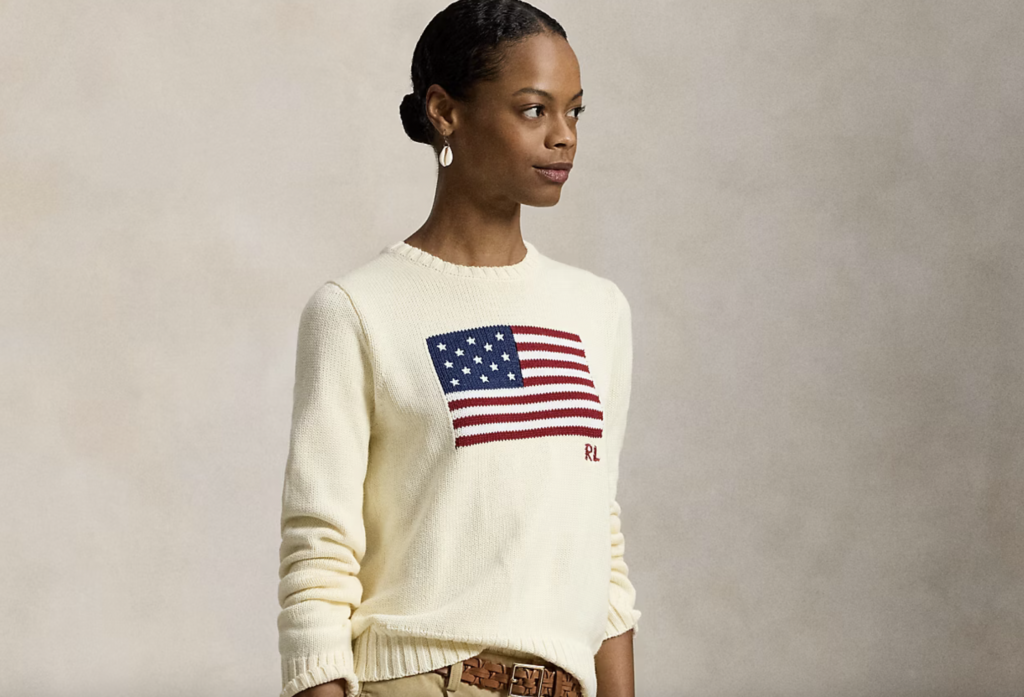
While brands may not build their distinctiveness on a true representation of the American flag, stylizing and incorporating other visual elements into the American flag into a logo can remix American heritage into brand identity. McCarthy’s leading trademark treatise notes in section 19:79 that, while federal law and state law prohibit use of the American flag in advertising, these laws largely go unenforced (as any regular shopper can readily observe).
Copyright law deems the American flag in the public domain and treats it like an idea rather than expression. No one can claim copyright to the American flag, but some courts have allowed copyright claims over original variations or compilations of the flag. For instance, in a couple of questionable decisions, courts denied motions to dismiss copyright claims involving the design of a distressed American flag, and a design consisting of overlaying the American flag on the map of the United States.
Even if these designs could qualify for copyright, which they should not under copyright’s originality requirement, idea-expression distinction, or merger doctrine, their scope would be extremely limited. Nevertheless, attempts to use copyright law to control American heritage is not limited to private parties: at least one member of Congress has, in the past, proposed that the U.S. government should claim copyright to the flag to regulate its use.
A Symbol Beyond Ownership
Federal law might publish guidelines governing the use of the American flag, and individuals may attempt to assert limited rights under trademark or copyright law, but the American people, as a collective, are the ones with an inalienable ownership interest in the American flag. The flag could even be viewed as a special type of American cultural property, a property in which collective inalienable ownership informs who controls and owns the flag as a piece of tangible property.
Since 1907, the Star-Spangled Banner, the flag that inspired our national anthem, has been in the collection of the Smithsonian, a museum established with funds from an English scientist donated to the United States’ (for its people) and placed in an independent federal trust established by an act of Congress. When Polo Ralph Lauren donated $10 million dollars to preserve the Star-Spangled Banner as part of the “Save America’s Treasures” program, the fashion brand was preserving a tangible object connected to its brand identity, but the essence of the donation was to support the public’s continued access to a historic object. Similarly, individual Americans may own the flags they display on holidays such as the Fourth of July, but a broader sense of collective cultural stewardship continues to shape how even privately owned worn or tattered flags are treated.
Wherever consumers shop this summer during America’s 250th anniversary celebrations, they are likely to encounter the American flag in countless forms. The law largely permits designers to reinterpret one of the country’s most recognizable symbols while preventing any single company from claiming exclusive rights in it. That legal balance has helped make the American flag one of fashion’s most enduring – and most freely shared – design motifs.
Cathay Smith is a Professor of Law and Co-Director of the Program in Intellectual Property Law at Chicago-Kent College of Law.
Felicia Caponigri is an Assistant Professor of Law at Marquette University Law School.
This article is part of the authors’ ongoing research into ownership rights in the American flag under U.S. law.
Share