



Can luxury brands use the courts to force platforms to remove content challenging how they allegedly make and market their products? Kering and Bottega Veneta tried to do exactly that after a content creator posted a video targeting luxury brands’ use of the “Made in Italy” label. But rather than deciding whether the heavily-shared video’s claims were true, a Paris court tossed out the case on procedural grounds.
In a new judgment, the Paris Judicial Court dismissed a summons filed by Kering and two Bottega Veneta entities that sought to compel Meta Platforms Ireland Ltd. to remove an Instagram and Facebook video that takes issue with luxury brands’ use of the “Made in Italy” label.
A Takedown Fight Over “Made in Italy”
The dispute pitted Kering and two Bottega Veneta entities against Meta Platforms Ireland Ltd. in a bid to compel the social media giant to remove a video that takes issue with luxury brands’ use of the “Made in Italy” label. In the video, Istok Pavlović claims that luxury products may lawfully bear the “Made in Italy” designation even when only a limited portion of their manufacturing – such as the attachment of a zipper – occurs in Italy. The digital marketing strategist argued in the May 2025 video that consumers are often misled about where luxury goods are actually made.
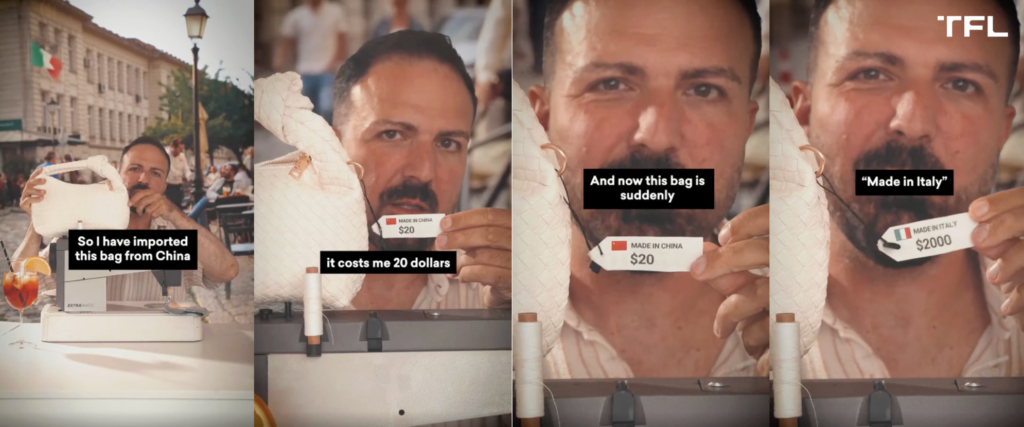
After the video gained traction online, Kering and Bottega Veneta filed suit against Meta and Pavlović. They argued in their July 2025 complaint that the video falsely accused them of misleading consumers about the origin of their products and further asserted that it featured a counterfeit version of Bottega Veneta’s Jodie bag.
Rather than pursuing a conventional defamation action against (and resulting relief from) Pavlović alone, Kering sought to use the France’s notice-and-takedown framework (LCEN) to compel Meta to remove the content itself – a procedural route that, if successful, would have provided a direct mechanism for ensuring the video’s removal.
A Defamation Case in Disguise?
In its July 9 judgment, the court sided with Meta, finding that while Kering and Bottega Veneta framed their claims under France’s takedown regime for online platforms, their allegations really turned on whether Pavlović was liable for defamation. Because Pavlović, the author of the allegedly defamatory statements, was named as a defendant alongside the content-hosting platform, the court held that the dispute fell within the realm of France’s Press Law and not the notice-and-takedown framework.
That decision proved fatal to Kering’s case. The Press Law – which governs freedom of expression and speech-related offenses – comes with exacting pleading requirements that the court found that Kering failed to meet. Finding that Kering’s summons failed to satisfy those requirements, the court dismissed the action without addressing whether Pavlović’s statements were accurate, whether the handbag shown in the video was counterfeit, or whether the content was ultimately defamatory.
Not necessarily the end of the matter, Kering and Bottega Veneta may opt to appeal or bring a new action under the Press Law.
THE BIGGER PICTURE: Regardless of the ultimate outcome, this round has important procedural implications for brands seeking to remove allegedly defamatory content online. It confirms that while LCEN provides a mechanism for compelling platforms to remove unlawful content, plaintiffs cannot avoid the procedural requirements of France’s Press Law by framing what is fundamentally a defamation dispute as a notice-and-takedown action.
More broadly, the case sheds light on the complicated reality in which consumer brands currently operate. As influential creators continue to shape public perceptions of brands and how they make, market, and sell their products, some companies are taking a more aggressive approach to managing those narratives – including through litigation.
Share