

Bob Mackie made headlines late last month when he filed suit against JCPenney in New York federal court, accusing the retail chain of co-opting his name, signature, and likeness for a collection that he had no part in. The famed designer – whose work has spanned six decades of sequined spectacle, from Cher’s bejeweled gowns to Taylor Swift tour looks – alleges that he was not involved in the “Bob Mackie” line that JCPenney launched and promoted as a collaboration. And it appears that Mackie’s suit against the retailer is part of even more significant clash, one that pits the designer against his business partner and namesake company.
In a separate but closely related lawsuit filed on October 30, just one day after he sued JCPenney, Mackie accuses Marc Schwartz, the general counsel and chief operating officer of Bob Mackie Design Group Ltd. (“BMDG”) and its majority shareholder, of orchestrating the JCPenney deal without his consent and exploiting the Bob Mackie name and likeness for his own gain.
A Partnership Unravels
According to Mackie’s complaint, his relationship with Schwartz dates back decades, with the parties forming BMDG in 1997 to manage Mackie’s licensing and design ventures. Schwartz holds a controlling interest in BMDG, while Mackie, 85, maintains a minority stake and acts as the company’s director.
From the outset, Mackie alleges that Schwartz handled the business and legal side of the operation, while he focused on creative work. That arrangement eventually eroded, per Mackie, as Schwartz began blurring the line between Mackie’s personal finances and the company’s obligations, including by using Mackie’s personal funds to pay BMDG’s expenses. As the relationship soured, Mackie claims that disagreements over financial management deepened into a broader fight for control over his business affairs, creative legacy, and the use of his name and corresponding IP.
The final straw was the JCPenney collection. BMDG’s bylaws require that any significant corporate action, including a license or collaboration involving Mackie’s name or trademarks, requires the approval of both Schwartz and Mackie. Yet, Mackie maintains that no such approval was ever sought or obtained for the JCPenney deal. He further alleges that, despite his revocation of Schwartz’s power of attorney in December 2024 or “in or about early 2025” (according to the respective complaints) and his July 2025 withdrawal of any consent for BMDG to use his name or likeness, Schwartz moved forward with the JCPenney agreement without him.
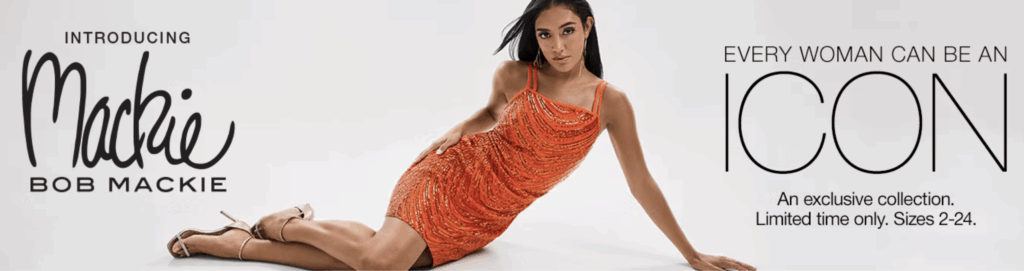
Fast forward to September 2025 and JCPenney announced a “Mackie: Bob Mackie” collection, with press coverage suggesting that Mackie had “teamed up” with the retailer. Mackie says he learned of the launch from the media and had no role whatsoever in designing or approving the line, arguing that he never would have agreed to a JCPenney deal.
>> “Mr. Mackie knew that when the designer Halston entered into a licensing agreement with JCPenney in the early 1980s, his brand was damaged when high-end fashion retailers stopped carrying his clothes because of Halston’s association with JCPenney, “a lower-priced mass-market retail chain store,” the complaint states, noting that “the last thing that Mr. Mackie wants is to diminish the value of his own name and legacy in a similar way.”
One Collection, Two Lawsuits
The JCPenney launch has become the flashpoint for litigation on two fronts: Mackie’s headline-making suit against the retailer and his governance-centric case against Schwartz and BMDG. Central to the latter suit is Mackie’s allegation that Schwartz, as officer, director, and majority owner, breached fiduciary duties by acting without board approval on the JCPenney license and by pursuing a “Bob Mackie” trademark application without consent.
More broadly, the case centers on control over a designer’s name, reputation, and archive – assets that Mackie argues that he has built over decades with “iconic” performers and should not now be weaponized against him.
Mackie is seeking damages for breach of fiduciary duty, declarations confirming ownership of his archives and related intellectual property, and cancellation or narrowing of BMDG’s claimed ownership of the “BOB MACKIE” trademark, along with the removal of Schwartz from company management.
In the JCPenney case, Mackie accuses the retailer of false endorsement, false advertising, and unauthorized use of his name and likeness under federal law, as well as New York and California statutes. He is seeking an injunction to stop JCPenney from using his name and likeness to market or sell any products, along with monetary damages.
THE BOTTOM LINE: Ultimately, the twin cases put forth a single narrative: That of a legendary creative seeking to reclaim control of his name and legacy from a corporate structure that, he contends, acted without the approvals its own bylaws require. Mackie frames his refusal to license to a mass-market chain within a broader history of reputational fallout from such deals, invoking Halston’s ill-fated JCPenney collaboration as a cautionary example.
At its core, the litigation aims to preserve the value and meaning of Bob Mackie’s signature – literally and figuratively – from both unauthorized commercial use and internal overreach.
The cases are Mackie v. Penney OpCo LLC, 1:25-cv-08984 (SDNY) and Mackie v. Marc Schwartz and Bob Mackie Design Group, Ltd., 1:25-cv-09015 (SDNY).
Updated
July 21, 2026
The parties advised the Court in both cases that they “reached an agreement in principle on certain material terms” and “expect to sign the settlement agreement by July 28.”
Share