


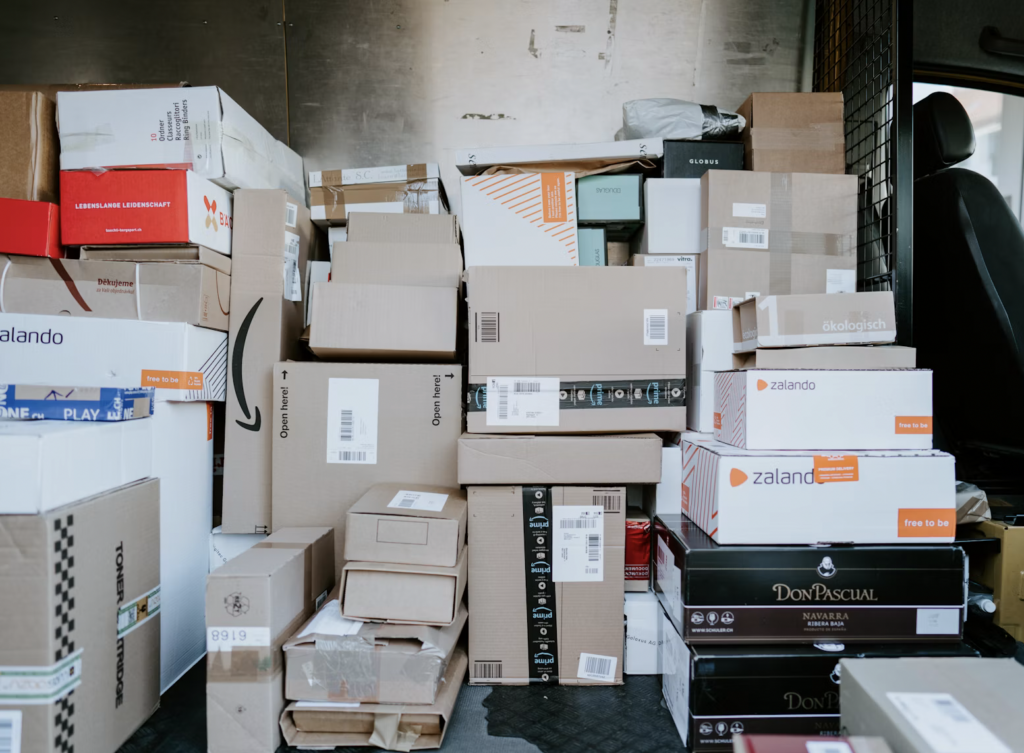
The billions of dollars in tariff refunds flowing back to U.S. companies are beginning to make their way to consumers, opening up a new front in the fight over who ultimately gets the benefit of duties collected under tariffs that the Supreme Court struck down in February. FedEx, UPS, and DHL have started passing tariff refunds on to customers in connection with eligible shipments for which the carriers collected duties that were subsequently refunded by the government. Meanwhile, Amazon says it will automatically refund customers in a narrower set of transactions where it can determine that specific import charges were passed on to shoppers.
The result is an early look at how a question hanging over the tariff refund process may play out in practice: When companies recover duties from the government, under what circumstances, if any, are their customers entitled to some of that money? And one key issue is coming into focus: whether the tariff cost can actually be traced to what particular consumers paid.
From Importers to Consumers
Following the Supreme Court’s decision to reject the Trump Administration’s International Emergency Economic Powers Act (“IEEPA”) tariffs, U.S. Customs has been processing refund requests from importers of record. An estimated $166 billion in duties, plus interest, is potentially subject to refund, with roughly $100 billion refunded so far, according to recent reporting. Roughly $100 billion has been refunded so far, according to recent reporting.
For logistics companies, moving that money back to customers can be relatively straightforward, as there is often a direct line between the tariff paid and the customer who paid it. FedEx has begun returning approximately $800 million in refunds to customers, while UPS, which collected roughly $5 billion in tariffs, says it will return reimbursements as it receives them. DHL similarly says it will return eligible refunds where it acted as importer of record.
For retailers, the issue is more complicated. Amazon, for instance, disclosed late last month that it received approximately $600 million in tariff refunds during the second quarter, but has identified only a limited category of transactions in which specific import charges can be traced to customers. In those cases, Amazon says it will automatically refund affected shoppers. For the remainder, the company says it will use the recovered funds to continue investing in lower prices.
Amazon’s approach highlights the broader challenge for many retailers: Tariffs often did not appear as a discrete charge on a consumer’s receipt that can simply be reversed. Companies responded to the 2025 tariffs in a range of ways, including raising prices, absorbing costs, shifting sourcing and inventory, and negotiating with suppliers. A government refund, therefore, does not necessarily map neatly onto a particular product, transaction, or customer.
Costco is grappling with the same question. CEO Ron Vachris said in May that the company plans to return “in some form” tariffs passed on to consumers, while noting that how much it returns and when will depend on the refunds it receives and developments in related litigation.
The “Double Recovery” Cases
The tariff refund process comes against a backdrop of thousands of lawsuits filed by companies and consumers alike. While importers have brought thousands of cases seeking to recover IEEPA duties from the government, more than 100 proposed consumer class actions have targeted retailers and other companies over whether consumers are entitled to tariff-related amounts that companies recover from the government.
Many of the consumer cases advance variations of the same theory: Companies passed tariff costs on to consumers and could receive a “double recovery” if they also retain corresponding refunds from the government. Nike, for example, was sued in May by consumers alleging that it raised prices to offset tariff costs and should not be permitted to retain corresponding government refunds. Costco has faced similar claims.
So far, the cases have not established that consumers are legally entitled to a share of the refunds, and recent reporting indicates that none has yet been certified as a class. A key hurdle is traceability: While duties assessed on individual shipments may be readily identifiable, retail prices reflect a range of inputs, making it difficult to determine whether – and to what extent – tariff costs were passed on to consumers.
THE BIGGER PICTURE: The tariff fight has moved from whether the President could impose the challenged duties under IEEPA to who is entitled to recover them – and now that billions are being refunded, what happens to the money once companies get it back. For retailers, the answer may depend in part on how tariff costs were treated in the first place. As consumer litigation mounts, the ability to show whether those costs were absorbed, passed on to consumers, or offset elsewhere is emerging as a key issue.
Share