

The U.S. Copyright Office is standing firm in its position that works generated by artificial intelligence (“AI”), even when refined or curated by a human user, do not qualify for copyright protection unless the human author clearly limits their claim to their own original contributions. In a newly filed response and cross-motion for summary judgment, the Office is asking a federal court in Colorado to deny artist Jason Allen’s motion for summary judgment and uphold its refusal to register the work at issue, arguing that the dispute turns on the Copyright Act’s long-established human authorship requirement and not hostility toward AI.
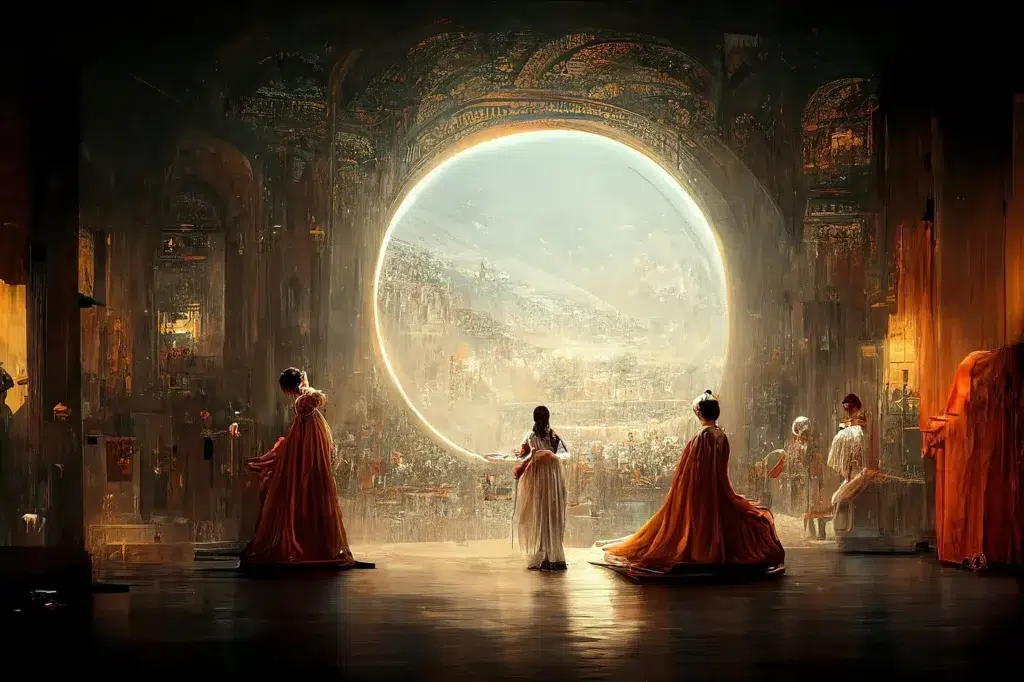
The Background in Brief: In September 2022, Allen applied to register a copyright for a 2-D artwork, Théâtre D’opéra Spatial, without disclosing that he created the work using AI. The U.S. Copyright Office, already aware of the piece due to its high-profile win at the 2022 Colorado State Fair, asked Allen to exclude the Midjourney-generated elements from his claim. When Allen refused to do so, the Office denied registration on the grounds that the work contained inseparable AI-generated material not attributable solely to human authorship.
After two unsuccessful requests for reconsideration, Allen filed suit in the U.S. District Court for the District of Colorado in September 2024, seeking a declaration that the work is registrable despite the Office’s conclusion that it lacks the necessary human authorship.
Human Authorship, Reaffirmed
In a filing on January 16, the Copyright Office leans heavily on the “human authorship” requirement embedded in both the Copyright Act and longstanding judicial precedent. It argues that courts have consistently rejected copyright claims for works created by non-human actors, including animals, natural forces, and machines. Prompting an AI system is closer to proposing an idea than translating that idea into protected expression, according to the Office, which emphasizes in its filing that effort, alone, no matter how substantial, does not equal authorship.
Crucially, the Office counters Allen’s argument that providing an AI model with detailed text prompts gives users meaningful control over the final output. (Allen has claimed that he experimented with over 600 prompts before selecting an “acceptable” image.) Citing Midjourney’s own documentation, the Office argues that the generative AI system relies on probabilistic processes, training data, and random noise to generate images, which means that users are left to select outputs without actually exercising control over their expressive content.
The Office’s arguments closely mirror those in a separate AI-generated image case lodged by Stephen Thaler. In March 2025, the U.S. Court of Appeals for the D.C. Circuit affirmed the Copyright Office’s refusal to register an AI-generated image created by Thaler, holding in that case that copyright protection requires human authorship and cannot vest in a machine. The court emphasized that while AI may be used as a tool, works created solely by artificial intelligence are not eligible for copyright protection under the Copyright Act.
Why the Disclaimer Matters
In addition to doubling-down on its stance on AI-generated works, the Copyright Office’s filing also sheds light on a less-discussed but highly consequential issue: the Copyright Office’s disclaimer requirement. When a work contains more than a de minimis amount of unprotectable material, including AI-generated content, applicants must identify and exclude that material from their claim. This practice, the Office argues, protects the integrity of the public record and prevents confusion about the scope of registered rights.
The Office stresses that it was prepared to register Allen’s human contributions, but by insisting on registering the work “as a whole,” including the AI-generated image, Allen effectively forced the Office to refuse the application altogether.
THE BIGGER PICTURE: While the case centers on a single image, its implications extend beyond the art world. Fashion, beauty, and media companies increasingly rely on generative AI for concept art, campaign visuals, and design exploration. The Copyright Office’s position makes clear that, without clear human authorship and careful claim limitations, such outputs may fall outside the protective reach of copyright law.
At the same time, the Office is careful to note that it has already registered hundreds of works that incorporate AI-generated material, so long as applicants properly identify and claim only their original, human-created elements.
Share