



In a decision that will resonate across the luxury sector, the European Union’s highest court has sounded off on when the inclusion of a historical date in a company’s branding crosses the line into deception. In a case that pits Goyard against Fauré Le Page and centers on the use of “1717” in trademarks for leather goods, the Court of Justice of the European Union (“CJEU”) held that a mark may be misleading when it invokes a distant founding date that suggests long-standing know-how and prestige that does not actually exist.
The Background in Brief: Filing suit, Goyard argued that Fauré Le Page’s inclusion of “1717” in its branding falsely implies a level of continuity, artisanal know-how, and prestige in the company, violating both EU and French trademark law – and rendering the marks invalid. The problem, per Goyard, is that while Fauré Le Page was established in its current form in 2009, it traces its heritage to Maison Fauré Le Page, a Parisian arms maker that was founded in the early 18th century and that ceased operations in the 1990s.
Lower courts initially sided with Fauré Le Page, but the Cour d’appel de Paris reversed course, finding that the “1717” trademarks were likely to deceive consumers. In 2024, France’s Cour de cassation referred the dispute to the CJEU, asking for guidance on how EU law applies to this type of heritage-based branding. In an advisory opinion in 2025, AG Emiliou took a relatively narrow view, concluding that heritage references like “1717” are only problematic where they convey false information about the products themselves, rather than the brand’s narrative.
A Legal Test for Luxury’s Origin Stories
Setting the stage in a decision issued on March 26, the CJEU set out a framework to assess when heritage-based branding amounts to deception under Article 3(1)(g) – moving beyond the narrower approach suggested by the Advocate General and making clear that, in the luxury market, product characteristics go beyond the goods, themselves, to encompass less tangible elements like prestige.
Specifically, the Court held that a trademark may be deceptive where it uses a date from the distant past, as this may evoke long-standing know-how and a resulting guarantee of quality and prestige. According to the Court, the key question is whether the relevant public believes that the date indicates the establishment of the business and in turn, signals “long-standing know-how, bestowing a perceived guarantee of quality and a prestigious image” on the goods. If the date creates the impression that the goods benefit from centuries-old expertise and heightened quality, when they do not, the mark may be considered deceptive.
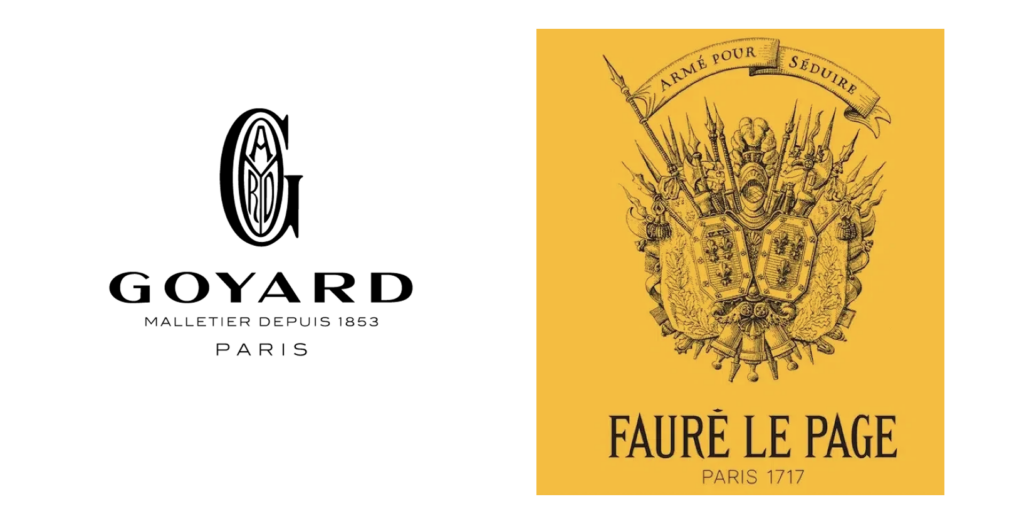
At the same time, the Court emphasized that this is not a mechanical test. In order to determine whether a mark is deceptive, the CJEU held that “the national court must examine each of the marks as a whole, taking into account, in particular, the presence in those marks, in addition to the number 1717, of the word ‘Paris’ and the message which they convey to the relevant public.”
Notably, the CJEU stopped short of declaring the Fauré Le Page marks invalid outright, which is what Goyard – which got its start in 1853 – is angling for. Instead, it left the ultimate assessment to the French courts, underscoring that deceptiveness remains a fact-specific inquiry grounded in consumer perception.
What This Means for Luxury
The highly-anticipated decision marks a meaningful development for luxury brand strategy and for the legal treatment of heritage marketing more broadly. The Court makes clear that heritage is not merely a matter of storytelling. In the luxury sector, historical cues can function as commercial signals of quality and prestige, and those signals fall within the scope of trademark law – and its effort to prevent consumer deception.
The ruling also turns on a crucial reality in the luxury market: the marketing, pricing power, and appeal of luxury goods is not exclusively tied to – or derived from – the products, themselves. Goodwill, reputation, and the allure associated with a brand can form a meaningful part of how consumers evaluate a product. With that in mind, even a simple numerical reference, such as a founding date, can carry legal significance if it implies long-standing know-how, quality, or prestige that does not in fact exist.
THE BOTTOM LINE: The court has not shut the door on heritage-driven branding. Instead, it draws a clearer line. Heritage-rooted branding remains permissible, but only if it does not mislead consumers about the qualities of the goods. The result is straightforward but consequential: Heritage may sell when it comes to luxury goods, but when a company’s use of heritage market misleads consumers about product quality or prestige, it can come at the cost of trademark protection.
The case is Fauré Le Page Maroquinier SAS v Goyard St-Honoré SAS, Case C‑412/24.
Share