



Fashion brands’ push to claim trademark rights in surface-level design details is facing renewed resistance. In an Office Action issued in December 2025, the U.S. Patent and Trademark Office (“USPTO”) shot down Naghedi’s attempt to register a repeating woven neoprene pattern as a trademark for use on handbags. The decision underscores a growing reality for fashion brands: ornamental designs – particularly those that are widely used across the market – face an uphill battle for trademark protection, even when paired with years of use, significant sales, and aggressive enforcement efforts.
The Background in Brief: Naghedi filed a trademark application in February 2023, seeking protection for a mark consisting of a “configuration of slim, uniformly-sized straps of neoprene interlaced, folded and woven to form a repeating weave pattern covering the surface of the goods, or a portion of the surface of the goods.” In an initial Office Action issued on June 2024, the USPTO preliminarily refused registration, concluding that the woven neoprene design would be perceived by consumers as mere ornamentation rather than a source-identifying trademark.
Naghedi responded in October 2024, challenging that conclusion and arguing that the repeating pattern – used across handbags, totes, clutches, and pouches – functions as a trademark. The New York-based accessories brand maintained that more than five years of consistent use, rising sales, substantial advertising expenditures, media exposure, and alleged copying by competitors had caused the pattern to acquire distinctiveness and operate as a source identifier for its goods.
A Pattern Problem
In its December 16 Office Action – issued as a supplemental and superseding refusal – the USPTO rejected Naghedi’s acquired distinctiveness arguments, concluding that the mark appears as an all-over surface design that creates a classic “wallpaper effect.” According to the examining attorney, repetition enhances the design’s ornamental character while dulling any source-identifying significance.
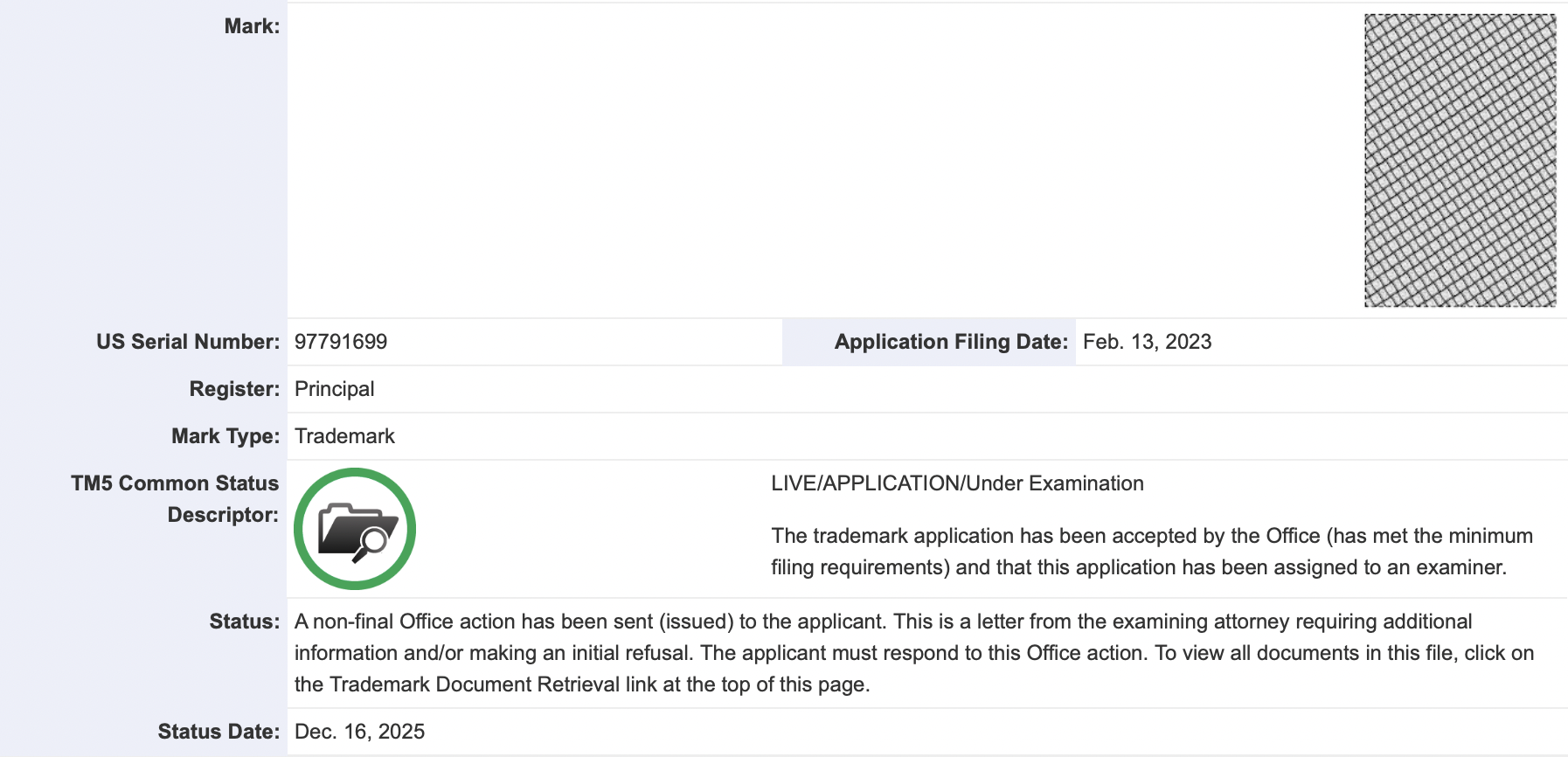
As the USPTO explained, even a distinctive design can lose trademark significance when repeated across a product’s surface, particularly in categories where patterns are commonplace. Here, the examining attorney emphasized that woven neoprene designs are pervasive throughout the accessories market, citing examples from retailers including Net-A-Porter, DSW, Amazon, Etsy, and Alibaba. In such a crowded field, consumers are more likely to view woven neoprene as a material choice or style rather than as an indicator of origin.
Although Naghedi pointed to years of use, substantial advertising, rising sales, and enforcement efforts in support of its acquired distinctiveness claim, the USPTO was unconvinced. In particular, the Office determined that Naghedi’s use of the design was not “substantially exclusive,” noting that numerous third parties continue to sell woven neoprene bags with similar constructions.
The examining attorney further rejected the notion that commercial success alone establishes trademark significance, reiterating that while sales and advertising figures may demonstrate market demand, they do not show that consumers perceive the design as a trademark absent consumer surveys, targeted branding, or unsolicited media coverage linking the pattern to a single source.
When Everyone Is “Copying,” No One Is
The USPTO also rejected Naghedi’s reliance on alleged copying by competitors, finding that the evidence did little to advance its claim of acquired distinctiveness. While Naghedi pointed to the presence of “knock-off” bags and its issuance of cease-and-desist letters as evidence that competitors were intentionally copying its woven neoprene design, the examining attorney was unconvinced.
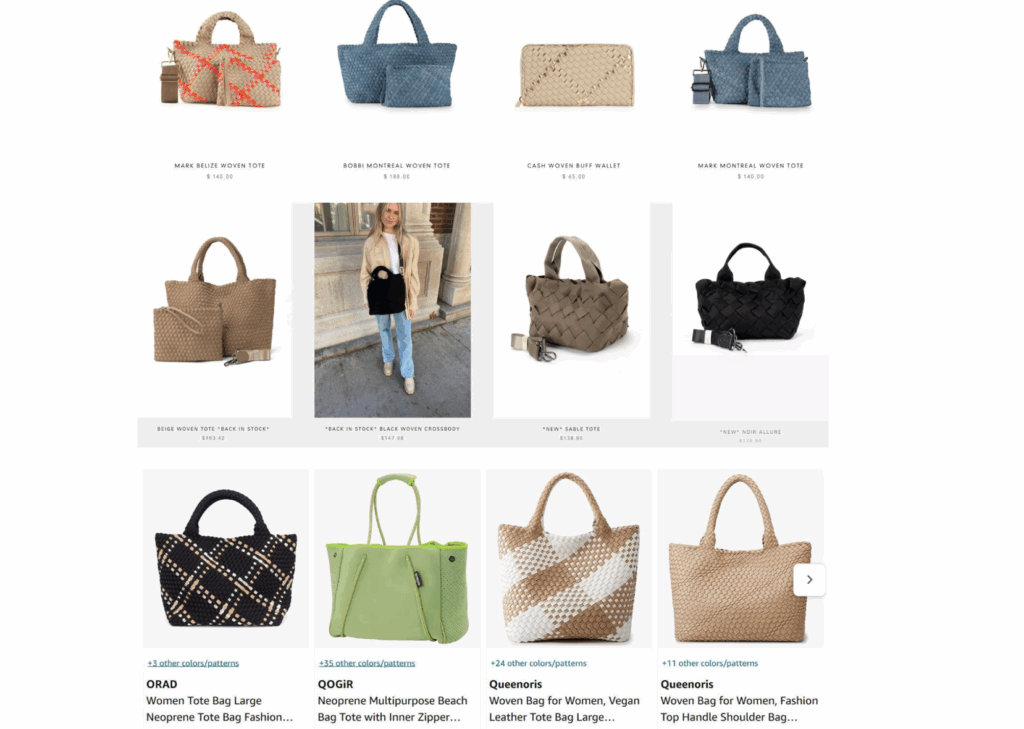
Instead, the USPTO found that the record shows numerous third parties continuing to sell overlapping woven neoprene bags despite Naghedi’s enforcement efforts and does not establish that Naghedi was the first to introduce the design. In a market crowded with similar products, the examining attorney concluded that it is unclear “who is copying whom” – a lack of provenance that undermines, rather than supports, Naghedi’s claim that copying evidences acquired distinctiveness.
LOOKING AHEAD: Naghedi may still respond by submitting additional evidence of acquired distinctiveness, amending the application to the Supplemental Register, or pursuing alternative procedural paths. But the December 16 Office Action sends a clear message: in fashion, repetition alone rarely creates a trademark – and widespread adoption may just as easily extinguish one.
Share