


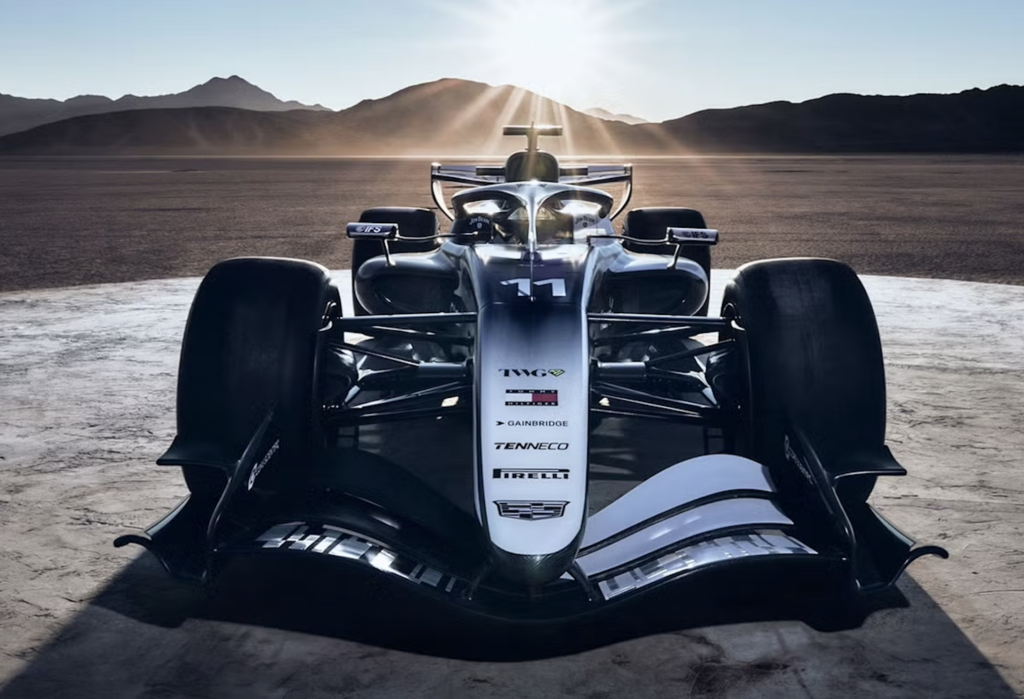
Behind the Cadillac F1 commercial that ran during the Super Bowl on Sunday is a budding $1.5 million-plus legal battle. In a lawsuit filed in Los Angeles Superior Court just a couple of days before the commercial aired, action-film director Michael Bay accused Cadillac’s nascent Formula 1 team of leveraging his blockbuster sensibility for a Super Bowl campaign – only to sideline him and allegedly repurpose his ideas without paying for them.
The February 6 complaint, which names General Motors LLC and TWG Cadillac Formula 1 Team Holdings LLC as defendants, asserts claims for breach of verbal contract, breach of implied-in-fact contract, fraud, and quantum meruit. At the center of the dispute is the Super Bowl LX commercial, which comes as part of the launch of Cadillac’s new Formula 1 effort under the umbrella of General Motors.
According to Bay’s suit, Dan Towriss, the owner and CEO of the new Cadillac F1 racing team, contacted him on November 28, 2025, saying that he wanted “the most American director” to create Cadillac F1’s Super Bowl debut. Bay – known for films such as The Rock, Armageddon, and Pearl Harbor – claims Towriss suggested incorporating President John F. Kennedy and desert, space-race imagery. Bay says he responded with a clip from Transformers: Dark of the Moon featuring JFK’s “race to the moon” speech and cited The Right Stuff as inspiration for a gold-toned, heat-hazed F1 reveal – an approach that allegedly left Towriss “thrilled,” according to the complaint.
Bay maintains that he does not engage in speculative pitches and only develops creative concepts once formally retained. After a follow-up presentation, his producer allegedly confirmed in writing that he had been hired on a “single bid” basis. With an alleged $3 million production budget and a February 2, 2026 delivery deadline ahead of the Super Bowl broadcast, Bay says he paused other projects and began mobilizing crew, locations, and an F1 car for a Mojave shoot.
However, on December 6, Bay maintains that his team was told the agency behind the commercial had decided to “go in a different direction.” When Bay texted Towriss, the CEO allegedly replied that he was “not at all happy with how this played out” and suggested a future collaboration without an agency “in the middle.”
Bay characterizes the sequence as a “bait and switch,” alleging that promo materials released in connection with Cadillac F1’s Super Bowl campaign incorporated visual elements he had proposed. Against the background, Bay is seeking compensatory damages in excess of $1.5 million, representing his standard director’s and producer’s fees, along with punitive damages.
Cadillac F1, for its part, has reportedly stated that Bay was only being explored as a potential director and that the core creative concept predated his involvement. The company has also suggested that timeline constraints ultimately foreclosed moving forward with him.
From Creative Concept to Enforceable Contract?
Looking beyond the cinematic flourishes, the case appears to fit squarely within a familiar corner of California entertainment law: implied-in-fact contract claims arising from creative pitches. While ideas, themselves, are not protected under U.S. copyright law (the creative expression of those ideas is), courts have long recognized that a plaintiff may recover where ideas are disclosed under circumstances indicating an expectation of payment and are later used without compensation.
Bay’s complaint is structured around that nuance in IP and contract law. In lieu of copyright infringement claims, he alleges that Towriss specifically solicited his creative vision, that he sought confirmation he was being hired, that he was assured of a single-bid engagement, and that he relied on those assurances in mobilizing personnel and incurring costs.
Whether those facts amount to an enforceable agreement – or merely exploratory discussions typical of high-level advertising negotiations – will determine whether this dispute remains a headline-grabbing clash or evolves into a potentially meaningful case on the economics of Super Bowl advertising and authorship in brand storytelling.
More broadly, the stakes extend beyond a single commercial. Cadillac’s planned Formula 1 entry follows FIA approval of an expansion effort backed by General Motors and Towriss-led ownership entities, with ambitions to establish a U.S.-anchored team operating across the United States and the United Kingdom and, over time, to develop its own power units. The Super Bowl campaign was intended to mark Cadillac’s formal arrival on Formula 1’s global stage.
The case is Bay v. TWG Global Holdings LLC, No. 710227 (Cal. Sup.).
Share