


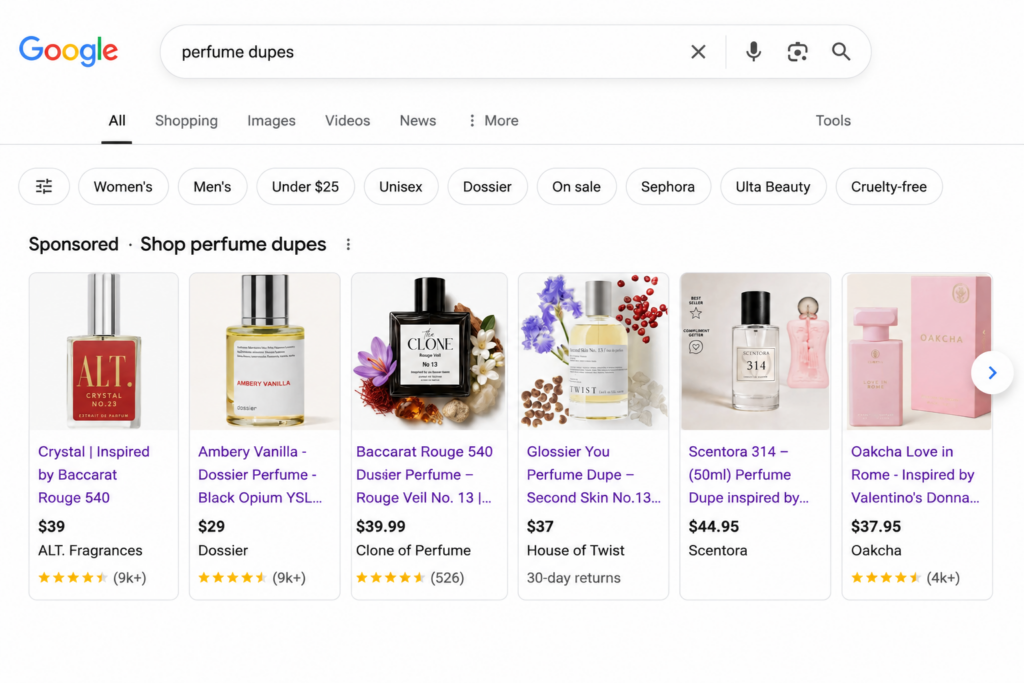
This summer, a German court weighed in on a trademark question that is likely to arise with increasing frequency as generative artificial intelligence increasingly powers search results: when an AI-powered search tool produces answers about “dupes” of branded products, when does the search platform itself become the trademark user?
In an interim relief decision this summer, the Regional Court of Berlin rejected an unnamed perfume and cosmetics group’s bid for an injunction against the operator of a search engine over AI-generated search summaries and chatbot-style answers that referred users to alternatives for brand-name fragrances. The court treated the challenged AI outputs as more akin to search results than to commercial communications from the Dublin-based platform – which looks to be a Google-affiliated entity.
AI Search, Perfume Dupes & the Infringement Claim
At the center of the case are two AI-powered search features: an “AI overview” that appeared above standard search results and summarized relevant webpages with links to third-party sources, and an “AI mode” that allowed users to ask questions and receive AI-generated answers based on webpages the search engine deemed relevant. Relying on several EU registrations for fragrances, the cosmetics group argued that both features infringed its trademark rights.
According to the court’s June 1 decision, when users searched for perfume dupes, the AI-generated outputs explained the concept and listed alternative fragrance providers, while linking to third-party sites. In some instances, sponsored products for branded perfumes or dupe fragrances appeared above the AI overview.
The perfume and cosmetics group argued that this went beyond ordinary search activity. By implementing the AI tools, structuring the results, and allegedly benefiting from directing users to dupe sellers, the operator was making unauthorized trademark use and engaging in unfair competition, it claimed.
When Search Results Become Trademark Use
The Berlin court disagreed, focusing on whether the search engine operator “used” the perfume and cosmetics group’s marks within the meaning of Article 9 of the EU Trademark Regulation. Drawing on CJEU case law, including Google France and Louboutin, the court emphasized that trademark use requires active conduct and direct or indirect control over the act of use, and that the sign must appear in the alleged infringer’s own commercial communication.
Applying that framework, the court held that the AI-generated summaries and answers did not amount to the operator’s own use of the marks. The outputs summarized third-party webpages comparing branded perfumes with dupe products; they did not create the impression that the search engine itself was advertising, offering, or selling those alternatives. An average, reasonably well-informed and attentive user, the court found, would understand the AI overview as a new search-result format rather than perfume-related content originating with the search engine.
Sponsored products appearing above some AI overviews did not alter the analysis. Citing Google France, the court held that receiving advertising revenue in connection with search activity does not, by itself, mean that the operator is using the trademark in its own commercial communication.
The court also rejected the unfair competition claim, finding that the perfume and cosmetics group, which sells perfumes, and the search engine operator were not competitors, and that unpaid links to dupe providers did not create a sufficient competitive nexus.
THE BIGGER PICTURE: The significance of the ruling lies in its treatment of AI-generated search outputs, at least in this setting, as functionally closer to search snippets than to autonomous editorial or advertising content. Generative AI-powered search tools complicate that characterization because these tools increasingly synthesize information, select and foreground sources, and provide direct answers within the platform itself.
A separate ruling from the Regional Court of Munich, issued just days earlier, illustrates how courts may characterize AI-generated search outputs differently when an answer goes beyond the underlying search results. In a case involving false statements about two publishers, the court treated Google’s AI Overview as Google’s own content, reasoning that it did more than display third-party links or snippets: it summarized and evaluated search results in its own words and generated statements that were not contained in the underlying search results. The case arose under a different body of law (German corporate personality rights law), but it highlights a potentially important distinction as courts grapple with AI search, namely, whether the tool is summarizing third-party content or generating new claims of its own.
For trademark owners, the Berlin ruling suggests that AI search tools may not be responsible for trademark use when they merely summarize or link to third-party content. The outcome could be different, however, where a platform plays a more active commercial role – for example, by favoring commercial partners, integrating shopping features, or presenting branded alternatives as part of its own offering. That is likely to become a key issue as AI search moves further into search and shopping.
Share