


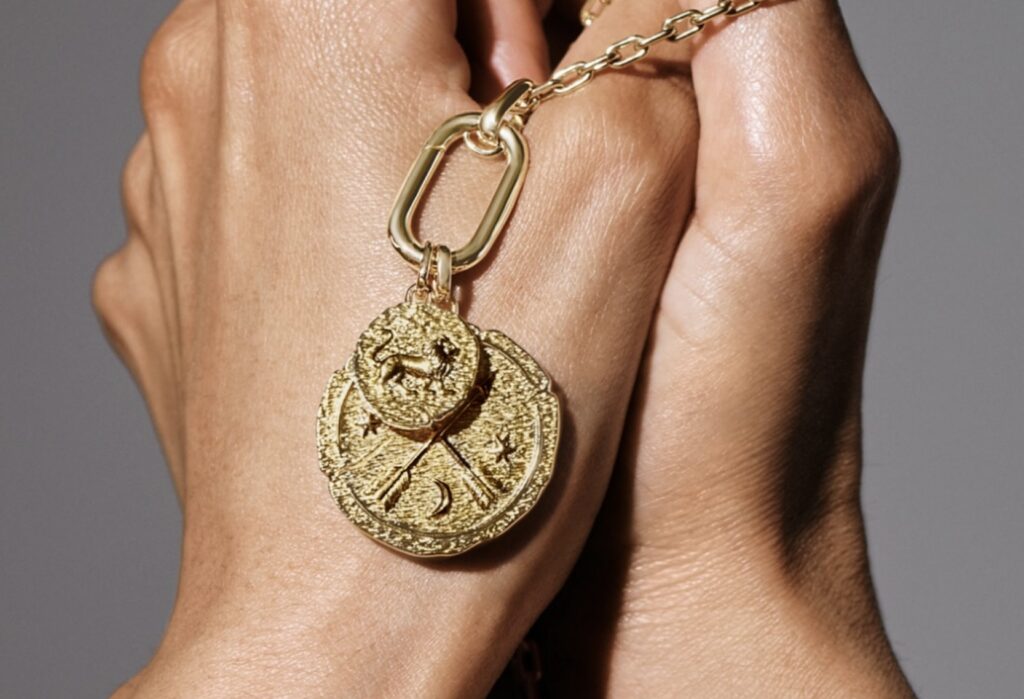
Pandora is looking to bring an early end to the copyright lawsuit filed against it by Foundrae, aiming to shut down its fellow jewelry company’s attempt to secure what it calls “an improper monopoly over commonplace designs.” The case – which centers on the jewelers’ use of widely recognized motifs like celestial imagery and crossed arrows – raises a consequential question for brands in the jewelry and fashion industries alike: how far can a brand go in claiming exclusivity over designs rooted in commonly used symbols?
What distinguishes the claims in this case from other infringement matters is not just the alleged similarity between the designs, but the nature of the design elements. Pandora does not just argue that its designs differ from Foundrae’s. It contends that the underlying designs fall outside the scope of copyright protection altogether, thereby, reframing the dispute around a threshold question about what copyright protects.
The Case in Brief: Filing suit in federal court in New York in February 2026, Foundrae alleges that Pandora’s “Talisman Collection” infringes its copyright-protected medallion designs. Foundrae maintains that Pandora copied key design elements of its jewelry, including celestial imagery, crossed arrows, circular medallions, and precious metals. In response, Pandora filed a motion to dismiss under Rule 12(b)(6), arguing that the designs rely on unprotectable elements drawn from the public domain and as a result, cannot support a viable copyright claim.
A Challenge to Copyright
The crux of Pandora’s argument, as first reported by TFL, is the well-established principle that copyright does not protect “elements of shape, color, and common symbols and ideas existing in nature and the public domain.” Before considering similarity, courts must first filter out those elements, leaving only the aspects of a work that are protected by copyright law. Here, Pandora contends that once those elements are removed, any copyright protection that Foundrae enjoys is “thin.” Where a work is built largely from unprotectable elements, infringement requires “virtual” identity, setting a materially higher bar that Pandora argues Foundrae cannot meet.
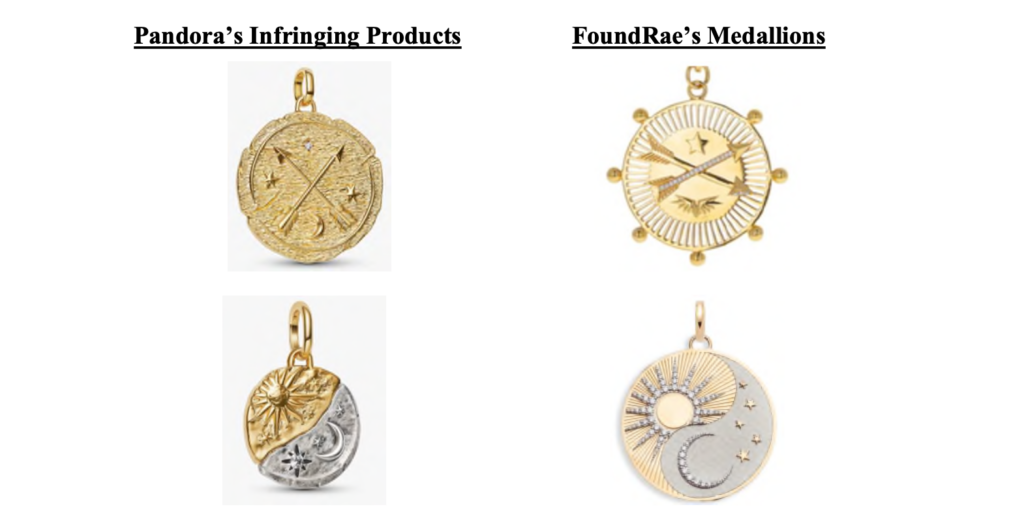
“The only arguable similarities … are the use of common symbols – namely, the sun, moon and crossed arrows – that have existed in the public domain for ages,” Pandora argues, positioning the case as one that can be resolved before any substantive similarity analysis. If that framing holds, the significance of the case is less about copyright doctrine than about how far copyright claims can be pressed in practice.
By focusing its defense on the alleged lack of protectable elements in Foundrae’s designs, Pandora seeks to bring an early end to the case by resolving the copyright infringement claim.
Defining the Limits of Protectable Design
The case brings a long-existing divide between protectable expression and widely used symbols into focus. In doing so, it underscores a practical limit: the more a product or collection depends on motifs drawn from the public domain, the less copyright-centric control a brand may have over how those designs are used in the market. That reality may influence how brands relying on similar design approaches think about amassing and enforcing intellectual property, particularly where collections draw heavily on motifs that are inherently difficult to police.
Pandora’s request for dismissal with prejudice reinforces that position. It is not arguing that Foundrae has pleaded its claims inadequately, but that its theory of infringement – grounded in similarities in “commonplace” designs – cannot succeed. How the court responds will indicate how readily it is willing to enforce these limits at the outset and how far brands can extend copyright claims over designs built on shared visual elements.
THE BOTTOM LINE: The case centers on a practical constraint: copyright may protect a design’s specific creative expression, but not “basic design concepts or works in the public domain.” For brands built around universal symbols or motifs, that distinction can define the limits of what can actually be enforced, a particularly relevant constraint in the age of dupes.
The case is Cemayla, LLC d/b/a Foundrae v. Pandora Jewelry LLC et al., 1:26-cv-01331 (S.D.N.Y.).
Share