


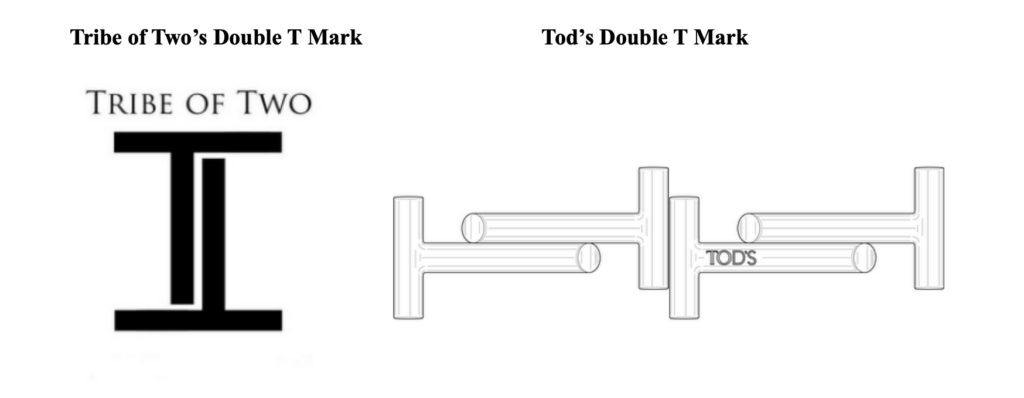
A New York federal court handed Tod’s a win in a case over its T-centric logo. Granting summary judgment to Tod’s in an order on May 11, the Southern District of New York found that no reasonable jury could conclude that Tod’s “Double T” hardware logo was likely to confuse consumers into thinking its products were connected to the federally registered “Double T” mark of Tribe of Two, a Florida-headquartered brand known for its Italy-made exotic-skin handbags.
The Case in Brief: Tribe of Two filed a trademark infringement and unfair competition suit against Tod’s in 2023, alleging that the Italian luxury brand’s use of its “Double T” hardware logo infringed Tribe of Two’s federally registered “Double T” trademark and created a likelihood of consumer confusion. In response, Tod’s denied that consumers were likely to confuse the brands and argued that it had used similar “Double T” branding years before Tribe of Two. It moved for summary judgment in January 2026.
A Marketplace Reality Check?
At the center of the case is Tribe of Two’s claim that Tod’s use of its horizontal metallic “Double T” hardware infringed its vertically oriented “Double T” mark, which founder Brenda Schad created in 2012, and that Tod’s market dominance risked overwhelming its identity through “reverse confusion.”
Judge Jessica G.L. Clarke ultimately rejected Tribe of Two’s claims, finding that “no reasonable juror could find a likelihood of confusion” between the companies’ marks. The court focused less on a side-by-side comparison of the logos and more on the marketplace realities surrounding the products, consumers, and channels of trade at issue. Weighing the Polaroid factors, Judge Clarke stated that “the totality of the evidence, particularly the weakness of [Tribe of Two’s] acquired strength, lack of commercial channel overlap, and absence of actual confusion, weigh insurmountably in favor of finding that consumers are unlikely to be confused.”
The court also emphasized that similar “Double T” branding already exists throughout the market, pointing to brands like Tory Burch as evidence that Tribe of Two’s logo is “not an especially creative or unique design.” While Tribe of Two argued that many of those third-party brands do not operate in the luxury handbag space, the court signaled that similar marks used across adjacent categories can still weaken a trademark’s distinctiveness.
That aspect of the ruling may prove especially significant for fashion companies. As luxury branding has shifted toward sparse visual identifiers and signature hardware, brands have increasingly sought expansive trademark protection over relatively simple design elements. The ruling suggests courts may be growing less willing to grant broad exclusivity where the underlying visual language is already crowded.
The Commercial Context
The decision also undercuts the reverse confusion theory in the case, one in which a smaller brand argues that a larger company’s extensive advertising and market presence have overwhelmed its identity in the marketplace. Tribe of Two claimed that Tod’s extensive marketing and commercial reach effectively overshadowed its smaller footprint in the luxury market. The court, however, appeared unconvinced that Tod’s commercial scale and visibility were enough absent stronger evidence that consumers actually believed the brands or products were connected.
At the same time, the court placed substantial weight on how consumers encounter the products in the market. Tod’s products are sold primarily through branded boutiques, department stores, and the company’s own retail ecosystem, while Tribe of Two relies heavily on trunk shows, private events, and direct sales. Rather than viewing those curated luxury environments as likely to increase confusion, the court suggested they may actually reduce it by reinforcing brand awareness at the point of sale.
Consumer sophistication further strengthened that conclusion. Noting that Tribe of Two’s handbags retail for roughly $1,000 to $3,000, Judge Clarke found that consumers purchasing products at those price points are likely to exercise a high degree of care. She similarly dismissed Tribe of Two’s evidence of actual confusion as “de minimis,” stating that recognizing similarities between the logos was not the same thing as confusion over source or affiliation.
A spokesperson for Tribe of Two told TFL, “We respectfully disagree with the Court’s decision and are evaluating our options, including appeal. Importantly, the Court acknowledged that Tribe of Two owns valid trademark rights. This case has always been about protecting small independent brands from being overwhelmed by much larger companies using confusingly similar branding. Reverse confusion trademark law exists for exactly this reason – to prevent a dominant market player from saturating the marketplace in a way that causes consumers to associate the smaller senior brand with the larger company. We remain committed to protecting the Tribe of Two brand and our intellectual property rights.”
THE BIGGER PICTURE: The ruling reflects a recurring tension in the luxury market and corresponding litigation. As deep-pocketed consumers continue to tire of bold, flashy trademarks, successful brands are increasingly relying on minimalist symbols and hardware as instantly recognizable brand signatures. The challenge for brands is that courts may not view those subtle visual similarities as enough, on their own, to establish that consumers actually perceive a shared source or affiliation.
The case is Tribe of Two, LLC v. Tods, S.p.A., Ltd., 1:23-cv-03255 (SDNY).
Share