


A consumer class action challenging Quince’s pricing practices has put the retailer’s prices – and accompanying savings claims – under scrutiny. The plaintiffs allege that Quince’s “Traditional Retail” pricing representations falsely suggest that consumers are receiving meaningful markdowns and that Quince’s products are comparable in quality to more expensive alternatives. More broadly, the plaintiffs take issue with Quince’s marketing strategy, which they say creates the “misleading” impression that consumers are receiving extraordinary discounts. Now, in a bid to have the case dismissed, Quince argues that the plaintiffs have mischaracterized what its “Traditional Retail” prices actually communicate to consumers.
A Different Theory of the Case
In its July 8 motion to dismiss, Quince asserts that the plaintiffs have misinterpreted its “Traditional Retail” figures. Rather than reflecting former prices for Quince products or prices previously charged elsewhere for identical goods, Quince asserts that the figures are comparisons to products of similar quality sold by other retailers. Because Quince sells its own branded products directly to consumers, it argues that a reasonable consumer would understand the pricing claims as comparisons to products sold through traditional retail channels – not as evidence of a markdown from a prior price.
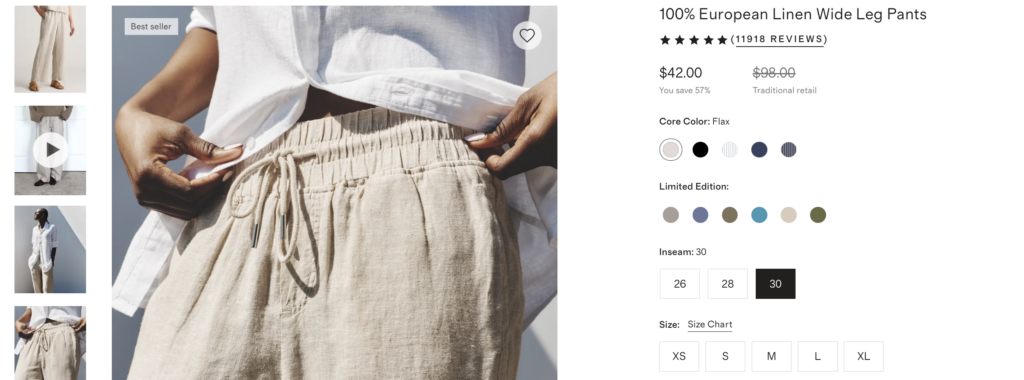
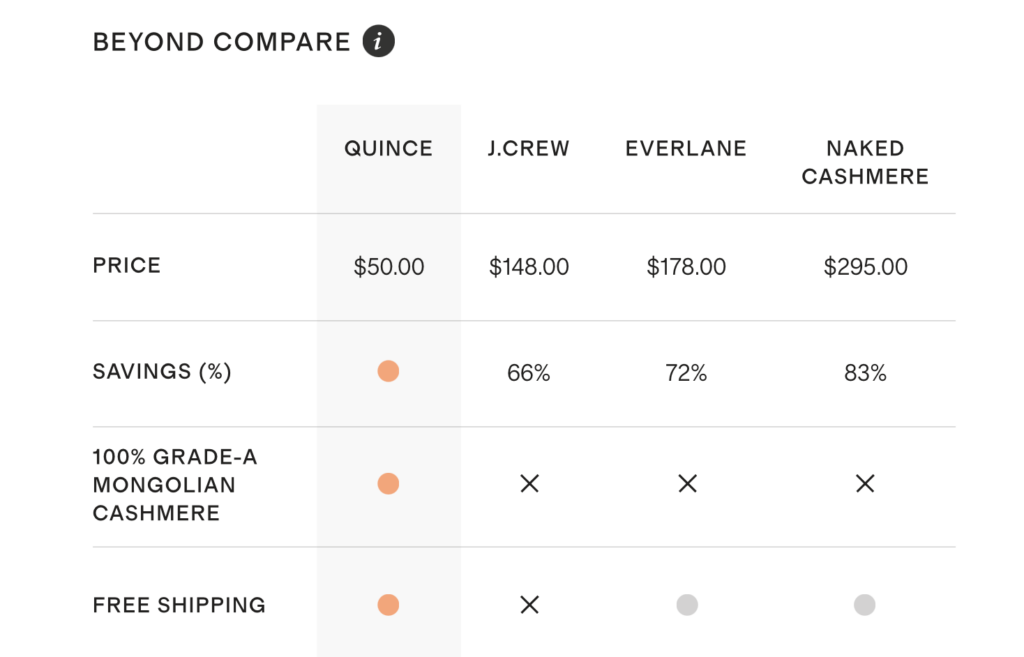
At the same time, Quince contends that the plaintiffs’ consolidated amended complaint, which was filed with the Northern District of California on June 8, ignores the broader context of its product pages. The plaintiffs rely on cropped images showing the “Traditional Retail” prices while omitting other information elsewhere on the page, per Quince. The omitted info includes a “Beyond Compare” chart identifying products of comparable quality sold by retailers, such as J.Crew, Everlane, and Naked Cashmere, as well as a “Transparent Pricing” section, which explains how Quince calculates its prices.
Viewed together, Quince says those features make clear that the pricing language compares its products with similar products sold through traditional retail channels – as distinct from reflecting a previous selling price.
Former Prices or Comparable Value?
Reference-pricing litigation has long been a fixture of consumer class actions in the retail sector. But reference prices can take different forms – a distinction at the heart of Quince’s motion to dismiss. A former-price comparison, for instance, contrasts a current price with a price previously charged for the same product, while a comparable-value comparison uses products of similar grade and quality as the benchmark. Quince argues that the complaint improperly treats those two forms of reference pricing as interchangeable.
Citing the Federal Trade Commission’s pricing guides, the company contends that its “Traditional Retail” figures fall into the latter category. According to Quince, that means the relevant inquiry is whether its comparisons to similar products have a reasonable basis – not whether the company previously sold the identical item at a higher price.
A comparable-value claim can still be deceptive if the underlying comparison lacks a reasonable basis. But Quince argues that the complaint does not adequately explain why its price representations are misleading. Instead, Quince says that the plaintiffs improperly conflate former-price and comparable-value comparisons and fail to plead facts showing that its comparison-value prices are inaccurate.
THE BOTTOM LINE: In furtherance of its push for dismissal, Quince also challenges the plaintiffs’ alleged injuries, nationwide class claims, unpurchased-product claims, and demands for damages and restitution. At the same time, the motion highlights a key distinction between former-price and comparable-value reference pricing that sits at the center of the parties’ dispute. Ultimately, at the heart of the parties’ dispute is the question of how a reasonable consumer would interpret Quince’s “Traditional Retail” prices and accompanying savings claims.
In Quince’s view, the figures are comparisons with higher-priced offerings sold through traditional retail channels. The plaintiffs, by contrast, allege that consumers understand them as evidence of a genuine markdown or that Quince’s products are comparable in quality and value to higher-priced alternatives.
The case is In re Last Brand, Inc. d/b/a Quince Pricing Litig., 3:25-cv-09780 (N.D. Cal.)
Share