


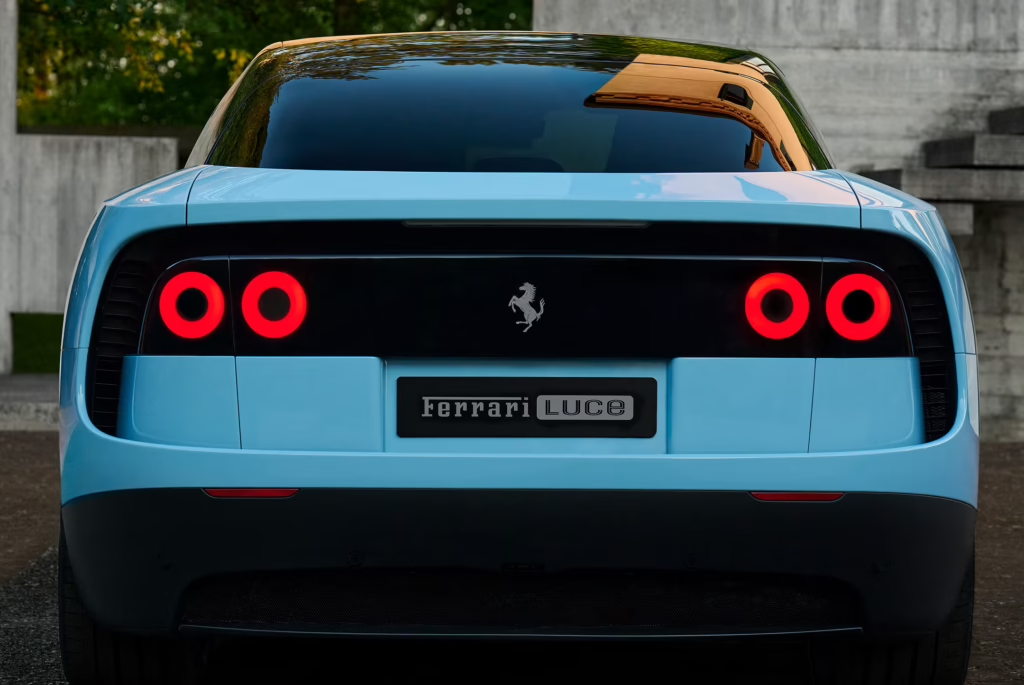
This week Ferrari denied that customers must buy its new Luce electric vehicle in order to qualify for future limited-edition models. Comments by Ferrari Chief Marketing and Commercial Officer Enrico Galliera rejecting a Bloomberg report that buying the €550,000 Luce – Ferrari’s first EV – could become a prerequisite for access to some of the company’s most exclusive future models may have shut down one rumor. But they also cast fresh light on a much bigger issue in luxury: The role of allocation systems that reward loyalty, repeat spending, and relationship-building with access to scarce, high-demand goods.
In comments published this week, Galliera said that pushing customers to buy the Luce in exchange for other benefits would be a “huge mistake,” one that could leave Ferrari with reluctant owners eager to resell the car and in turn, damage its residual value. Ferrari, he said, has instructed its dealer network to ensure that Luce buyers are “truly motivated” to own the vehicle, rather than purchasing it in hopes of currying favor with the brand.
Allocation Under Scrutiny
Whether or not Ferrari ever seriously contemplated linking Luce purchases with access to future limited-run cars, the scenario is nonetheless notable because it draws attention to the mechanics of the allocation system Ferrari traditionally uses for its most sought-after vehicles.
Ferrari has long favored established clients when allocating its most sought-after vehicles, particularly limited-edition models, with its allocation system prioritizing multiple owners, customers who participate in factory events, and those who retain cars for long periods. In 2025, Ferrari said that roughly 84 percent of its new cars were sold to existing Ferrari owners and about 56 percent to buyers who already owned more than one Ferrari.
That kind of relationship-based gatekeeping is hardly unique to Ferrari. Across luxury fashion, watches, jewelry, and auto, access to the most desirable products often depends on much more than a customer’s willingness to pay retail. Companies look to purchase history, client status, and perceived long-term value to determine who gets the chance to buy what.
In some cases, these systems are framed as a way to reward loyalty and preserve exclusivity; in others, they are designed to deter resellers and protect secondary-market value. Either way, the result is the same: brands are not simply selling products but managing access to them.
From Supercars to Coveted Handbags
Galliera’s comments arrive amid heightened scrutiny of luxury allocation practices. After all, Hermès has been tied up in litigation over how it allegedly assigns ownership of its hardest-to-get handbags. In a closely watched antitrust suit, three consumer plaintiffs accuse Hermès of effectively conditioning access to Birkin bags on the purchase of other Hermès goods. They claim that customers are expected to spend thousands of dollars on shoes, scarves, jewelry, and home goods before being offered the opportunity to buy one of the brand’s coveted handbags.
Hermès denied any unlawful tying arrangement, and a California federal court dismissed the complaint on more than one occasion, finding that the plaintiffs had failed to adequately plead key elements of an antitrust claim, including a cognizable market and competitive harm. An appeal is currently underway in the case.
Ferrari’s situation is not directly analogous to the one alleged in the Hermès matter: Ferrari, for one, is not being accused of unlawful tying, and Galliera’s comments appear aimed at distancing the company from precisely that kind of arrangement. Still, Ferrari’s decision to publicly reject the notion that buying a less-desired product might unlock access to a more desirable one is telling. It appears to reflect a broader understanding among luxury consumers that access to highly scarce products is often governed by unwritten rules – and that buying strategically can matter as much as buying lavishly.
It also underscores the extent to which luxury brands increasingly act as market managers, not simply manufacturers or retailers. Galliera framed Ferrari’s approach to the Luce not only in terms of sales, but also in terms of residual value, warning that forcing the EV onto reluctant buyers would create “negative ambassadors” who would “speak poorly of the Luce and, after a few months, resell it” – a dynamic that, he said, would “destroy its residual market value.”
That is a familiar luxury concern. From handbags and watches to supercars, brands are laser focused on what happens after the point of sale, and allocation systems have become one tool for shaping that outcome.
THE BOTTOM LINE: Ferrari may have denied that it is using the Luce as a gateway to future limited-edition models. But the episode still reveals something important about the modern luxury market. Access has become one of the most valuable things a brand can offer, even when it is not sold outright. And as brands continue to use scarcity, loyalty, and controlled distribution to shape consumer behavior, the scrutiny surrounding those practices is unlikely to fade.
Share