

In an industry where luxury is often defined by big footprints and high room counts, Aman chose intimacy, architecture, and a rigorous sense of place, and in the process built one of hospitality’s most defensible brands. What began as a private beach retreat became a scarcity-driven model that now spans remote pavilions, branded residences, and marquee urban flagships.
Craft, Design & a Slow-Growth Luxury Model
Indonesian-born hotelier Adrian Zecha went looking for a private escape on Phuket’s Pansea Beach in the mid-1980s – not a hotel but a home. Partnering with investor Anil Thadani and architect Ed Tuttle, he formalized the vision as Amanpuri, which opened in 1988 and established the brand’s thesis: architecture that recedes, materials that belong to the site, and a service culture set to discretion. “Aman”, Sanskrit for peace, became both the company’s name and its operating principle – the promise that luxury could mean quiet, space, and time.
From the outset, Aman favored low room counts, high staff-to-guest ratios, and architecture that speaks to the nature of its mission as opposed to operating like a billboard. Early projects like Amandari in Bali and, later, Amangani and Amangiri codified a minimalist, restorative guest experience – pavilions or villas, long sightlines, regional materials – with designers including Ed Tuttle, Kerry Hill, and Jean-Michel Gathy. The restraint functions as strategy and the product drives loyalty among travelers who value craft and privacy over spectacle.
Management has characterized the collection of properties as “very boutique” – resorts often ~30–50 keys (reported averages vary) and urban sites typically under ~90 keys – underscoring how design control and scarcity are baked right into the heart of the Aman model.
Litigation, the Zecha Years, DLF & then Doronin
Growth in the 1990s brought both capital – and complexity – for Aman. Changes in control brought investors with different horizons into the fold, and by 1998 a dispute involving Colony Capital precipitated Zecha’s resignation. Settlements and restructurings followed; in 2000, Zecha returned and drove renewed expansion. The later governance chapter centered on investor control disputes in the London High Court in 2014–2016. The case ultimately settled in March 2016 and served as a reminder that a brand built on intangibles still lives inside very real corporate structures.
In furtherance of yet another string of ownership changes, India’s DLF acquired control of Aman for a reported $400 million (including $150 million of debt) in 2007. By 2014, DLF exited to a group led by Vladislav Doronin for a reported $350–360 million, excluding The Lodhi in New Delhi.
Following litigation and settlements, Doronin consolidated ownership by 2016 and tightened strategic guardrails. Today, the corporate entity is Swiss-headquartered (Aman Group Sàrl, Baar) with a London regional office – a structure aligned to global development, residences, and membership.
Product Evolution: Janu, Interiors & Urban Ventures
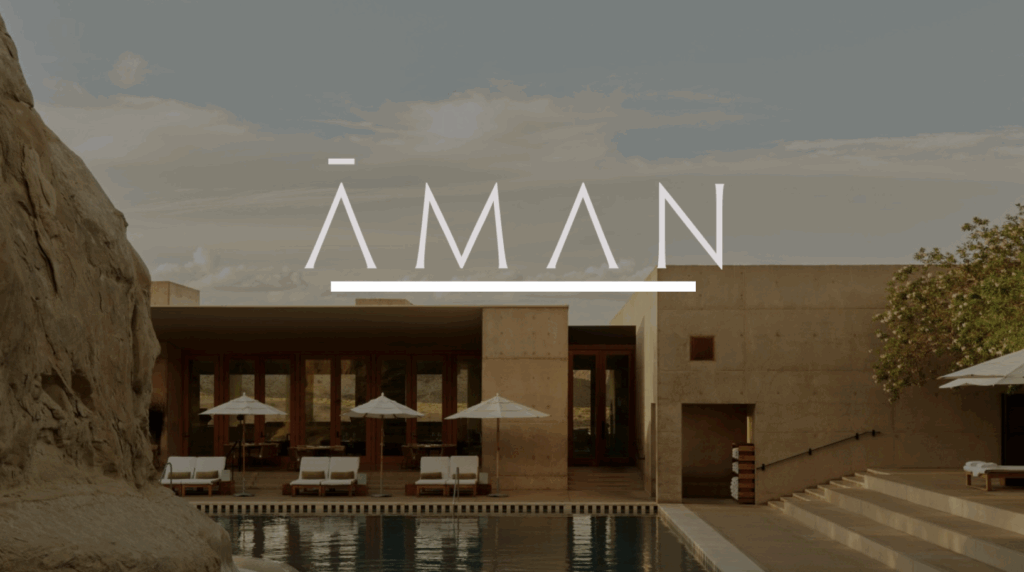
In its quest to build a portfolio of incomparable properties, Aman uses architecture as storytelling. Amansara in Siem Reap reanimated a 1960s villa associated with King Norodom Sihanouk; lacking complete plans, Aman used archival photographs to guide the restoration. At Amangiri, concrete planes frame the desert landscape. At Aman Le Mélézin, Alpine cues take on a warm restraint. In dense cities, Aman Tokyo and Aman New York lift the same quiet choreography into vertical space.
The New York flagship, opened August 2, 2022 in the Crown Building, carries 83 suites and a substantial wellness and dining program – proof the Aman model can scale to an urban context without sacrificing its ethos.
Under Doronin, Aman’s offerings have diversified. In 2020, the company announced Janu – a sister brand to Aman with a more social, energetic posture – and in March 2024, it opened Janu Tokyo in Azabudai Hills as proof of concept. In 2023, Aman Interiors debuted at Design Miami with a Kengo Kuma collection, expanding into residential furnishings, including seating and casegoods, to extend Aman’s material vocabulary into private homes and branded residences. All the while, the company has built out a lineup of products, including apparel, accessories, and homewares, in a bid to fully cater to the desires of its guests.
Finally, Aman New York layers hospitality, a members’ club, and branded residences in a single vertical stack – an apparent template for future urban sites.
Aman’s economics are a study in managed scarcity – fewer keys, higher rates, and guest recognition that aims for an experience that is as bespoke as possible. The membership layer, exemplified by Aman Club in New York, and a robust branded-residence strategy convert affinity into recurring fees and capital-light income streams. Aman Club’s positioning, with a reported six-figure initiation and limited membership, underscores how the brand monetizes time, attention, and atmosphere – with architecture and privacy as collateral for price realization.
Expansion, Controversies & Modern Positioning
The 2014 transaction and subsequent expansion has drawn headlines and increased scrutiny of Aman’s leadership, but the operational focus has largely been one of consolidation: refining a distinct design language, expanding its branded residences portfolio, and entering new markets with precision rather than speed.
The governance challenge is emblematic of luxury’s broader tension: how to scale without diluting the core. For Aman, that means safeguarding its service ethos and architectural integrity while ensuring the corporate infrastructure is robust enough to support a brand whose most valuable asset remains its intangible aura of credibility.
This piece was prepared in collaboration with Jamie Zwirn and Emilie Mentrup.
Share