


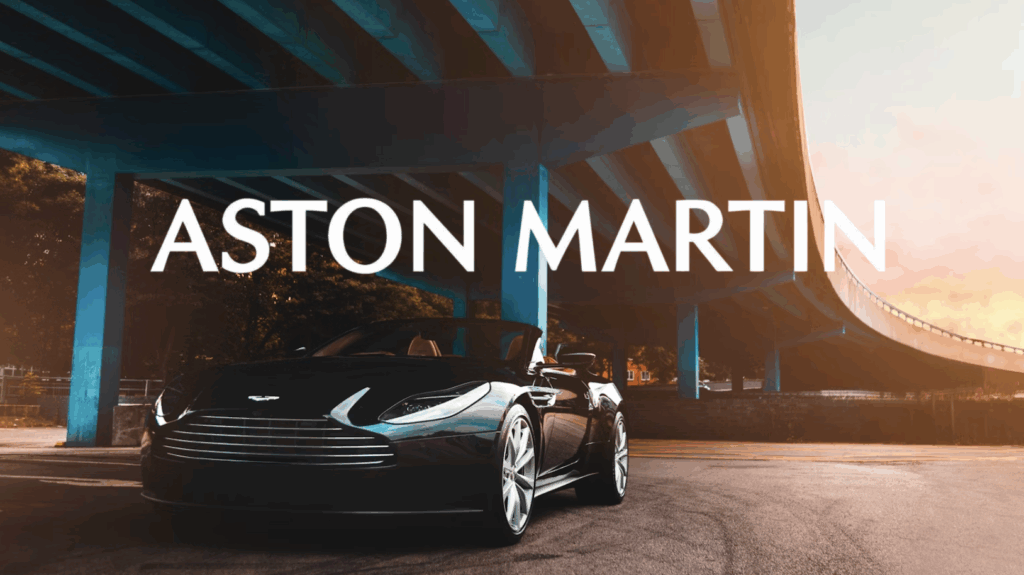
Aston Martin’s story is one of craftsmanship, cultural visibility, and repeated efforts to balance exclusivity with commercial viability. Founded in 1913 and redefined under David Brown’s ownership after World War II, the brand established itself through racing credibility and a clear design identity. Its long-running association with the James Bond franchise helped embed it in global popular culture, giving it a level of recognition few low-volume manufacturers are able to achieve.
But behind the iconic image is a company that has struggled with financial instability, multiple ownership changes, and the challenges of scaling a luxury business. Today, Aston Martin’s strategy blends heritage design with diversification – from SUVs to lifestyle partnerships, all while navigating pressures to protect its identity, manage growth, and maintain pricing power in a competitive market.
Origins to the DB Era: Engineering Ambition Meets Identity
Founded in 1913 as “Bamford & Martin Ltd.” by Lionel Martin and Robert Bamford, the company eventually took on the “Aston Martin” name in a nod to Martin’s hill climb races at Aston Hill, marking an early connection between the brand and performance. Pre-war experiments gave way to real momentum after World War I, with race entries in the 1920s helping Aston Martin to define a house style of light, fast, hand-finished cars. During World War II, the company suspended car production and shifted to manufacturing aircraft components, expanding its workforce to roughly 130 to 160 employees and surviving a bombing of its Feltham works. Capital was persistently thin, and multiple restructurings marked the years during and after the war, but the brand’s core idea hardened early: limited production, a devotion to racing precision, and a willingness to chase elegance alongside speed.
The decisive turn came in 1947 when industrialist David Brown acquired the firm, inaugurating the “DB” lineage. The DB2 (1949) put a modern face on the company, while the DB4 and DB5 models fused Italian coachwork with British engineering in a way that still reads as the template. And racing validated the company’s ethos: in 1959, the DBR1 won the 24 Hours of Le Mans with Carroll Shelby and Roy Salvadori.
Icon and Instability: Bond, Ownership Changes, and the Cost of Aura
All the while, Aston Martin began making waves from a cultural perspective. The silver DB5’s 1964 appearance in Goldfinger did more than sell tickets, it sparked a new type of brand equity. Across six decades of Bond films, models from the DBS to the V8 Vantage to the DB10 refreshed that original association, effectively turning Aston Martin into a visual synonym for British sophistication. The brand’s place in British culture was reinforced by royal enthusiasm as well. The Duke of Edinburgh was a well-known admirer who even brought his Aston Martin aboard the Royal Yacht Britannia, and King Charles’s own Aston Martin DB6, a gift from Queen Elizabeth and Prince Philip, remains one of the most publicized royal cars, including its appearance at the 2011 wedding of the Prince and Princess of Wales.
That cultural capital cushioned – but never erased – the company’s recurring financial fragility. The oft-quoted “seven bankruptcies” shorthand reflects a long record of insolvencies, rescues, and ownership handover for the automaker.
From David Brown’s exit in 1972 to Ford’s stewardship from 1987 to 2007, Aston Martin oscillated between niche artistry and the industrial discipline needed to scale. Under Ford, the DB7 (1994) and Vanquish (2001) modernized the company’s design language and manufacturing approach, proving that platform sharing and craftsmanship could coexist. A Kuwaiti-led consortium acquired the company in 2007, and the brand returned to public markets in 2018 – a high-profile listing that underscored both investor appetite for luxury equities and the volatility of funding low-volume, high-complexity cars.
Modern Strategy: Design, Diversification, and the Second Century Plan
Today, Aston Martin’s product philosophy remains tactile and bespoke – hand-built cars from Gaydon, Warwickshire, with interiors customized like one-offs, not mass-produced parts. From a production POV, the company’s 2015 “Second Century Plan” sought to regularize cadence and broaden the base: DB11 (2016) introduced a fresh design and powertrain era, Vantage (2018) sharpened the sport coupe brief, and DBS Superleggera restored a grand-touring flagship. Most importantly, the DBX SUV arrived in 2020 – a strategic admission that the luxury buyer’s garage starts with a high-riding daily driver – and a necessary revenue stabilizer for a low-volume brand.
All the while, lifestyle extensions have become part of Aston Martin’s strategy as opposed to a side hustle. Partnerships, such as the AM37 speedboat with Quintessence Yachts, a limited-run motorcycle with Brough Superior, selective real-estate developments, and design tie-ups translate the car company’s aesthetic codes into adjacent categories. The aim is coherent halo, not scattershot licensing – to make “Aston Martin” function as a design and materials standard beyond four wheels.
Racing, Governance, and the Road Ahead
Finally, returning to Formula 1 in 2021 re-ignited the competition narrative and furnished a valuable global marketing avenue for Aston Martin. Under Executive Chairman Lawrence Stroll, the team’s presence supports the showroom story, technology transfer, aerodynamic credibility, and a pipeline for talent and partnerships. At the same time, the brand leverages paddock visibility to reinforce its luxury positioning.
In 2024, Aston Martin received a royal warrant from King Charles III, a formal endorsement that linked the brand even more tightly to British heritage and signaled its relevance at the highest institutional levels.
The path ahead is relatively straightforward: Execute electrification without losing tactile identity, keep volumes disciplined enough to maintain pricing power, and align governance to ensure its successful transition from niche heritage brand to modern luxury manufacturer. Hybrid and full-electric models are in development, collaborations with elite partners keep the aura warm, and the brand continues to navigate the central tension of its century-long narrative – how to scale a feeling. If Aston Martin holds its line on production, craftsmanship, and controlled scarcity, it stands to preserve one of its biggest intangible assets: the instant legibility of British glamour at speed.
This piece was prepared in collaboration with Jamie Zwirn and Emilie Mentrup.
Share