

Patagonia and Worn Again Technologies have settled a branding-centric scuffle if a trio of new filings is any indication. In a move to resolve a behind-the-scenes trademark dispute, as exclusively reported by TFL, the companies filed coordinated withdrawals before the U.S. Patent and Trademark Office’s Trademark Trial and Appeal Board (“TTAB”) in a fight centered on Patagonia’s WORN WEAR trademarks and Worn Again’s “WORN AGAIN” marks.
The dispute got its start in 2023, when Patagonia opposed Worn Again’s applications to register the “WORN AGAIN” and “WORN AGAIN TECHNOLOGIES” marks for use on goods and services spanning textile recycling, industrial chemicals, and apparel. Patagonia – which launched its Worn Wear venture as part of its broader sustainability strategy focused on repairing, reselling, and extending the lifecycle of used garments – argued that the marks are confusingly similar to its WORN WEAR mark and could create the impression of an affiliation between the companies or their sustainability-focused initiatives.
Worn Again countered that the marks created different commercial impressions and that “WORN WEAR” is descriptive in the context of reused or repaired apparel.
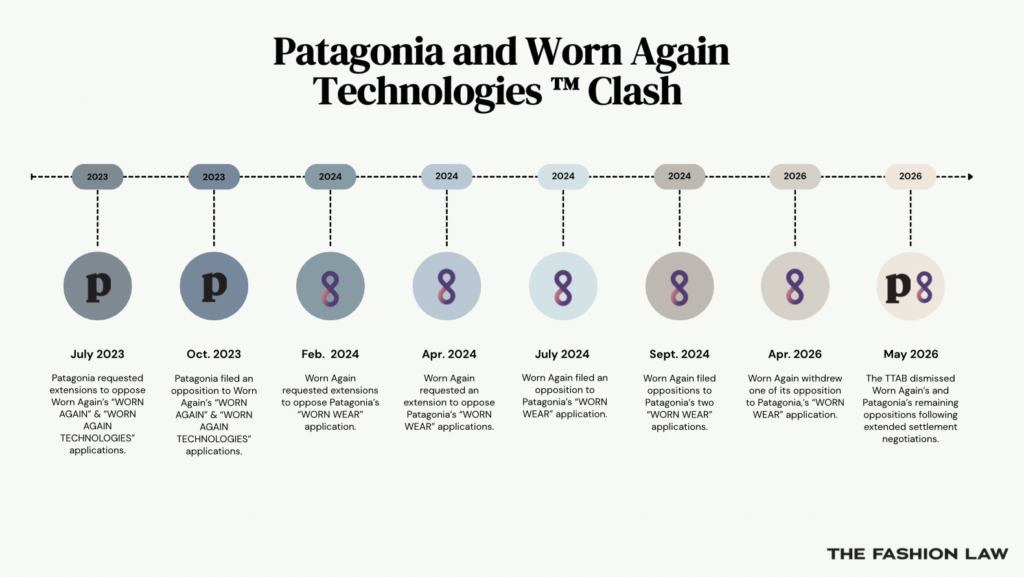
Now, the matter appears to have been resolved. In an April 22 joint filing, Worn Again agreed to delete International Class 25 – the apparel category – from both of its applications, and Patagonia agreed to withdraw its opposition without prejudice, subject to approval of the amendment. At the same time, Worn Again withdrew its own oppositions against several Patagonia WORN WEAR applications, including applications for WORN WEAR and WORN WEAR & Design.
The resolution effectively draws a line between Patagonia’s consumer-facing apparel branding and Worn Again’s textile recycling and industrial sustainability services, a distinction that may become increasingly important as circular-fashion businesses expand and companies compete for rights in sustainability-focused terminology.
THE BIGGER PICTURE: The Patagonia, Worn Again clash is a byproduct a broader shift underway across the apparel industry, where resale, repair, recycling, and circularity initiatives are evolving from ancillary sustainability efforts into increasingly valuable brand assets. As companies invest more heavily in those business models, they are also looking to secure trademark rights in the language associated with them.
That creates an inherent tension: many of the terms that brands want to utilize as indicators of source – particularly words tied to reuse, repair, and “worn” products – are also highly descriptive of the underlying services themselves. The result is a growing wave of conflicts over who gets to control the vocabulary of sustainability.
Against that backdrop, the Patagonia-Worn Again resolution looks like something of a pragmatic coexistence arrangement. Patagonia preserved clearer territory around WORN WEAR in the consumer apparel space, while Worn Again retained room to operate in textile recycling and related technology services, creating a type of boundary-setting that may become increasingly common as circular-fashion branding continues to expand.
Share