


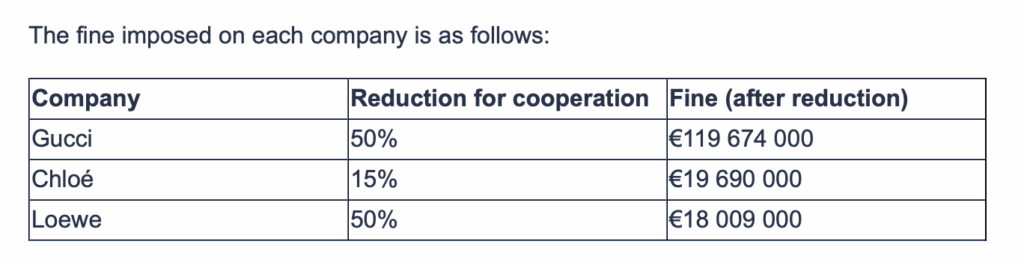
The European Commission is targeting luxury brands in a headline-making enforcement action centering on their attempts to control the retail prices of their wares. The regulator announced on Tuesday that it has fined Gucci, Chloé, and Loewe a combined total of €157.4 million for engaging in illegal resale price maintenance (“RPM”) practices across the European Economic Area. The Commission said that the brands systematically restricted independent retailers from setting their own retail prices, both online and offline, in violation of EU competition rules.
The decision marks one of the most high-profile interventions by EU antitrust regulators in the luxury fashion space and serves as a clear warning to industry players that seek to control downstream pricing under the guise of brand protection.
Resale Price Maintenance Across Europe
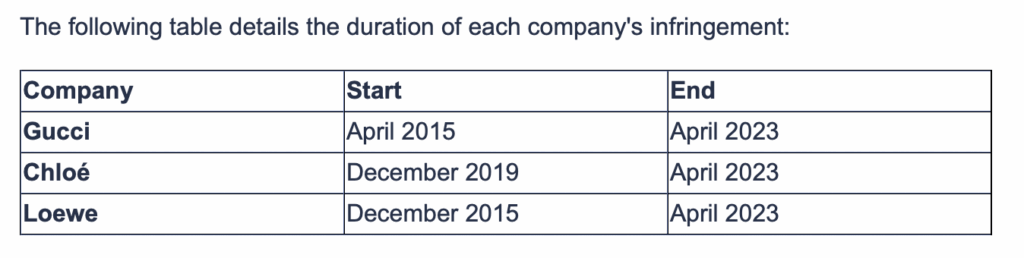
According to the Commission, Kering-owned Gucci, Richemont’s Chloé, and Loewe, which falls under the umbrella of LVMH, implemented vertical price controls designed to maintain premium price positioning across retail channels. The conduct – which spanned nearly eight years in some cases – involved restricting discounts and mandating adherence to recommended retail prices, imposing caps on discounts even during promotional periods, dictating specific sales windows, temporarily prohibiting discounts altogether, and monitoring retailer compliance with pricing rules while exerting pressure when deviations occurred.
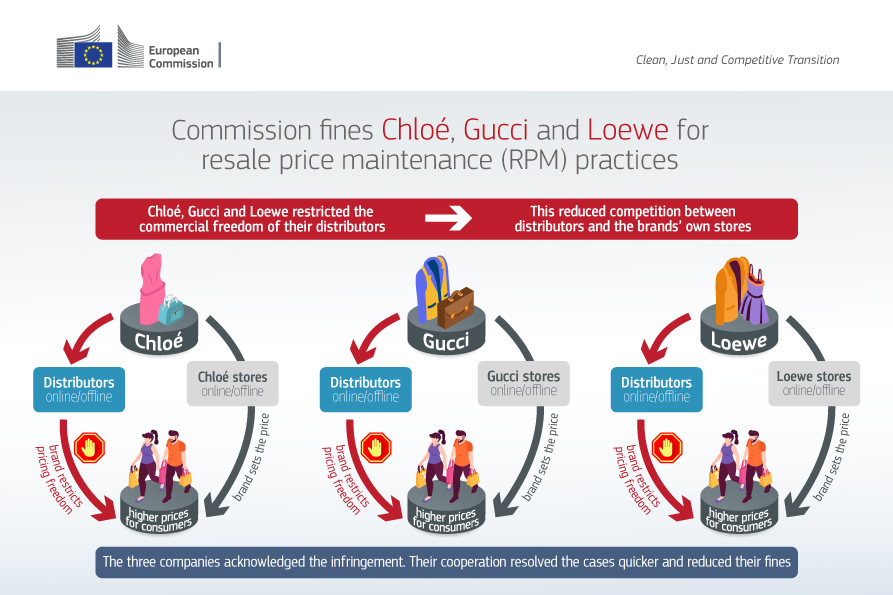
Retailers, many of which stock multiple luxury brands, generally complied either initially or after being requested to do so, according to the Commission, which noted that the practices were in place throughout the entire EEA, covering a wide array of products including ready-to-wear, handbags, shoes, and fashion accessories. The infringements ended in April 2023 following unannounced inspections by the Commission.
“By enforcing resale pricing across their retail partners, these companies effectively eliminated price competition,” said Margrethe Vestager, Executive Vice-President in charge of competition policy. “This behavior undermines both consumer choice and market fairness.”
Independent but Parallel Conduct
While the three fashion houses acted independently, their actions shared striking similarities. Each case was treated separately, yet all three involved restrictive practices within the same high-end segment and overlapped in duration. Many of the affected retailers stocked products from all three brands, amplifying the market impact of the practices.
In Gucci’s case, the Commission also found evidence of online sales restrictions, including instructing retailers to cease selling a specific product line online – a clear violation of the bloc’s e-commerce and competition framework. Gucci’s cooperation was particularly instrumental, with the company voluntarily disclosing conduct that was previously unknown to the Commission. Loewe’s cooperation helped expand the temporal scope of its own infringement. All three firms acknowledged the facts and their liability, facilitating a more efficient resolution.
The fines were calculated using the Commission’s 2006 Guidelines on fines, factoring in the gravity, duration, and geographic scope of the infringements, as well as the value of the sales affected. Importantly, all three companies received fine reductions for cooperating under the Commission’s antitrust cooperation procedure, a relatively new mechanism inspired by the cartel settlement model.
Legal Framework & Industry Implications
The decisions are grounded in Article 101 of the Treaty on the Functioning of the European Union and Article 53 of the EEA Agreement, which prohibit agreements that restrict competition. The Commission concluded that the conduct of each company constituted a single and continuous infringement over the respective periods.
These decisions underscore a growing regulatory focus on vertical restraints in luxury retail, particularly as brands seek to reconcile price integrity with digital decentralization. The Commission’s action sends a clear message – luxury branding does not confer a license to fix prices.
Aside from reputational impact, Gucci, Chloé and Loewe may face civil damages actions from retailers or consumers under national laws. The Commission’s decisions, once final, serve as binding proof in such proceedings.
Luxury brands are also now on notice that monitoring and disciplining retailers for pricing decisions – especially in online channels – can lead to significant liability under EU law. These cases may also prompt compliance overhauls across the industry, particularly in pricing and distribution policies.
The Bigger Picture
While resale price maintenance is often rationalized by brands as necessary to maintain prestige or brand image, EU competition law does not allow for such justifications when they result in reduced price competition. The luxury fashion market, long reliant on tightly curated distribution and brand-centric control, must now reconcile its aesthetic values with an evolving regulatory landscape.
The crackdown comes on the heels of reports that the European Commission was engaged in a probe that reportedly centered on how fashion brands set prices for distributors and particularly, whether they pressure multi-brand retailers to comply with set consumer prices by threatening to cut off supply. The investigation, first revealed in April 2023 following unannounced raids on several fashion companies’ headquarters. Kering confirmed at the time that it was under review as part of what the Commission described as a preliminary investigation into possible violations of EU antitrust rules.
As the Commission ramps up enforcement in the sector, luxury brands are facing a new reality – one in which their traditional pricing strategies are increasingly incompatible with EU competition law. In other words, the era of quiet price control through “suggested” retail terms may be coming to an end.
Share