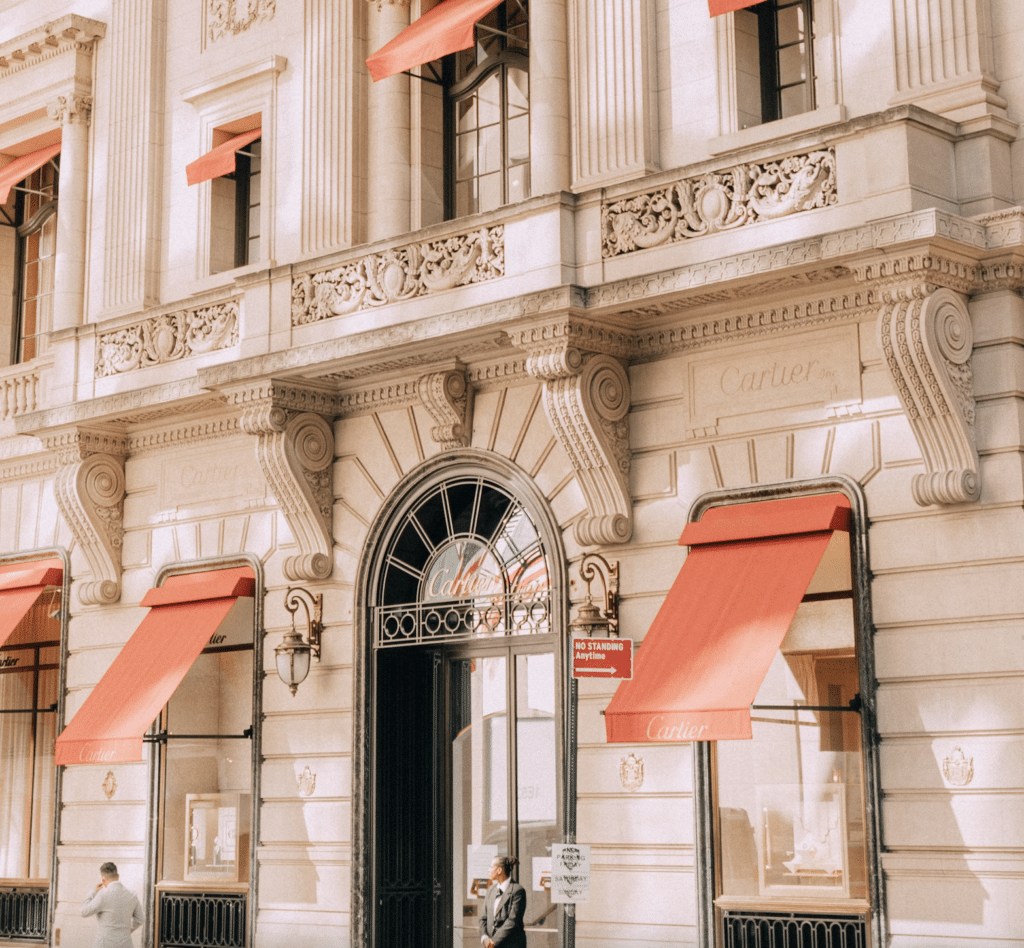
Richemont, the Swiss conglomerate now known for its dominance in the luxury goods segment got its start not in high-end watches or expensive jewelry but in tobacco. In 1941, Anton Rupert took £10 and funds from two investors and Voorbrand Tobacco Company was born to manufacture tobacco in South Africa. Rupert “had a gift for marketing, his company flourished and within less than a decade he had formed the Rembrandt Group.” With an eye on diversification, the budding entrepreneur amassed stakes in the financial services, wines and spirits, and the gold and diamond mining industries, as well as other tobacco companies, including Rothmans, the famed English tobacco entity.
The transformation of Rembrandt into the luxury-focused Richemont started in 1968 when Robert Hocq, the owner of Silvermatch lighter company, explored a buyout of Cartier alongside a group of investors. An offer from Rupert is said to have stood out: He was angling to acquire a 20 percent stake in Cartier America in exchange for a license to produce Cartier-branded cigarettes. When Hocq was killed in a car accident in Paris in 1979, Rupert acquired a majority stake in Cartier and consolidated its divisions from France, the United Kingdom, and the United States into one entity.
The establishment of Richemont as a luxury player was cemented in 1988 by way of the spin-off of group’s assets into two companies: the Switzerland-based Richemont, which grouped the Rothmans and Dunhill operations together, and the South African-based Rembrandt, which controlled the other holdings.
Against that background, here is a look at the timeline behind the building of Richemont into one of the world’s most valuable luxury goods conglomerate …
1993: Cartier
Rothmans International, Dunhill Holdings, and their Swiss-based parent company Richemont agreed on a restructuring plan to separate their tobacco and luxury goods businesses. The newly formed Vendôme Luxury Group, initially 70 percent owned by Richemont, comprised Cartier and the Dunhill luxury goods businesses, including Montblanc and Chloé. Through Cartier, Richemont also acquired Baume & Mercier and Piaget.
In January 2026, Richemont announced it would sell Baume & Mercier to Damiani Group.
1996: Vacheron Constantin
Vendôme expanded its watchmaking portfolio by acquiring Vacheron Constantin, one of the oldest Swiss watch manufacturers.
1997: Officine Panerai
Vendôme acquired Officine Panerai, the Italian high-precision watchmaker.
1997: Lancel (Exited)
Vendôme acquired French leather goods maison Lancel. In 2018, Richemont sold Lancel to Piquadro, fully exiting the brand.
1998: Vendôme Luxury Group
Richemont acquired 100 percent ownership of Vendôme’s luxury goods interests by buying out its minority shareholders.
1998: Shanghai Tang (Exited)
Richemont acquired a majority stake in Shanghai Tang. In 2017, the group sold the company to an entity controlled by entrepreneur Alessandro Bastagli, exiting the brand.
1999: Van Cleef & Arpels
Richemont acquired a 60 percent stake in Van Cleef & Arpels in 1999. It increased its holding to 80 percent in 2001, and in 2003 acquired the remaining shares, bringing the maison into full ownership.
2000: Jaeger-LeCoultre, IWC, and A. Lange & Söhne
Richemont acquired Jaeger-LeCoultre, IWC Schaffhausen, and A. Lange & Söhne, strengthening its position in vertically integrated haute horlogerie. In 2003, Richemont acquired the remaining 10 percent of A. Lange & Söhne, achieving full ownership.
2002: Net-a-Porter/Yoox-Net-a-Porter (Exited)
Richemont entered luxury e-commerce in 2002 with a 30 percent stake in Net-a-Porter. By 2010, it had increased its stake to over 90 percent. In 2015, Richemont merged Net-a-Porter with Yoox to create Yoox Net-a-Porter. In 2018, Richemont acquired full control. In 2024, Richemont agreed to transfer 100 percent of YNAP to Mytheresa in exchange for a 33 percent minority stake, effectively exiting operational control of online retail.
2006: Fabrique D’Horlogerie Minerva SA
Richemont acquired Fabrique D’Horlogerie Minerva SA, an entity that specializes in the development and manufacturing of high-end mechanical movements.
2006: Greubel Forsey (Exited)
Richemont entered a long-term partnership with Greubel Forsey, initially acquiring 20 percent. Richemont sold its entire 20 percent minority stake in March 2022. The stake was sold back to the brand’s founders, Robert Greubel and Stephen Forsey, alongside chief executive officer Antonio Calce. Financial terms were not disclosed.
2007: Maison Alaïa
Richemont acquired an interest in Maison Alaïa, the Parisian fashion house founded by Azzedine Alaia.
2007: Manufacture Roger Dubuis SA
Richemont acquired component manufacturing operations of Roger Dubuis in 2007 and a 60 percent stake in the maison in 2008, later achieving full ownership.
2007: Donzé-Baume SA
Richemont acquired watch case manufacturer Donzé-Baume SA.
2007: Ralph Lauren Joint Venture
Richemont entered a watchmaking joint venture with Ralph Lauren, combining Richemont’s technical expertise with Ralph Lauren’s brand.
2012: Varin-Etampage & Varinor SA
Richemont acquired 100 percent of Varin-Etampage & Varinor, a specialist in stamped exterior components and precious metal processing.
2012: Peter Millar
Richemont agreed to acquire U.S. luxury apparel brand Peter Millar in September 2012 from Winona Capital Management.
2017: Serapian
Richemont acquired Serapian, an Italian producer of leather goods and former leather supplier to Cartier and Dunhill.
2018: Watchfinder.co.uk Limited
Richemont acquired Watchfinder.co.uk Limited, an e-commerce site that buys and sells luxury watches.
2019: Buccellati
Richemont acquired Italian jewelry brand Buccellati from privately held conglomerate Gangtai Group Corporation Ltd. for an undisclosed amount.
2019: AZFashion (Shuttered)
Richemont launched AZFashion with designer Alber Elbaz. Following Elbaz’s death in 2021, the venture continued briefly before being wound down in 2023, with no ongoing operations.
2021: Delvaux
Richemont acquired Delvaux, the world’s oldest luxury leather goods house
2024: Gianvito Rossi
Richemont acquired a controlling 70 percent stake in Gianvito Rossi, one of the world’s leading luxury shoe Maisons.
2024: Vhernier
Richemont acquired Vhernier, the distinctive Italian jewelry Maison, in a private transaction.
Share