

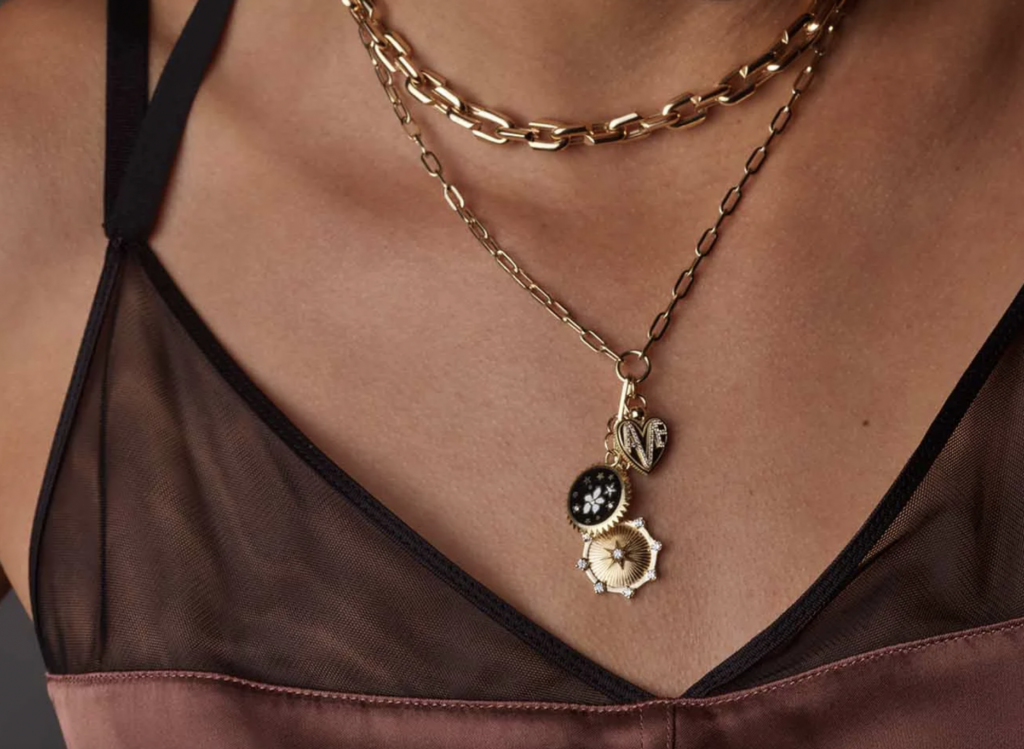
Luxury jewelry label FoundRae is taking on Pandora in a copyright case over jewelry designs that allegedly mirror its signature medallion aesthetic. In an opposition to Pandora’s motion to dismiss, which FoundRae filed in the Southern District of New York on May 4, FoundRae argues that Pandora unlawfully copied two of its signature medallion designs as part of Pandora’s 2025 “Talisman Collection,” rejecting Pandora’s effort to characterize the contested motifs as generic – and unprotectable – symbols drawn from the public domain.
At the center of the dispute are FoundRae’s “Passion” and “Balance” medallions, which the New York-based jewelry company says it secured federal copyright registrations for in 2021 and 2023, respectively, before Pandora launched its allegedly infringing pieces in August 2025.
Going Beyond Generic Symbols
The case reflects a broader tension in fashion and jewelry law: where courts should draw the line between unprotectable ideas and protectable artistic expression. Pandora’s dismissal argument, as set out in its April 20 motion to dismiss, rests heavily on the claim that symbols like crossed arrows and sun-and-moon imagery belong to the public domain and therefore cannot be monopolized by a single brand. FoundRae, however, contends that it is not seeking ownership over the symbols themselves, but over the specific arrangement, styling, and composition embodied in its medallions.
That distinction is critical, particularly in the Second Circuit, according to FoundRae, where “a plaintiff may claim protection in combinations of elements, as well as the unique selection and arrangement of those elements – even if each constituent element is not original in and of itself.” In its brief, FoundRae points to precedent involving rugs and jewelry to argue that originality may arise from the “selection, coordination, and arrangement” of design features rather than from entirely novel components.
In its opposition, as first reported by TFL, FoundRae also pushes back on Pandora’s contention that the medallions are entitled only to “thin” copyright protection requiring near-identical copying, arguing instead that the designs contain sufficiently original expressive arrangements to warrant broader protection.
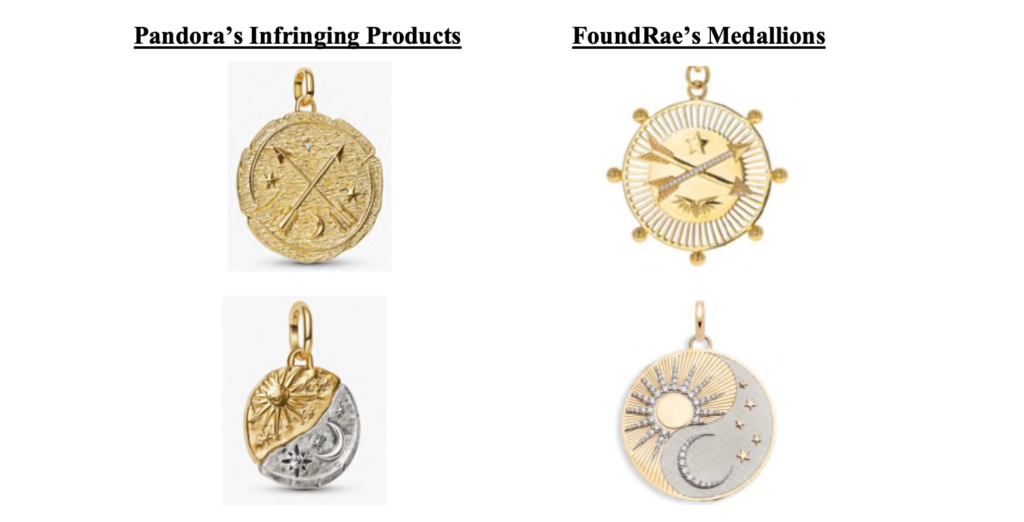
FoundRae relies on copyright law’s longstanding “total concept and feel” framework for substantial similarity, under which courts assess whether the protectable expressive elements of two works are sufficiently alike even absent exact duplication. FoundRae argues that Pandora appropriated the distinctive visual compositions of its medallions – including the yin-yang-style division of the “Balance” design and the crossed-arrow-and-star arrangement of the “Passion” medallion – closely enough to constitute substantial similarity. The company asserts that Pandora improperly attempts to dissect the designs into isolated, unprotectable elements rather than evaluating their cumulative expressive effect.
Notably, FoundRae’s allegations extend beyond the medallion designs themselves. In its filing, the company claims Pandora also emulated elements of its broader merchandising and storytelling strategy, pointing to Pandora’s collage-style campaign imagery featuring photographs, notes, and keepsakes, as well as marketing language emphasizing personal narratives and heirloom-oriented storytelling.
Those allegations aim to bolster FoundRae’s broader contention that Pandora did not merely arrive at similar jewelry designs independently but instead sought to emulate the brand’s broader aesthetic identity and storytelling-driven approach. More broadly, the case reflects how luxury brands are increasingly seeking protection for broader aesthetic “worlds” encompassing symbolism, merchandising, and storytelling.
FoundRae argues that Pandora’s motion to dismiss should be denied and that the case should proceed to discovery. One immediate stake is whether FoundRae will gain discovery into Pandora’s design-development process and marketing strategy. In the alternative, the company asks the court for leave to amend its complaint if any deficiencies are identified.
THE BIGGER PICTURE: The outcome may prove significant for independent luxury brands increasingly competing against larger companies that can rapidly commercialize niche aesthetics at lower price points. At the same time, the litigation highlights the tension between protecting distinctive creative expression and preserving room for trend adoption and iterative design in fashion and jewelry markets. If the court allows the case to proceed past the pleading stage, discovery could provide a closer look at how inspiration, trend adoption, and internal design development operate within the contemporary jewelry industry. More broadly, the litigation may help shape how far symbolic and heritage-inspired jewelry motifs can be protected once they are transformed into recognizable brand signatures.
Share