

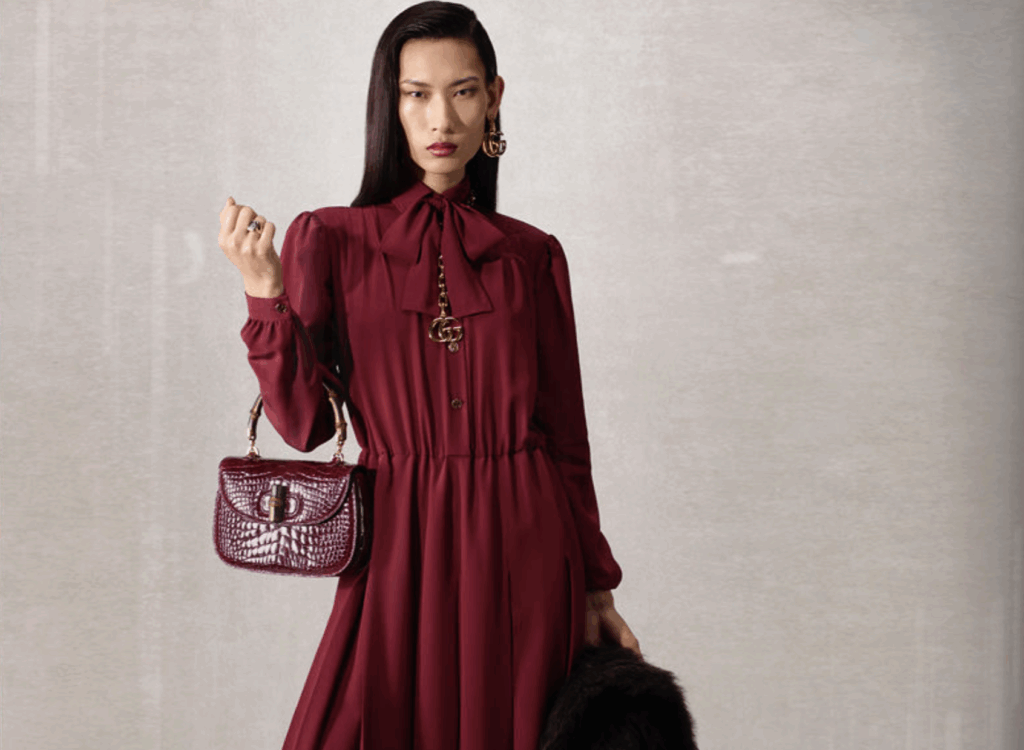
Kering posted a mixed third quarter. The group reported revenue of €3.4 billion ($3.95 billion) for the three months ending in September, down 5 percent on a comparable basis, marking a sharp sequential improvement from Q2’s 15 percent decline but still trailing the broader market. By brand, Gucci fell to €1.34 billion (−14% comparable) as retail declined 13 percent, but momentum improved in North America and Western Europe and new Leather Goods resonated; Yves Saint Laurent delivered €620 million (−4%), with a return to growth in North America, and double-digit gains in ready-to-wear and shoes.
Bottega Veneta proved resilient at €393 million (+3%), and Other Houses totaled €652 million (+1%), with better trends at Balenciaga, a moderated decline at McQueen, continued strength at Brioni, and double-digit jewelry growth. For the first nine months, revenue was €11.0 billion (−12% comparable).
Reflecting on a “series of bangs in the form of highly rated fashion shows and presentations,” Kering CFO Armelle Poulou pointed to Demna’s La Famiglia collection and its presentation through a short movie, Tiger, which “reimagine Gucci’s codes through a modern-day prism,” Louise Trotter’s “subtle reinterpretation of the intrecciato motif and other house codes resonated strongly with audiences” at Bottega Veneta, and Pierpaolo Piccioli “balancing [of] couture craftsmanship with modern designs and accessories” at Balenciaga.
An array of questions from the Q3 earnings call with Poulou and Kering COO Jean-Marc Duplaix are as follows …
>> Chiara Battistini (J.P. Morgan): On North America, there was a particularly strong read across the board, not just for one single brand. Can you give us more color? Can you talk a bit more about what you’ve seen with the American consumer throughout the quarter between trust and conversion, and also whether you’re seeing new consumers coming, young Americans and maybe aspirational consumers coming back, or rather the high-net-worth individuals and returning customers across the different brands?
Poulou: On North America, we had a sequential improvement that occurred across the board, much beyond the compares. Happy to see Saint Laurent and Balenciaga back to growth, and Bottega Veneta confirming a very strong momentum in the region. In terms of consumer, traffic is improving, but the growth is also helped by the fact that the AUR is going up through mix. In terms of customers, I would say still a good resilience of the high-end customer, but also maybe some good performance on the e-commerce that is generally a channel where we see more aspirational customers.
Duplaix: That being said, we had started the process of optimizing the structure of our balance sheet that we will not give up in the sense that, as I said, we continue to work on the refinancing of the real estate, which was something already as an ambition when we bought the assets two years ago. Nothing’s changed on that side. When it comes to the portfolio, I want to be very clear. We’ll review, of course, in a very open manner, as we always did, the relevance of the assets we have in the portfolio. I want to be clear that when it comes to Kering Eyewear, because I read some articles on that, Kering Eyewear is a core in the strategy of Kering, is doing extremely well, is the leader on its segment. You can see that the performance in Q3 was more than robust.
We are very pleased with the investments we have in Kering Eyewear, which is instrumental in the development of the group. Beyond the portfolio, when it comes to the savings, we are working on with, under the helm of Armelle, who is doing a brilliant job on that front. To be honest, as I said, we keep the pace because the idea is not to cut the muscle or to touch the muscle, but it’s really to be sure that what we are doing and where we are investing, it’s always bringing results and return. There is no reason to stop there. I think it’s really a good window for us in this period for the industry and for the group to continue this work of streamlining the organization to chase for the maximum of efficiency.
>> Edouard Aubin (Morgan Stanley): It looks like there was some gradual improvement during the quarter in terms of the trends. If you could comment on that in terms of September and what you’ve seen so far in Q4 in the Golden Week, that would be question number one. Just to come back on the sale of the beauty unit to L’Oréal, just to talk numbers to the extent you will be willing to share any.
I think some of the players have indicated that the cosmetic sales of Saint Laurent is about EUR 3 billion versus Gucci at about EUR 500 million. It looks like there is a really huge opportunity there to grow the business. When you look at that, should we be aware of any fundamental structural reason why Gucci in the medium to long-term cosmetics business should not be more or less the same size? Obviously, Saint Laurent has a bit more heritage there in terms of perfume and cosmetics, but that would be one.
The last one, which is quite important and maybe the most sensitive, is for the investors to judge about the merit of the transaction. Obviously, it would be helpful to understand what type of royalty fees are going to be paid by L’Oréal. I think the industry norm is about high single digit to maybe sometimes 10% of sales.
Again, I don’t know what you’re going to be willing to share, but if you can just give us a little bit more color in terms of the structure of the deal. I understand that Saint Laurent, the fees are substantially lower than that today that you’re getting from L’Oréal.
Poulou: September performance was in line with the quarter. July was weaker, but it was a month with the first conveys. August was the best month, and then September was in line with the average of the quarter. You know, in terms of current trading, it’s very early in the quarter. I’d like also to remind you that the conveys in Q4 is much sharper than in Q3. That being said, retail trends in key regions are in line with Q3 but be mindful that October shows the easiest comparison base in the quarter.
Duplaix: When it comes to the size or the potential size of the beauty business for our brands, this business should encompass, at the end of the day, if you look long-term, fragrances, makeup, and to a certain point, the more mature the brand is, skincare. Of course, I cannot disclose any figure. I think that maybe you got some figures from L’Oréal management. It’s true that we consider that if you look at the profile of the luxury brand, I will say that we know that the beauty category, if we think in terms of retail price or penetration of the market, should be higher than the one we have currently or that we had historically for Bottega Veneta and Balenciaga.
That’s the reason why we decided to repatriate these brands and to internalize the business with the success we know because, you know, you may remember that we had very successful launches, and we are very pleased with what has been done so far by Kering Beauté. We can imagine also that Gucci brand would deserve … a higher penetration on that segment, especially if you look at the ranking of the fragrances in different geographies. I think we need to develop more of this business across the board for our brands and that’s the rationale behind the transaction with L’Oréal. For sure, I think all the brands, relative to their respective size, have the potential to grow quite massively, with, of course, an incremental level of royalties for us.
As your last question, as we always did with Coty, being very careful about not disclosing any contractual obligations, we will not disclose what is the content of the contract we signed with L’Oréal.
>> Oliver Chen (TD Cowen): You mentioned early signs in handbags and also carryover. What are the early signs you’re seeing? Can you accelerate the flow? You’ve done that in the past in terms of working very quickly there. My second question is on traffic. Is traffic continuing to be fairly volatile? Given that Tiger was such a success, should we expect traffic to get better? It sounds like you’re doing a great job with AUR and managing conversion very well. Third, in your prepared remarks, you mentioned reduced sensitivity to cycles. I would love for you to let us know what you mean there, in terms of, you know, we’ve seen so many cycles between hard luxury and softer luxury, as well as thinking about aspirational.
Poulou: Regarding handbags, you know that we’ve done a lot of work since the end of 2024 by reintroducing many new lines in the offer at Gucci, but also at Saint Laurent. The performance that we have on newness in handbags is very positive. We’ve been suffering from the underperformance of carryover that was offsetting the very good performance of the newness. We are on handbags coming to a point where it equals, and we are very happy to see the performance of the handbags at Gucci stabilizing this quarter. There will be, of course, a lot of new introductions in Q4. You know some of them that you’ve seen during the cruise show in France, and of course, some other in 2026. The trend is very positive. In terms of %, you know in the mix, you have some seasonal effects.
At the moment, I would say in handbags, at the end of September, we were at more than 60% of the sales in handbags were coming from newness. Of course, the newness from last year is now feeding the carryover base. Regarding traffic, traffic improved sequentially during the quarter. It’s still largely impacted by Japan and APAC.
>> Oliver Chen (TD Cowen): One quick follow-up on mainland China customer. How would you characterize what you’re seeing now? Are you encouraged in terms of rays of light and stabilization, just color on what you think is happening in that dynamic market?
Poulou: Consumer spending in mainland China is still not very supportive, but we are seeing some sequential improvements. We are working on the product offers, the retail network, and things are progressing. Of course, we will continue going into Q4 and next year. Things are going in the right direction. We are seeing still some polarization in the customer, but we are progressing in the right direction.
>> Anne-Laure Bismuth (HSBC): I have three questions, please. The first one is on Gucci. The Demna presentation and film is very U.S.-centric, it seems. Do the Chinese react to it? Maybe if you can comment about the performance of Gucci during the Golden Week. My second question is about the wholesale performance. What could we expect by year-end for all the brands, and should we see a further decline in wholesale next year, or … stabilize as we have done most of the rationalization of the doors? Finally, concerning Balenciaga, the recent Balenciaga stores are big and Demna-driven, and as a consequence, not in line with the new direction of the brand, given the limited financial means, or will you prioritize the CapEx allocation?
Poulou: Regarding La Famiglia, you know it was presented in 10 stores all over the world in every region. It’s true that we had a very good response in the U.S., but also in Europe, and also to mention in Japan, especially with local Japan press. We have already a pretty good response in China, maybe not with us to the same extent as the very strong one we had in the U.S.
Regarding the Golden Week, you know, consumer spending is not very supportive in mainland China. Overall, this year’s Golden Week is not changing the picture, even if some brands are posting better results than last year. For wholesale, we are confirming our indication that wholesale should decrease by EUR 350 million … For next year, we expect wholesale to stabilize as we have done most of the rationalization of the doors. Of course, it always depends on the dynamic of the wholesalers themselves.
Regarding potential bond buybacks, we will, of course, and the management of the cash inflow. Of course, first, it’s written on our balance sheet. We will balance between cash investment and potential buyback of some bonds, trying to be smart but also always very mindful of our liquidity profile.
Duplaix: Maybe a word on the store footprint of Balenciaga. In recent years, we have enlarged on average, the stores of Balenciaga. First of all, nothing is changing regarding the categories that we have at Balenciaga. It will remain, in any case, a brand with ready-to-wear, leather goods, footwear, with a good proportion of men and women in the collection. When it comes to the size, I’m not particularly worried. When it comes to the denim aesthetic, you see, first of all, that in the first show, there was Pierpaolo, there was a bridge, in a way, with what was the aesthetic of denim. It was a good combination. We don’t plan a short-term major reshuffle of the network. All the stores have not exactly the same magnitude in terms of aesthetic.
We have already tested some mockups where, obviously, just the addition of a few things and also some painting, additional painting, things like that can easily create an environment that would be very consistent with the new collection. Here again, we don’t expect a jump in terms of CapEx on that side. As usual, with Armelle and under the helm of Luca, we will have a global arbitration at group level of the CapEx to be sure that we have to do, we invest rightfully in the right places and especially at the right pace.
>> Charles-Louis Scotti (Kepler Cheuvreux): On the denim first collection … rolled out globally in January, could you remember, also, you mentioned in the past, capsules for Christmas and Chinese New Year, as well as the cruise collections before the presentation of fall-winter 2026, end of February. If I’m not mistaken, could you please update us on the coming pipeline at Gucci? Secondly, the deal with L’Oréal includes a joint venture as well on the longevity, health, and wellness. L’Oréal already gave us some details yesterday about it. Could you tell us more about this joint venture? Is this part of a broader move towards a more experiential luxury, which seems to be gaining a lot of momentum now? Third question, regarding your beauty licenses for Bottega Veneta and Balenciaga.
You previously had a very selective approach in terms of distribution, which obviously mechanically limits the development potential. This is not, I guess, L’Oréal’s strategy, even for the couture brands, except for the private collections. Are you now more open to adopting a maybe less selective strategy that will allow the business to scale up more quickly?
Poulou: The denim collection will be distributed in stores as of January, 2026. In Q4, there are many initiatives at Gucci. We just introduced a new sneaker, the Gucci Shift. There is also the cruise show collection that is arriving in store in November. Of course, there will be plenty of capsule and animation in December for the Chinese New Year and more generally for the holiday season. That will be amplified by some campaigns. There is already a campaign that you’ve seen probably on the new Shift sneaker on digital. There is also a campaign on the ski altitude. There will be, of course, the Gucci Shift campaign at the end of the year as it happened last year.
Duplaix: I think we are convinced on both sides that definitely there is an opportunity in that segment of wellness, longevity. It’s true that it has to do with how luxury experience can expand in different categories, in different areas. We see that today, the high-net-worth individuals and many top clients of our brands are reallocating wallet also to experience, resorts, travels, restaurants, and also wellness and longevity, which has become clearly a topic for the billionaires and high-net-worth individuals. Yes, definitely, we are at the early days of this joint venture. We are convinced that, of course, the idea for us is not to work on products because it’s really the expertise of L’Oréal. I think there are a lot of R&D in that area
For us, it’s more about finding some synergies, bringing also our capacity to find locations in the city, outside of the city, to create an environment which does correspond to the expectations of these clients, to work on our CRM and database with the top clients we have. This is really what we are targeting, to really provide … a unique experience, mixing wellness, care … with a luxury experience. We believe this is a market which is very fragmented, on which there is an opportunity probably to consolidate and to be with this joint venture a major player, considering that our two groups are global and the capacity to enter in the main cities in the world and also to provide unique experiences.
When it comes to Balenciaga and Bottega Veneta, your question is a good one. I think the plan, you know, that historically, these two licenses of these two brands have been completely under-exploited in the beauty category. We had to rebuild credibility, and we started by launching these niche products, these niche fragrances, very elevated in terms of quality, in terms of price. It was a way to reestablish the credibility of these brands in the beauty segment. Clearly, the plan for Kering Beauté, especially for Balenciaga and to a certain extent to Bottega Veneta, but the positioning of the brands are slightly different. The idea was at a point, once we had started to be credible again, to go down to the prestige segment with a broader distribution, with the usual suspects in terms of distribution. It was part of the game.
If I come back to the rationale of the joint venture, of the deal with L’Oréal, clearly, the idea is that, of course, we can scale up that business more rapidly. We are very pleased if we could accelerate the development of these two brands, but starting with Balenciaga in the more prestige segment, considering that, of course, we will, and that was some of the discussions we had with L’Oréal. Of course, we want to keep an offer which is very elevated for the top clients and also to have some fragrances in our stores.
>> Carole Madjo (Barclays): To come back on the first question being on Gucci, can you help us understand a bit more what should be the position of Gucci going forward? I guess to come back on the point you mentioned before, you talk about trying to reduce cyclicality, about being a bit more exposed to the high-end consumer. Then talk, I think, about being a bit more exposed towards minimalism at Gucci when he does his first fashion show in February. Can you just help us envision what could be the new Gucci in terms of pricing point, brand aesthetic, and positioning going forward?
Second question, just to come back also on the jewelry side in the other houses, which I think has been quite solid for the past few quarters now, can you remind us how big jewelry, so the Boucheron and Pomellato brand mostly, count for now in this division? What kind of potential do you see for these, for those brands, going forward?
Poulou: Your question on Gucci is an interesting one. I think it will be part of probably a larger strategic update that Luca and the team will give during the CMD in the spring. What I can tell you at this stage, going back to La Famiglia presentation as an example, it was very positive to see that the looks that Demna presented were large in their style, in the categories. I think it was showing how diverse and rich the Gucci brand can be and very true to the DNA of the brand. Regarding jewelry, I can just mention that if I look at last year, the turnover of our jewelry brands … was around EUR 1 billion.
>> Luca Solca (Bernstein): When you look at the retail dynamics going forward, so the retail network being trimmed and potentially space being reduced, would that go hand in hand with rental costs also being reduced? I doubt that because most likely you would be closing tail stores and you would be beefing up flagship and prime locations. I just wanted to be sure what you thought about this. Maybe a more general question on the EBIT consensus that you see. There’s been many moving parts, the reacceleration over the summer and the cost efficiency program continuing. I wonder if you want to touch base on that guidance that you provided or if not.
Maybe more of a blue sky question on Armani. You’re obviously focusing on your own business and on improving it organically, but you haven’t been shy, for example, with the Valentino acquisition to play a protagonist role in consolidating some of the most important Italian fashion brands. I wonder if this is on your radar screen at all and if we could envisage down the road a role for you, especially in a scenario where L’Oréal could potentially try an Estée Lauder deal, that is buying the brand for the beauty business and licensing out the fashion and leather goods business as in the case of Tom Ford, was done by Estée Lauder with Zegna.
Duplaix: We don’t streamline the network just for the sake of making some savings on the rental cost. The idea is just to be sure that we have the right setup brand by brand. I think that there was a wave of utilization in the past few years, which was made across the board. For all the brands, I think all the brands are not in a situation because of the size, because of the product categories, in a situation to be at 80% or 90% retailized. If I think about Brioni or McQueen, these are brands which probably need to rebalance a little bit between wholesale and retail. I would not say the same for the other brands where there is still the ambition to have predominantly a retail distribution.
The idea is just to be sure that we have the right setup and that we don’t multiply the number of points of sale in a city, that we keep the most efficient one and that we are able to increase the sales density. We have to be very lucid and we are very candid on this. The problem of the group is not so much about the rental cost … it’s more about the sales density. The purpose for us is, of course, to have the right setup. When there is an opportunity to renegotiate a rental or the rent, we will do it. Part of the game also in this reshuffling of the network is also to create the conditions to renegotiate some rent. The ambition is, first of all, to maximize the efficiency of the network, to reignite the top line, as we said before.
On the outlook for this year, I gave already a lot of moving parts regarding top line, gross margin, and OpEx. Maybe what I can flag additionally is that, if foreign exchanges remain at current level, the drag on Q4 reported sales will be higher than the one in Q3. For the rest, I think I gave you already a lot of information.
About your last question, you can imagine that it’s premature to comment. Also, you know, we have just signed a deal, which was very important for us. We have the Valentino brand in the radar going forward, even if we have postponed the exercise of the options. Still, there will be a need at a point to integrate the brand. We have a lot of challenges in our brand. I think our plate is quite full so far, and the priority for us is to work on the action plan that Luca is giving to us and to the brands. It’s not a consideration we have so far about Armani. We will see what will happen with the different players that have been listed in the testament of Mr. Armani.
Share