

Mass lawsuits targeting online sellers have become an increasingly prominent feature of anti-counterfeiting enforcement. Known as “Schedule A” litigation, these actions allow trademark owners to pursue dozens – or even hundreds – of online sellers in a single case. Rather than naming each defendant in the case caption, plaintiffs often identify them in a Schedule A filed under seal and seek ex parte temporary restraining orders, asset restraints, and other expedited relief before the defendants receive notice of the action. This enables plaintiffs to obtain restrictions on assets and online storefronts before targeted sellers have a chance to take evasive action.
The procedural speed and cost efficiency of the Schedule A model have made it a prominent tool for online anti-counterfeiting enforcement for companies across industries, particularly in the Northern District of Illinois, which has become the dominant venue for such litigation. Companies filing Schedule A actions range from luxury fashion brands and automakers, such as Toyota, Volkswagen, and Stellantis-owned FCA to mass-market apparel and footwear companies like Levi Strauss and Reebok. Sports franchises, gaming companies, and entertainment giants like Netflix have also turned to Schedule A cases to pursue alleged counterfeiters online.
But the approach is also facing growing judicial scrutiny. Courts are questioning personal jurisdiction, joinder, service, and the sweeping ex parte relief often sought in these cases. The Seventh Circuit has also made clear that merely operating a website accessible in Illinois – even one capable of accepting orders for shipment into the state – does not, without more, establish personal jurisdiction. Completed sales in Illinois can supply the necessary forum contact.
How Companies Are Using Schedule A
As courts reassess the legal boundaries of Schedule A litigation, an obvious question emerges: how heavily are fashion brands actually relying on it? To find out, TFL examined federal trademark litigation filed by five fashion and luxury brands with identifiable Schedule A activity – Dior, Chrome Hearts, Louis Vuitton, Stüssy, and Gucci – selected to capture brands with differing patterns of Schedule A activity, including longstanding users of the procedure and more recent entrants. TFL reviewed their filings between January 1, 2021 and August 31, 2026, identifying actions that employed the Schedule A procedure.
Across the five brands, TFL identified 203 qualifying cases, but the data reveals substantial differences in how the companies are incorporating Schedule A litigation into their broader trademark enforcement strategies.
Dior: Leaning Heavily on Schedule A
Dior emerged as the most active Schedule A filer in the sample, with TFL identifying 79 qualifying lawsuits filed between January 1, 2021 and August 31, 2026. The annual count rose from 8 filings in 2021 and 8 in 2022 to 16 in 2025 and 31 during the first eight months of 2026. Although Dior’s Schedule A filings dipped to 6 in 2024, the broader trajectory points to a growing role for the procedure in its federal trademark enforcement strategy.
That trend is particularly notable because the other federal trademark actions identified by TFL for Dior during the period include comparatively few traditional infringement suits against named retailers or commercial defendants. The identified docket therefore suggests that Schedule A has played an unusually prominent role in Dior’s federal trademark enforcement.
Chrome Hearts: Two Parallel Enforcement Strategies
Chrome Hearts has adopted a markedly different approach. TFL identified 57 qualifying Schedule A cases, making it the second-most active filer in the sample. At the same time, the company has maintained one of the busiest conventional trademark litigation dockets among the brands reviewed, repeatedly suing specifically named defendants, including Nordstrom, Walmart, Crocs, Hot Topic, Urban Outfitters, Boohoo, Fashion Nova, Brandy Melville, Shein, and other retailers and businesses.
Its Schedule A activity has also accelerated: Chrome Hearts filed 3 qualifying cases in 2021, 4 in 2022, 7 in 2023, 10 in 2024, 11 in 2025, and 22 through August 31, 2026.
Rather than replacing conventional trademark litigation, Schedule A appears to complement it. Chrome Hearts has pursued large Schedule A actions targeting groups of online sellers alongside conventional infringement suits against retailers, competitors, and other identifiable businesses, reflecting two distinct approaches to federal trademark enforcement.
Louis Vuitton: A More Balanced Enforcement Mix
TFL identified 38 qualifying Schedule A filings by Louis Vuitton during the study period. Its filings rose from 3 in 2021 to 7 in 2022 and peaked at 12 in 2023, before falling to 8 in 2024, 5 in 2025, and 3 through August 31, 2026. Louis Vuitton also brought trademark and anti-counterfeiting actions against specifically identified defendants and participated in other forms of mass enforcement litigation. Its identified docket therefore shows Schedule A operating alongside other approaches to online anti-counterfeiting and trademark enforcement.
Unlike Dior, Louis Vuitton’s identified federal docket is not overwhelmingly structured around Schedule A. The procedure is a recurring part of its enforcement activity, but one of several litigation models the company has used during the period.
Stüssy: A Sudden Shift
No brand exhibited a sharper change than Stüssy. TFL identified no qualifying Schedule A filings between 2021 and 2025. In 2026, however, TFL identified 16 Schedule A lawsuits through August 31, all in the Northern District of Illinois. The shift is particularly clear when viewed against Stüssy’s earlier docket. Its identified federal trademark cases before 2026 were conventional actions against named defendants, including entities associated with Shein. Against that backdrop, the 16 Schedule A cases identified in the first eight months of 2026 represent a marked change in the structure of Stüssy’s federal trademark litigation.
Whether that activity represents a lasting change in Stüssy’s enforcement strategy remains to be seen. What is clear is that the company moved into Schedule A litigation abruptly rather than gradually.
Gucci: A More Selective Approach
Gucci used Schedule A more selectively than some of the other brands examined. TFL identified 13 qualifying Schedule A filings between January 1, 2021 and August 31, 2026: 1 in 2021, 2 in 2022, 4 in 2023, 1 in 2024, 3 in 2025, and 2 during the first eight months of 2026. TFL also identified Gucci federal trademark actions targeting specifically named websites, retailers, businesses, and other commercial defendants. The identified docket therefore shows Gucci using Schedule A alongside other forms of infringement and anti-counterfeiting litigation.
Compared with Dior, Chrome Hearts, and Louis Vuitton, TFL identified substantially fewer Schedule A cases for Gucci during the study period.
What the Data Shows
Across the five brands, TFL identified 203 qualifying Schedule A filings: 79 by Dior, 57 by Chrome Hearts, 38 by Louis Vuitton, 16 by Stüssy, and 13 by Gucci. The annual totals show a sharp increase in 2026 among the brands examined. TFL identified 15 qualifying cases among the five brands in 2021, 21 in 2022, 33 in 2023, 25 in 2024, and 35 in 2025. Through August 31 alone, the 2026 count had reached 74.
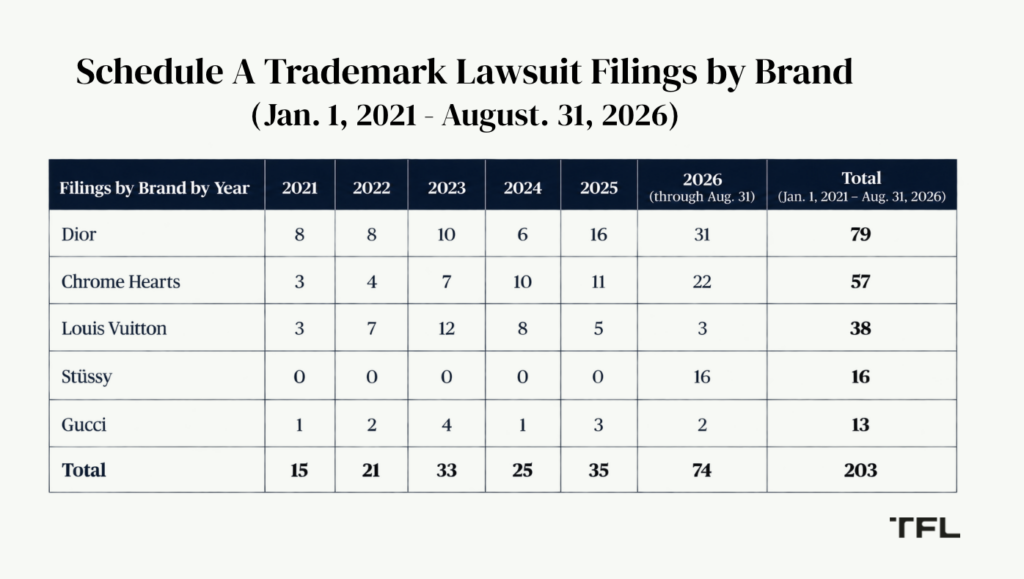
The findings reveal that there is no single approach to Schedule A litigation among the brands examined. Dior’s identified docket is heavily weighted toward the procedure. Chrome Hearts has paired a substantial Schedule A docket with an equally substantial roster of conventional infringement suits. Louis Vuitton has used Schedule A alongside other forms of trademark and anti-counterfeiting litigation. Stüssy moved from no qualifying cases identified through 2025 to 16 in 2026, while Gucci has used the procedure more selectively.
The identified dockets also show that none of the five brands relied exclusively on Schedule A. Even the most robust filers of Schedule A cases filed federal trademark actions outside the Schedule A framework during the period.
The findings also come at a time when the legal environment surrounding Schedule A litigation is becoming less accommodating. Courts are scrutinizing issues that frequently arise in these cases, including personal jurisdiction, electronic service, asset restraints, joinder, and default judgments. Recent rulings make clear that the procedural efficiencies associated with Schedule A litigation do not displace ordinary jurisdictional and service requirements. The Seventh Circuit, for example, recently vacated a default judgment against online sellers after finding that the plaintiff had failed to establish personal jurisdiction over them.
THE BIGGER PICTURE: Taken together, the data reflects a broader shift in how some companies are approaching online counterfeiting enforcement. Rather than pursuing alleged infringers one defendant at a time, companies can use Schedule A litigation to target groups of online sellers in a single proceeding. The sharp increase in filings among the companies examined in 2026 comes as courts are simultaneously applying greater scrutiny to jurisdiction, joinder, service, and other features of the model.
Whether judicial scrutiny ultimately narrows the use of Schedule A litigation remains to be seen. For now, the data suggests that the procedure has become an important – though far from uniformly adopted – component of modern trademark enforcement.
Methodology
TFL reviewed federal trademark actions identified through its docket research for Dior, Chrome Hearts, Louis Vuitton, Stüssy, and Gucci between January 1, 2021 and August 31, 2026. The Schedule A counts reflect cases identified and classified under the criteria below. References to other forms of litigation are descriptive of the identified dockets and are not presented as an exhaustive quantitative breakdown of each brand’s entire federal trademark portfolio.
An action is classified as a Schedule A case where the case caption or docket expressly identified the defendants, or a group of defendants in the action, as listed or identified on a “Schedule A,” or where the court expressly treated the action as a Schedule A cause of action, including through an “Omnibus Order Regarding Schedule ‘A’ Causes of Action.”
Cases were not classified as Schedule A actions merely because they involved multiple online sellers, counterfeiting claims, sealed filings, ex parte motions, alternative service, asset restraints, or other procedural features commonly associated with Schedule A litigation. Appeals, severed follow-on proceedings, administrative shell dockets, and unrelated cases were excluded from original-filing totals.
Share