



A federal judge has dismissed the trademark lawsuit accusing Lady Gaga of infringing surf brand Lost International’s MAYHEM trademark in connection with her Mayhem album, tour, and related merchandise. In a newly-issued order, Judge Fernando M. Olguin of the U.S. District Court for the Central District of California granted Lady Gaga and merchandising company Bravado International Group’s motion to dismiss Lost’s second amended complaint with prejudice, finding that Lost failed to sufficiently allege that the defendants’ use of MAYHEM was explicitly misleading under the Rogers v. Grimaldi test.
The Case in Brief: Lost filed suit against Lady Gaga in March 2025 over her Mayhem album, accompanying tour, and apparel bearing the MAYHEM name. Lost – which has used the MAYHEM mark since 1986 in connection with its surf and lifestyle business – alleged that some of the merchandise used a design that was nearly identical to its own stylized MAYHEM mark and was likely to cause consumers to believe the goods were connected to or authorized by Lost.
The court rejected Lost’s bid for a preliminary injunction in December 2025, finding that it had not shown a likelihood of success on its Lanham Act claims under Rogers, the test the Ninth Circuit applies to certain trademark claims involving expressive works. Lost subsequently filed a second amended complaint, asserting federal and common law trademark infringement, false designation of origin, and unfair competition claims.
The First Amendment Issue
In its August 18 order, the court sided with Gaga and Bravado, finding that Lost had not alleged enough to overcome the First Amendment protections that apply under Rogers. Under Rogers, once a defendant establishes that the challenged trademark use is part of an expressive work, a plaintiff must show that the use either lacks artistic relevance or explicitly misleads consumers about the source or content of the work. Lost did not meaningfully dispute that the defendants’ use was artistically relevant, leaving its Lanham Act claims to turn on whether the use was explicitly misleading.
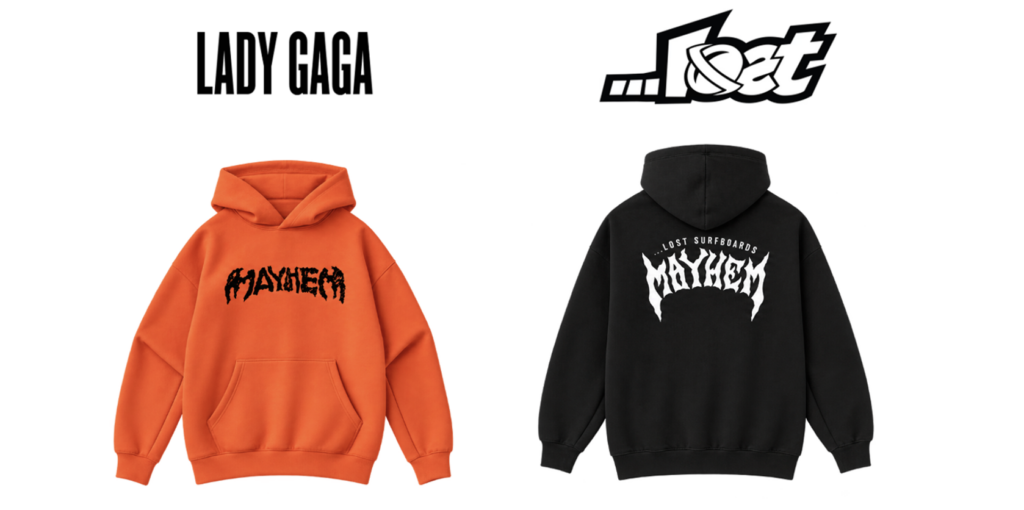
Lost’s allegations that Gaga and Bravado intended to confuse consumers or lead them to believe their merchandise was authorized by Lost were “conclusory,” the court held. The complaint did not identify an affirmative misrepresentation about the source or content of Gaga’s work. “The use of a mark alone is not enough” to satisfy the explicitly misleading prong of Rogers, the court stated, finding that nothing in Lost’s complaint pointed to an overt claim or misstatement identifying Lost as the source of Gaga’s work. As a result, Rogers barred Lost’s Lanham Act claims, as well as its derivative state statutory and common law claims.
The merchandise piece is particularly relevant here. While MAYHEM is the title of Gaga’s album and tour, putting the name squarely in the context of an expressive work, Gaga and Bravado also used the name on t-shirts and other apparel – goods that overlap with the clothing for which Lost uses and has registered its MAYHEM mark. In other words, the dispute did not stop with two parties using the same name for an album and a brand; it extended to products being sold to consumers.
That extension did not take the dispute outside of the realm of Rogers. The court treated the defendants’ use of the title on consumer goods as artistically relevant to Gaga’s Mayhem project, and Lost did not meaningfully contest that point. That left Lost to show that the use was explicitly misleading as to source – a showing that requires more than allegations that consumers could encounter similar marks on similar goods and be confused about an affiliation.
The court declined to give Lost another opportunity to amend. Judge Olguin noted that the company had already had three chances to state viable claims and had been put on notice of the shortcomings in its trademark allegations through meet-and-confers with defendants’ counsel and the court’s earlier preliminary-injunction ruling. Despite that, the allegations in the second amended complaint remained “virtually identical” to those in the earlier complaint. The court determined that another amendment would be futile and dismissed the complaint without leave to amend.
THE BOTTOM LINE: The case puts a modern music merchandising issue into sharper focus: An album title may begin as part of an expressive work, but artists routinely extend the use of those titles across apparel and other consumer goods products. That overlap was not enough for Lost here. Because the MAYHEM merchandise remained connected to Gaga’s broader Mayhem project, the court applied Rogers, leaving Lost to show more than likely consumer confusion – and its complaint did not identify an overt claim or affirmative misrepresentation linking the surf brand to Gaga’s work.
The case is Lost International, LLC v. Germanotta, 8:25-cv-00592 (C.D. Cal.).
Share