

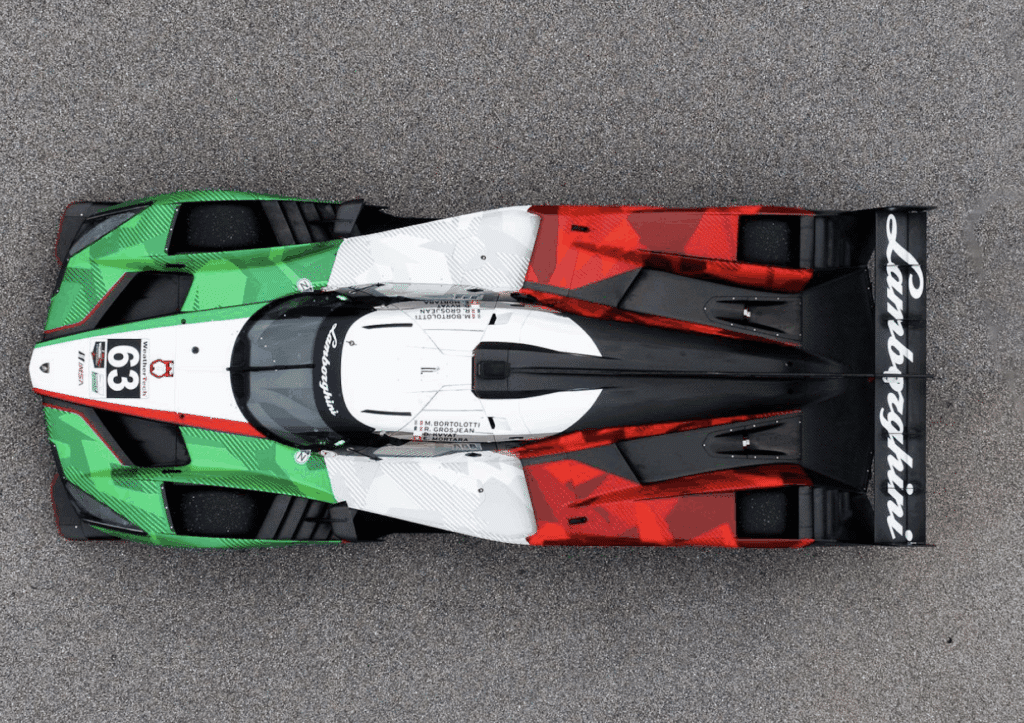
Automobili Lamborghini S.p.A. is asking a federal judge in Texas to toss out a lawsuit accusing it of stealing trade secret-protected data to gain an unfair advantage in its top-tier prototype racing program. At the heart of the litigation is a high-stakes breakup between Lamborghini and its former engineering partner, Prema Engineering S.r.l., which is suing Lamborghini for allegedly accessing and copying proprietary steering wheel configuration data while they were working together in 2024 and then using that stolen data to bolster Lamborghini’s racing activities with a rival team.
The Background in Brief: Prema Engineering filed suit against Lamborghini in the Western District of Texas in April, alleging that the Italian automaker improperly accessed and copied its confidential steering wheel setup data during a 2024 racing test at Circuit of the Americas in Austin. According to Prema, Lamborghini later used that data after the companies parted ways – a move the engineering firm says breached their agreement and gave Lamborghini an unfair competitive edge.
Wrong Court, Weak Claims
Fast forward to July 30 and Lamborghini asked a federal judge in Texas to dismiss Prema’s lawsuit, arguing that the U.S. is the wrong venue for what it characterizes as a deeply Italian dispute. The luxury automaker maintains that Italy is the proper forum and, even if it is not, Prema’s claims fail as a matter of law. Lamborghini contends the stateside suit is a tactical maneuver to sidestep a related legal battle already playing out in Milan with DC Racing Solutions SA, which owns Prema.
According to Lamborghini, the events, witnesses, documents, and governing contract all point to Italy as the right venue. The decision to file in Texas, the automaker argues, stems solely from a single test event in Austin and ignores the parties’ agreement to resolve disputes exclusively in Italian courts under the LMDh Hypercar contract. Keeping the case in Texas, Lamborghini warns, would create a logistical and legal mess – with non-U.S. witnesses outside the court’s reach, documents in Italian, and complex questions of foreign IP law that would unnecessarily burden the American judiciary.
And even if the court declines to send the case back to Italy, Lamborghini has a fallback argument: most of Prema’s claims fail under U.S. law. On the core trade secret claims, Lamborghini argues Prema failed to safeguard the data it now calls proprietary – pointing out that the allegedly secret steering wheel interface was visible on television and that confidentiality was only discussed after the files had already been shared.
As for the Texas Harmful Access by Computer Act claim, Lamborghini asserts that this is redundant, merely repackaging Prema’s trade secret allegations and is, therefore, preempted by Texas’s Uniform Trade Secrets. And in terms of Prema’s Computer Fraud and Abuse Act claim, Lamborghini contends there was no unauthorized access, as Lamborghini had permission to access the steering wheel configuration files during their joint work on the LMDh Hypercar project. Lamborghini argues that the law applies only to unauthorized access, not misuse of permitted data.
A High-Stakes Feud
At its core, the bi-national legal battle is more than just a dispute over intellectual property, it is the unraveling of a once-promising partnership built to propel Lamborghini into the future of top-tier endurance racing. The LMDh prototype class, a high-stakes international racing platform governed by both FIA and IMSA regulations, represents Lamborghini’s most ambitious push yet to compete against the likes of Porsche, BMW, McLaren, and co. on the global stage. Success in this arena depends not only on cutting-edge machinery but also on seamless collaboration between manufacturers and specialized engineering partners. Prema, brought on for its technical expertise, claims it played a central role in developing the steering wheel interface and control systems that Lamborghini allegedly later used without authorization.
From Prema’s perspective, Lamborghini crossed the line by accessing hard-won intellectual property and walking away without consequence to align itself with Riley Motorsports. Lamborghini, however, frames the lawsuit as a strategic and unnecessary extension of a dispute already being addressed in Italian court, suggesting that Prema’s claims are an overreach driven by its removal from the program. Whether this is a case of industrial betrayal or a routine reshuffling in the ever-competitive world of endurance racing, the litigation may offer a cautionary tale about what happens when high-stakes partnerships break down and when engineering collaboration turns into courtroom confrontation.
The case is Prema Engineering S.r.l. v. Automobili Lamborghini S.p.A. et al., 1:25-cv-00602 (W.D. Tex.).
Share