

Louis Vuitton is taking on an apparel and accessories company that touts itself as the maker of “everyone’s new favorite designer dupe sweatshirt.” According to a newly filed lawsuit, Louis Vuitton accuses United Monograms of “manufacturing, distributing, supplying, advertising, promoting, offering for sale and/or selling, without authorization … clothing and footwear bearing studied imitations of the Louis Vuitton trademarks.” The complaint paints United Monograms as a business that is piggybacking on the appeal of luxury branding to sell low-cost sweatshirts and other personalized goods.
In the complaint that it lodged with the U.S. District Court for the Southern District of New York on October 1, Louis Vuitton asserts that United Monograms is engaging in counterfeiting and/or infringement of some of LV’s “most distinctive and popular trademarks.” The French mega-brand argues that it has “expended extensive resources designing, developing, promoting and selling goods,” including apparel and footwear, that bear its well-known marks. It claims that United Monograms is offering infringing products with the “deliberate intent to improperly trade off and reap the benefits of the extensive goodwill associated with the LOUIS VUITTON brand.”
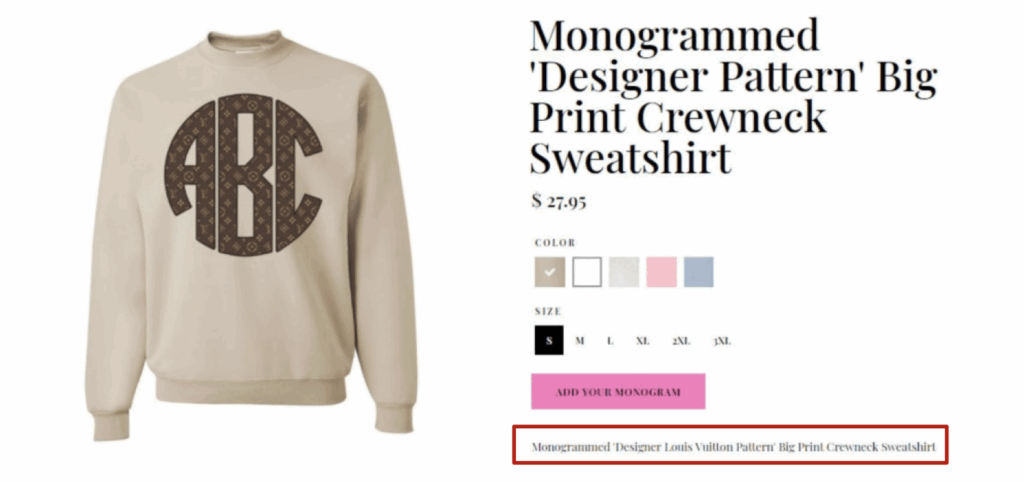
In addition to allegedly co-opting its monogram and Damier marks, Louis Vuitton claims that United Monograms goes so far as to market the products with “direct references” to the Louis Vuitton brand. For example, Louis Vuitton points to United Monogram’s description of one of its $30 sweatshirts as a “Monogrammed ‘Designer Louis Vuitton Pattern’ Big Print Crewneck Sweatshirt” and another as “This LV ‘Check Pattern’ Big Print Monogram Crewneck.”
Accusing United Monograms of deliberate and willful infringement, Louis Vuitton sets out claims of trademark counterfeiting, infringement, dilution, and unfair competition and is seeking injunctive relief, monetary damages, and disgorgement of United Monograms’ profits.
Imagery & Infringement
While Louis Vuitton does not address it in the complaint, one of the more interesting aspects of United Monograms’ alleged infringement scheme is its advertising of the “infringing” wares alongside authentic (or seemingly authentic) Louis Vuitton products. A screenshot of an Instagram post from United Monograms included in the complaint, for instance, depicts a woman wearing one of the allegedly infringing sweatshirts and holding a monogram Louis Vuitton bag. Similarly, marketing emails and product imagery display the sweatshirts alongside Louis Vuitton handbags.

This kind of visual association could heighten the potential for consumer confusion (even if the prices, channels of distribution, etc. may weigh against it), blurring the line between genuine Louis Vuitton products and United Monograms’ knockoffs. By pairing the accused sweatshirts with authentic luxury goods, the marketing implicitly suggests a connection, endorsement, or stylistic compatibility that might lead consumers to believe the items are part of an authorized collaboration or inspired collection – precisely the type of false association trademark law aims to prevent.
At the same time, the lawsuit also highlights a growing tension between how companies market imitation goods and how the law defines them. While United Monograms promotes its $30 sweatshirts as “designer dupes,” Louis Vuitton’s filing makes clear that there is nothing above-board about them; they are outright counterfeit or otherwise infringing goods. The brand’s position underscores a central point in today’s “dupe” economy: while “dupe” has become a casual marketing term used interchangeably with “inspired by” or “similar,” that is not always the case.
The case is Louis Vuitton Malletier SAS v. Lowery et al, 1:25-cv-08152 (SDNY).
Share