

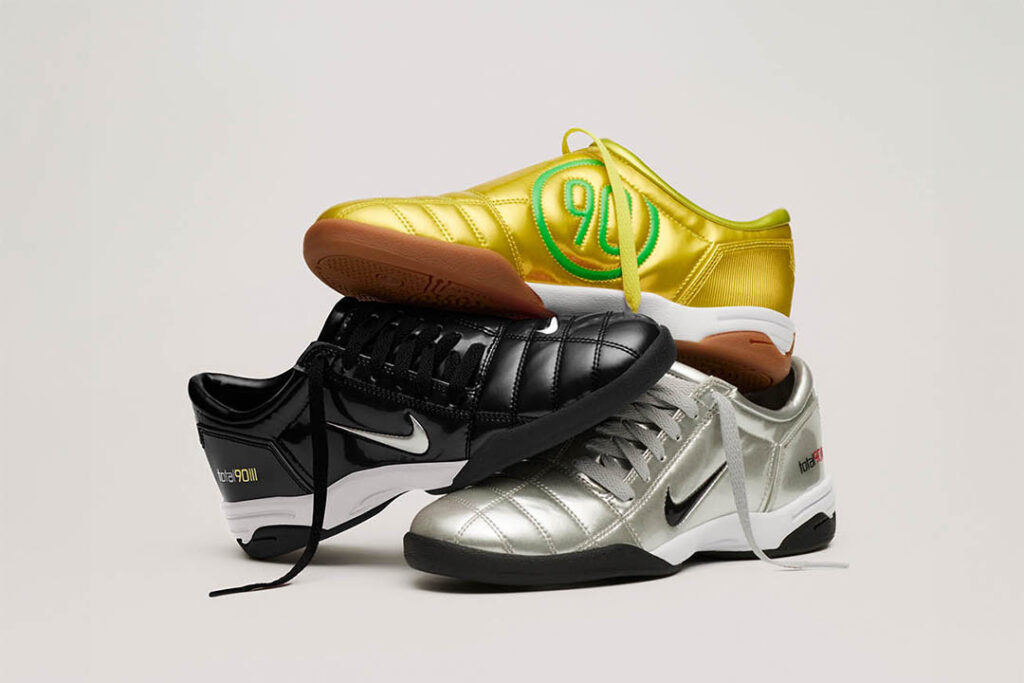
Nike has responded to Total90 LLC’s trademark lawsuit, denying liability and asserting affirmative defenses and counterclaims that place the validity of Total90’s federal TOTAL90 trademark registrations at the center of the dispute. In its counterclaims, as first reported by TFL, Nike asks the court to cancel two registrations for the mark, arguing that Total90 engaged in fraud on the U.S. Patent and Trademark Office and that its applications suffered from defects tied to ownership and priority at the time of filing.
The Background in Brief: In the lawsuit that it filed in November, Louisiana-based Total90 alleges that Nike is infringing its federally registered TOTAL90 trademark by using the same mark on footwear and apparel sold through overlapping retail channels. The company claims that Nike’s March 2025 relaunch of “Total 90” cleats has eclipsed its brand presence, causing consumer confusion and harm to its business. Total90 asserts federal and state trademark infringement and unfair competition claims and seeks injunctive relief, cancellation of Nike’s pending trademark applications, and monetary damages.
Nike originally launched its “Total 90” product line in 2000 and previously held a U.S. registration for the mark, which lapsed in 2019. Total90 contends that following the lapse, which it characterizes as abandonment, it began using the TOTAL90 mark in connection with soccer-related digital platforms and later expanded into apparel and accessories, ultimately securing two federal registrations that issued in September 2024.
On November 26, Judge Wendy Vitter of the U.S. District Court for the Eastern District of Louisiana denied Total90’s request for a temporary restraining order, finding that the company had not met the standard for emergency injunctive relief.
Priority and Non-Abandonment
At the center of Nike’s response is a threshold issue: priority. Nike contends that it used the TOTAL 90 mark in the United States beginning in or around 2000 and that it maintained enforceable rights in the mark even after its prior registration lapsed in 2019. Nike’s position: The lapse of a registration does not equate to abandonment of underlying common law rights.
Nike points to the court’s TRO ruling as consistent with its broader position that a registration lapse alone does not establish abandonment, though the case will ultimately turn on facts and legal standards governing use in commerce, continuity of use, and intent. To support its non-abandonment narrative, Nike cites post-2019 product, marketing, and licensing activity that it says reflects continued use of the TOTAL 90 branding and situates the dispute within its broader 2025 reintroduction of Total 90-branded products.
Beyond its defenses, Nike seeks affirmative relief in the form of cancellation of Total90’s federal registrations. Nike alleges that Total90’s applications included material misrepresentations and omissions and challenges whether Total90 held rights sufficient to support the filings when they were submitted. Nike asks the court to direct the USPTO to cancel the registrations – which were issued in September 2024 – and to enter declaratory relief consistent with Nike’s asserted priority and non-infringement positions.
Nike’s counterclaims also describe a series of pre-suit communications in which, according to Nike, Total90’s counsel proposed that Nike make a one-time payment of between $2.85 million and $2.5 million in exchange for a “clean assignment” of one of Total90’s TOTAL90 registrations. Nike alleges that after it rejected those demands, Total90 indicated it would file suit.
What Comes Next
From a procedural standpoint, Nike’s answer makes clear that the case will not turn solely on likelihood-of-confusion analysis, but also on threshold questions of priority and the validity of the registrations on which Total90’s claims are based. If Nike succeeds on its cancellation counterclaims, it could significantly narrow – and potentially eliminate – the foundation for Total90’s infringement case, while strengthening its own position as it reintroduces Total 90-branded products in the U.S. market.
The case is Total90 LLC v. Nike, Inc., 2:25-cv-02325 (E.D. La.).
Share