

Nike has scored a significant courtroom victory in its ongoing battle against counterfeit goods. In a verdict out of the U.S. District Court for the Central District of California, an eight-person jury found Nicholas Tuinenburg and his brand, Divide The Youth, liable for counterfeiting and trademark infringement over their use of Nike’s Dunk trade dress. The jury awarded $8 million in Lanham Act statutory damages for direct and contributory counterfeiting, along with $1 million in punitive damages tied to the trade dress infringement claim.
The Background in Brief: Nike filed suit against Tuinenburg and Divide The Youth in December 2023, alleging that the influencer built and operated a multi-platform counterfeit ecosystem to promote and facilitate the sale of replica Nike products. Nike claimed that Tuinenburg not only marketed counterfeit goods, but also partnered with third-party sellers, provided purchasing guidance, and used affiliate links and discount codes to drive sales, all while trading on Nike’s trademarks and the design of its Dunk sneakers.
Trade Dress Takes Center Stage
Nike brought trademark and trade dress infringement, counterfeiting, and unfair competition claims against Tuinenburg and his brand (the “defendants”), pointing to their use of its NIKE and AIR JORDAN word marks, the Swoosh and Jumpman logos, and the trade dress-protected design of its Dunk sneakers. The sportswear giant alleged that the defendants sold sneakers that replicated the overall look of its Dunks while replacing Nike branding with Divide The Youth’s own name and logos.
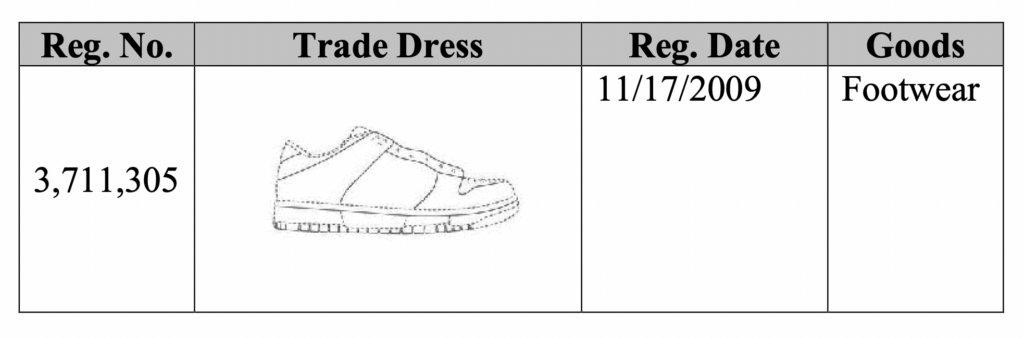
At trial, the focus centered on Divide The Youth’s “Division Dunks,” which Nike alleged copied the distinctive elements of its Dunk silhouette and gave rise to a likelihood of consumer confusion. Nike also took issue with Tuinenburg’s use of his social media presence to promote counterfeit goods and drive traffic through affiliate links and discount codes. Nike characterized conduct as willful, pointing to his use of the shipping agents and Discord channel – a position the jury appears to have credited, as reflected in its award of punitive damages.
The defendants, for their part, emphasized the branding differences between their offerings and Nike’s, arguing that the sneakers were clearly marketed as DTY products and unlikely to cause confusion as to source or affiliation. They also pointed to distinct design elements, including a star logo, and maintained that the products were not presented as authorized Nike goods.
At the same time, they sought to minimize the scope of the conduct, asserting that Tuinenburg sold just 384 pairs for roughly $56,000 in profit and challenging Nike’s $18 million damages theory as unsupported by the evidence.
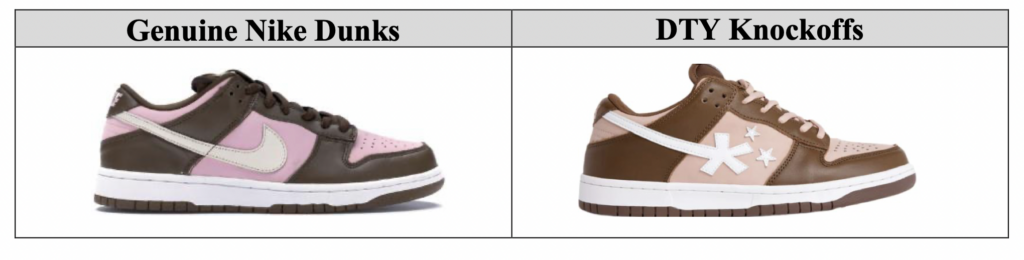
The jury was ultimately unpersuaded. It found the defendants liable for counterfeiting and trademark infringement, as well as infringement of Nike’s Dunk trade dress, and declined to award the full $18 million sought by Nike, instead awarding $11 million in total damages. That award included $8 million in statutory damages for direct and contributory counterfeiting arising from the defendants’ use of shipping agents and Discord-based sales channels, $2 million in punitive damages for counterfeiting and infringement of Nike’s Dunk word mark (claims for which liability had already been established on summary judgment), and $1 million in punitive damages on the trade dress infringement claim.
THE BIGGER PICTURE: The verdict sheds light on the continued strength of registered trade dress as a tool for fashion and footwear brands, particularly in cases where logos are absent but the source-indicating look and feel of a design remains recognizable. For Nike that means that the Dunk trade dress can be infringed even “if you remove the SWOOSH,” as DLA Piper LLP’s Tamar Duvdevani, who represented Nike, put it. This point is particularly significant as lookalike products are increasingly marketed without the most traditional elements of companies’ branding (i.e., word marks and logos) in an effort to sidestep liability.
The case is Nike, Inc. v. Nicholas C. Tuinenburg, 2:23-cv-10495 (C.D. Cal.).
Share