


Quince has filed a striking new lawsuit against Deckers Outdoor Corp., alleging that the UGG owner is engaging in an “anticompetitive” effort to maintain its hold on the footwear market by filing “sham” trade dress lawsuits. In the complaint, as exclusively reported by TFL, Last Brand, Inc. d/b/a Quince claims that Deckers has deployed a trade dress enforcement campaign to prevent competitors in the U.S. market for sheepskin- and shearling-lined footwear from offering “value-priced alternatives using commonplace design features,” thereby enabling it to “maintain supracompetitive prices and exclude competition.”
Turning Trademark Claims into Antitrust Action
Filed in the Northern District of California on February 20, the suit alleges that Deckers has waged “hundreds” of cases asserting “unprotectable, unregistered product-design trade dresses as an exclusionary weapon” to block rivals and maintain its dominance in the market. Characterizing that conduct as attempted monopolization, Quince alleges that Deckers repeatedly asserts trade dress claims in the U.S. “Sheepskin Casual Footwear Market,” where it “possesses market share exceeding 50%,” in order to “eliminate or marginalize competing products.” According to Quince, “each successful enforcement action entrenches Deckers’ position,” enabling it to charge prices “typically 50% to 100% higher than competing products.”
“Prices are elevated because Deckers’ exclusion of lower-priced competitors removes downward pricing pressure,” Quince claims, asserting that “when lower-priced alternatives are removed through sham litigation pressure, consumers face narrower choice sets skewed toward Deckers’ higher-priced products.”
The lawsuit follows from an earlier case between the parties, in which the Northern District of California ruled that the asserted trade dresses for the UGG Tasman slipper and Classic Ultra Mini boot are “generic and unprotectable.” Despite that ruling, Quince says that Deckers “immediately filed dozens of new lawsuits recycling the same invalidated five-feature definition,” and has filed “at least forty such pleadings” since October 2025, which it argues reinforces its monopolization theory.
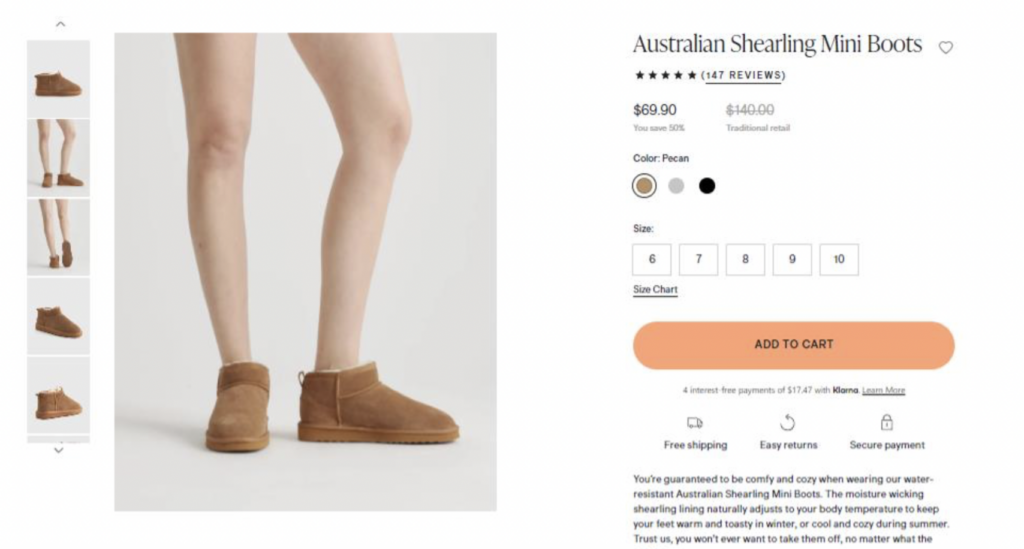
Against this background, Quince – a fast-growing startup known for its collection of “luxury for less” offerings – brings a single claim for attempted monopolization under Section 2 of the Sherman Act and seeks treble damages, attorneys’ fees, and injunctive relief barring Deckers from asserting trade dress claims previously deemed unprotectable.
Aggressive Enforcement in Context
Not entirely novel territory, many of the largest consumer goods brands have long embraced forceful IP enforcement to protect both the source-identifying function and goodwill of their marks and their competitive positions. Adidas, for example, has aggressively litigated to defend iterations of its Three-Stripe mark, while Levi Strauss & Co. has built a robust enforcement program around its Arcuate stitching and pocket tab marks. Both have faced pushback from defendants challenging the scope of their asserted rights and the aggressiveness of their brand-protection strategies.
In an industry inundated with infringement action, what makes Quince’s suit notable is its effort to recast a familiar enforcement playbook as exclusionary conduct under Section 2 of the Sherman Act. By framing the dispute as trademark enforcement targeting widely used product-design features within a concentrated market, Quince argues that the cumulative effect of repeated litigation can resemble attempted monopolization rather than mere brand protection. In doing so, the lawsuit takes aim at the potential limits of aggressive IP activity and asks when assertive enforcement may cross into antitrust territory.
Courts, however, have been reluctant to treat such enforcement as antitrust misconduct. In a 2017 decision involving adidas, a federal district court in Oregon rejected claims that the sportswear giant was misusing trademark litigation to “acquire a monopoly,” holding that its enforcement activity was protected under the Noerr-Pennington doctrine absent proof that the lawsuits were objectively baseless and constituted “sham” petitioning.
The ruling sheds light on the narrowness of the sham-litigation exception, which applies only where lawsuits are objectively baseless and are pursued to interfere directly with a competitor’s business relationships.
Quince, nonetheless, contends that this case fits squarely within that narrow window. The complaint alleges that “Deckers’ baseless threats and lawsuits constitute sham petitioning,” asserting that the company lacked probable cause to believe its unregistered product-design trade dress claims could succeed on a developed record. It points to repeated refusals by the U.S. Patent and Trademark Office, prior judicial findings that Deckers’ feature definitions were overly broad or conclusory, and what it calls as a decade-long pattern of template complaints relying on brand-level promotion rather than design-specific consumer perception.
Most notably, Quince argues that Deckers continued filing materially identical trade dress claims even after a federal court declared the Tasman trade dress generic – conduct that, in its view, would not be pursued by a reasonable litigant.
Whether those allegations are enough to overcome the formidable protections afforded to petitioning activity remains to be seen. But by pleading objective baselessness and subjective intent in granular detail and by tying that theory to a pattern of enforcement rather than a single lawsuit, Quince is attempting to bring an aggressive trade dress campaign within the narrow confines of the sham-litigation exception – and to defend its dupe dynasty in the process.
A representative for Deckers was not immediately available for comment.
The case is Last Brand, Inc. d/b/a Quince v. Deckers Outdoor Corp., 5:26-cv-01540 (N.D. Cal.).
Share