


Fashion and retail companies are among the most frequent filers of trademark oppositions in the U.S., with Hugo Boss, Chanel, GOAT, and ALO ranking alongside McDonald’s, Apple, and Amazon in challenges to third-party trademark applications. Filings before the U.S. Patent and Trademark Office’s Trademark Trial and Appeal Board (“TTAB”) offer a measure of how frequently these companies seek to prevent potentially conflicting marks from securing federal registration.
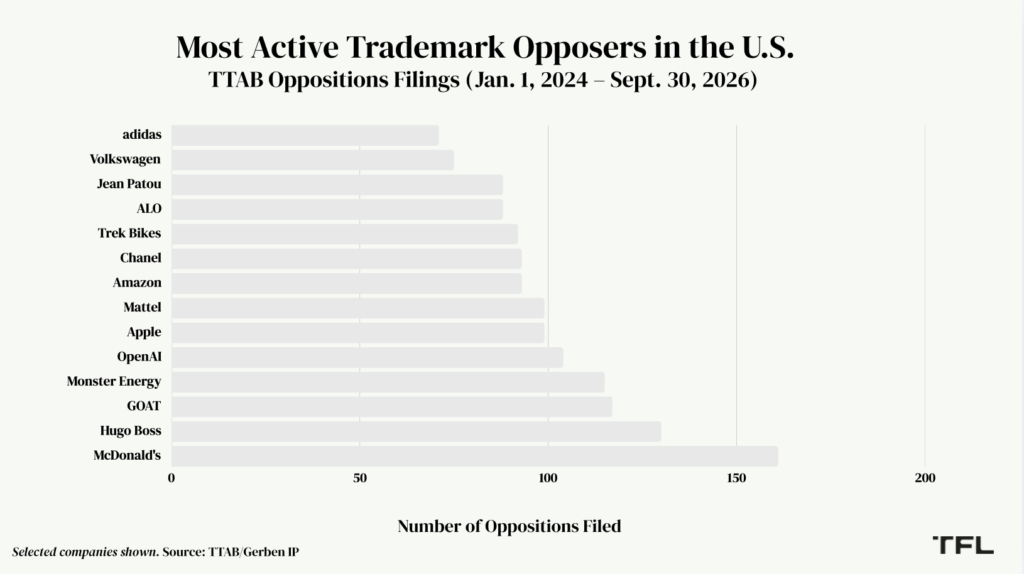
According to data from Gerben IP, Hugo Boss ranked second among all trademark opposition filers between January 1, 2024, and September 30, 2026, with the fashion brand initiating 130 oppositions, trailing only behind McDonald’s, which filed 161. The parent company of sneaker marketplace GOAT, 1661, Inc., tied for third with 117 filings, while Chanel tied for seventh with 93. New Era followed with 89 oppositions, ALO and Jean Patou each had 88, Adidas had 71, and Nike had 56.
TTAB oppositions determine whether an applicant is entitled to register a mark, rather than whether its use constitutes infringement. The proceedings can nevertheless impose substantial costs on applicants and lead to settlements involving amendments to the identification of goods or services, restrictions on use, or withdrawal of an application. Gerben’s rankings reflect formal notices of opposition, excluding requests for extensions of time to oppose, which preserve a potential opposer’s filing deadline without commencing a contested proceeding.
Different Brands, Different Strategies
Looking beyond the aforementioned tallies, TFL’s review of opposition filings brought by Chanel, ALO, Adidas, and Patou reveals distinct approaches to protecting trademarks, with the underlying disputes raising questions about the scope of rights in brand names, logos, and other design elements.
> CHANEL: Chanel’s opposition filing reveals a recurring focus on COCO-formative marks and designs that the luxury house alleges conflict with its interlocking-CC monogram. The company has challenged applications for marks like COCO SHIMMY, COCOGLAM, and AUGUSTCOCO, while also opposing stylized marks incorporating different letter combinations, including OG, DD, and GC. Other proceedings invoke its rights in ALLURE, CHANCE, and No. 5 against applications, such as DERMALLURE, CHANCCI, and FIRST FIVE.
The filings reflect Chanel’s efforts to protect individual elements of its trademark portfolio against marks that do not reproduce them exactly. Its monogram-related oppositions are particularly notable: by challenging designs incorporating letter combinations such as OG, DD, and GC, Chanel is seeking protection that extends beyond the specific letters forming its interlocking-CC mark. These disputes put the emphasis on the visual configuration of the challenged designs and whether their overall appearance is sufficiently similar to Chanel’s monogram to support its claims.
> ALO: ALO’s oppositions reflect the trademark implications of its expansion beyond activewear. In September, for instance, it opposed RALO Health’s application for RALO for eye-health supplements, relying in part on its own registration for ALO covering nutritional supplements. The yoga-turned-lifestyle company has also challenged HEALO for goods including cosmetics and personal-care products, and Glo Digital’s application for GLO covering fitness-related software, digital content, and equipment.
The filings illustrate how ALO’s expansion into additional product categories has broadened the trademark rights it can invoke when challenging third-party applications, including those covering goods and services outside its original activewear business.
> ADIDAS: Adidas continues to challenge applications for marks that incorporate parallel bands and geometric elements without reproducing its registered three-stripe configurations, including marks filed by Colombian Gymwear and Track Houston Youth Track Club, alleging likelihood of confusion and dilution by blurring.
The disputes highlight the tension between protecting adidas’s distinctive stripe arrangements and preserving room for competitors to use stripes as a common design element in apparel and sports branding.
> JEAN PATOU: Patou’s opposition activity presents a different set of considerations. As previously reported by TFL, the formerly-LVMH-owned house has pursued challenges to applications incorporating JOY, the name of its historic perfume, against a backdrop of existing JOY-formative registrations across beauty and related categories. Its opposition activity increased following LVMH’s 2018 acquisition of the house, as it sought to strengthen protection for the heritage mark.
The existing registrations complicate that effort: Patou’s ability to challenge newer applications does not necessarily extend to displacing earlier third-party rights, and the scope of protection available for JOY depends on the particular marks, goods, and evidence involved.
THE BOTTOM LINE: The rankings offer a high-level measure of trademark enforcement activity, which Gerben suggests warrants closer scrutiny given the costs and commercial pressure that opposition proceedings can impose on smaller businesses. But filing volume alone reveals little about the nature or merits of individual challenges. TFL’s review of the underlying proceedings shows how similar levels of opposition activity can reflect markedly different enforcement priorities, legal considerations, and claims to trademark protection.
Share