


A sharp zigzag on a running shoe has sparked an interesting design-versus-trade-mark battle. The European Union Intellectual Property Office (“EUIPO”)’s Cancellation Division has sided with Salomon in a dispute over a footwear design that featured a zigzag graphic similar to its registered EU trademark. In a decision issued on November 12, the Office declared Road Star Group’s Registered Community Design invalid and ordered the Czech footwear company to pay EUR 750 in costs.
At the heart of the trademark-centric clash was a simple question: When does a design use a sign that is too close to a protected trademark? For the Cancellation Division, the answer turned on the strength of Salomon’s earlier mark and the degree of similarity between the two signs in the eyes of the everyday consumer.
The Background in Brief: Salomon initiated a cancellation proceeding in a bit to invalidate Road Star’s design under Article 25(1)(e) of the EU Design Regulation, which allows an EU design to be declared invalid if it uses a distinctive sign that the rights holder (Salomon in this case) is entitled to prevent others from using. To make its case, Salomon relied on an EU registration for a figurative trademark made up of a jagged double zigzag with three peaks and a curved band beneath. The contested design was registered for footwear and appeared on a sport shoe. To Salomon, Road Star’s zigzag decoration (below right) was not just similar, but close enough to mislead consumers.
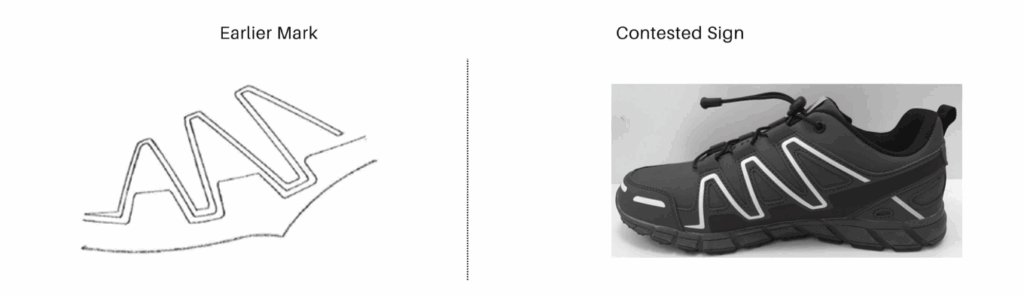
Road Star pushed back, arguing that zigzag graphics are common in the footwear industry, that its own zig zag design differed in key details, and that any similarities were overshadowed by other elements on the shoe, including its inclusion of the “ROAD STAR” word mark.
The EUIPO’s Analysis in a Nutshell
Considering the issue of invalidity under Article 25(1)(e), the Cancellation Division was tasked with deciding three things: Whether the contested Road Star design used a sign identical or similar to Salomon’s earlier trademark; whether Road Star’s goods were identical or similar to Salomon’s; and whether that use would infringe Salomon’s rights, including by creating a likelihood of confusion. Everything else, including allegations of bad faith, past disputes in Czech courts, or other branding on the shoe, was irrelevant to that assessment, according to the EUIPO, and was therefore set aside.
Taking on those three core points, the Cancellation Division found that …
> The goods are identical: Both the design and Salomon’s trademark cover footwear. That alone weighed heavily in favor of finding a conflict.
> The relevant public is the general consumer. The average buyer of sports shoes pays a normal level of attention. They notice visual features, but they rely on memory rather than precise measurement. This matters because the assessment is based on overall impression, not technical differences.
> The signs look similar enough to cause confusion. This was the crux. The EUIPO compared Salomon’s registered zigzag with the zigzag on Road Star’s design. Both used a thin, angular zigzag line with three peaks positioned above a thicker band. Both shared the same basic structure and rhythm. Road Star pointed to differences in angles and the length of certain strokes, but the Office considered these minor. When consumers look at a shoe, they do not study degrees of inclination. They notice structure and pattern. On that level, the signs were similar to an average degree.
Because the earlier mark has normal distinctiveness and the goods are identical, the design’s use of a similar sign was enough to create a likelihood of confusion. According to the Office, buyers could easily assume that Road Star’s shoe was a Salomon model or a variant from an affiliated company.
The Bottom Line: Under EU law, once there is a likelihood of confusion, the owner of an earlier trademark has the right to ban the use of that sign in a design. That is exactly what Article 25(1)(e) exists for. The EUIPO concluded that Salomon met the legal threshold. Road Star’s design made unauthorized use of a sign too close to Salomon’s protected figurative mark. The design could not stand. Because the case was fully resolved on this ground, the Office did not examine Salomon’s other claims, such as lack of novelty or individual character.
The Takeaway for Brand Owners, Designers
This decision is another reminder that decorative elements on products can cross into trademark territory. Even a line pattern or geometric feature can be distinctive enough to trigger legal protection if it is registered as a trademark and used consistently in the market. When that happens, what looks like a simple design choice can become a protected identifier of origin. Brands that rely on graphic signatures or recurring motifs need to be conscious of that overlap, both when developing new products and when assessing the risk of adopting similar visual cues.
For trademark owners, the ruling indicates that Article 25(1)(e) can be a powerful tool. Rightsholders do not need a perfect copy to prevail in an invalidation proceeding. A design that creates a similar impression can be enough. For design owners, the takeaway is simple. Before filing a design application, check whether key visual elements of a design overlap with existing trademarks. And remember that the EUIPO will focus on how an average consumer sees the overall pattern – not on small stylistic differences.
Share