

By the time Sex opened its doors on London’s King’s Road in the early 1970s, Vivienne Westwood and Malcolm McLaren were not just selling clothing; they were putting a new cultural current in motion. The pieces that came out of that small shop – marked by a front door that read “Clothes for Heroes” – and later under their Seditionaries label were constructed with zips and straps, detailed with hand-cut appliqués, and shifted in materials from one batch to the next. But more importantly, they were fused with ideology, irreverence, and a furious kind of intent. They functioned as provocations aimed at challenging both fashion norms and cultural convention.
Half a century later, those very same items have become precious artifacts in museum collections and the secondary market, alike, where Westwood’s bondage trousers and Anarchy shirts command price tags in the thousands. And with the elevation of these objects into cultural artifacts has come a parallel rise in complexity and an onslaught of confusion, one that plagues buyers and sellers of vintage Westwood wares and raises questions about what is real – and who gets to decide.
The Question of What’s “Real”
At a time when the fashion resale market is booming and the value of an item’s backstory can be a commodity in itself, Joe Corré, son of Westwood and McLaren and co-founder of The Vivienne Foundation, is confronting those questions. “There has been a problem for some time within the world of vintage Westwood and Westwood/McLaren garments, in particular, where there’s been a lot of confusion,” he told me. He is aiming to clear up some of the ambiguity.
Distinct from the status quo in the luxury market, where authentication is typically complicated by complex counterfeit supply chains and sophisticated “superfake” products, Westwood wares present a unique challenge: the variations that exist among early Westwood offerings was a hallmark of her production.
Westwood’s work was, by design, improvisational and somewhat inconsistent. Zips changed. Fabrics ran out and others were swapped in. Branded labels were sometimes left out entirely. “Just because you find a pair of black bondage trousers that does not have a Lightning brand zip … doesn’t mean they’re not authentic,” Corré explains. “They could have a YKK zip in them and absolutely be authentic.”
Early manufacturing irregularities are only part of what complicates the issue of provenance. Equally significant is the creative ethos of the 1970s. “DIY culture and all the creative experimentation at the time contributed to this,” Corré notes. In fact, “Vivienne’s and Malcolm’s customers were encouraged to make their own versions of things. Take somebody like Boy George, he made his own bondage trousers or got his mum to make them for him, and he loved them,” bringing additional nuance into the fold.
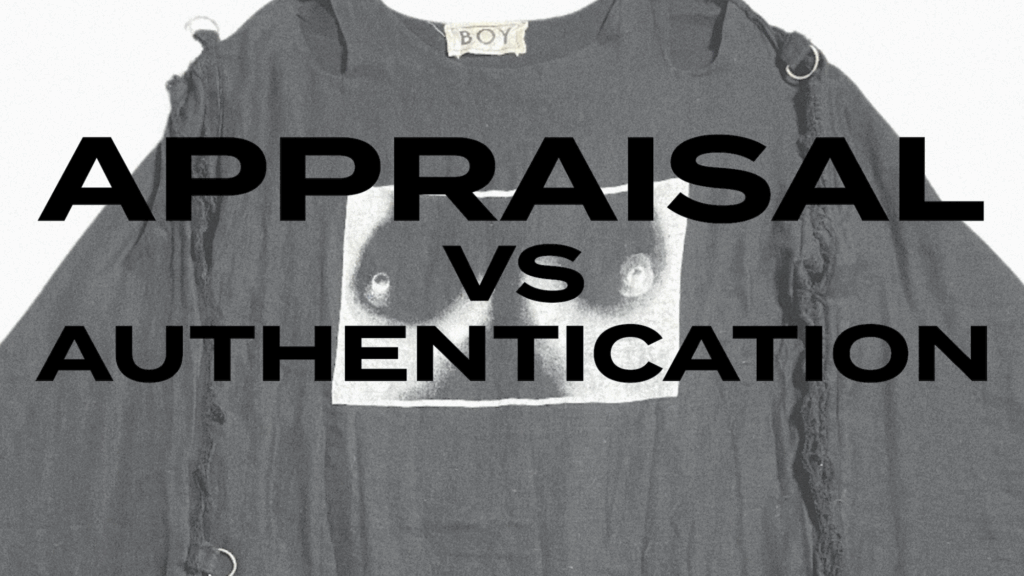
This is precisely why Corré prefers the term “appraisal” to authentication. The art of engaging with Westwood’s early offerings is less about drawing rigid binaries between “real” and “fake” than it is about understanding the conditions in which these garments were made and the subtle distinctions at play.
The Era That Created the Confusion
After Westwood moved on from punk into the fashion mainstream, debuting her Pirate collection on the runway in London in 1981, demand for the older pieces only grew. Some were produced under official licenses, like those from BOY London, which used original labels and high-quality fabrics. “Taking one of the original pieces made under license and comparing it to something that came from 430 Kings Road, it’s actually quite difficult to tell the difference,” Corré states.
However, when those licenses expired, the landscape started the change. Many manufacturers continued production with declining quality and changed designs. As a result, “Some people think they’ve got the original thing,” he says. Yet, what they really have is “a cheap copy that wasn’t even licensed in the end.”
Then came the Japanese replicas – meticulously crafted homages that never claimed authenticity but were later artificially aged and resold as originals in the secondary market. “Those Japanese companies were never selling them as authentic. It was always: ‘These are replicas or copies of the original, and we’ve got the details down very well.’” But as Corré notes, “Certain people would buy those pieces, stick them out in the rain for a week and then claim they were original garments.”
Against that backdrop, Corré says that this period – when Westwood, in partnership with McLaren, first developed her punk rock look – “was such a narrow part of her story,” but it is the source of “most of the confusion.” The cumulative result is a market clouded by inconsistent appraisals, unreliable expertise, and misidentified works, a market that Corré describes as “a bit of a risky business.”
While Corré is not interested in protecting “rich banker-type people[s] that want to have a piece of punk rock on their wall [to] pretend that they were a part of it,” he claims that there is value helping “true collectors and museums make sense of what they have.” This is particularly true when it comes to pieces like the Anarchy shirt, which he singles out as one of the only garments from the period designed and produced solely by Westwood, herself. “Every one of those Anarchy shirts ever made was entirety made by her.”
Behind the Push for Preservation
What complicates the narrative further is an undercurrent of tension over legacy. There are issues over authorship, with Corré alleging that during his lifetime, his father overstated his involvement in creating the early Westwood products. This muddies the water from a provenance perspective, Corré says: “You have had people saying that Anarchy shirts were fake because they weren’t in Malcolm’s handwriting, which they never were … because he never made them.”
At the same time, there is the ongoing struggle over how Westwood’s values are being interpreted and enacted by the company bearing her name following her death. Internal divisions have emerged between family members and corporate leadership in the wake of her death in December 2022, with her granddaughter, Cora Corré, for one, publicly criticizing the brand’s current trajectory – including its use of archival pieces – and accusing management of prioritizing commercial growth over the activist ethos that defined her grandmother’s work.
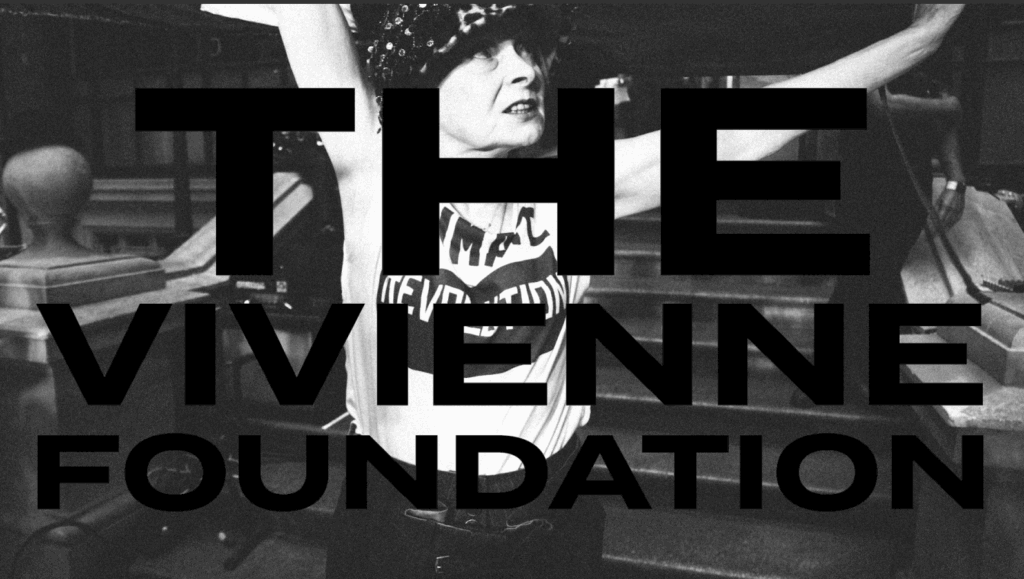
It is against this background that Corré is seeking to shed light on both authorship and intent. He distinguishes his mother’s broader legacy from the small window of the Sex/Seditionaries works and differentiates his current effort from the brand’s commercial treatment of the Westwood archive, saying that his appraisal-centric work in collaboration with vintage platform Byronesque is not about commodifying his mother’s past. It is about grounding it.
“Hopefully I’ve illustrated that it is not an exact science,” he says. “You do need deep insider knowledge to approach appraising or authenticating something.”
For Corré, this initiative has another layer of purpose: Fundraising for The Vivienne Foundation, which supports causes Westwood cared deeply about, namely, climate action, peace, human rights, and economic justice. Through licensing, resale, and the careful appraisal of vintage items, the Foundation hopes to turn fashion history into future impact. “It seems quite a lovely opportunity to be able to trade these vintage garments that not only tell Vivienne’s story, but are the perfect sustainable product,” Corré says. “You’re giving new life and new energy to something that already exists, and that’s kind of sustainability in action to me.”
Ultimately, authenticity in this context turns less on specific hardware or product labels than on the conditions that produced the garments and the market forces that now shape their interpretation. And in true punk fashion, there are no easy answers – only the ongoing tension between the myth and the material.
Share