



As brands grapple with artificial intelligence companies scraping their websites, training models on their content, and building agents that can access retail sites on consumers’ behalf, much of the legal response has focused on keeping AI out. LEGO offers a case study in why brands may also want to consider the other side of the equation: the information they make available when AI systems encounter them.
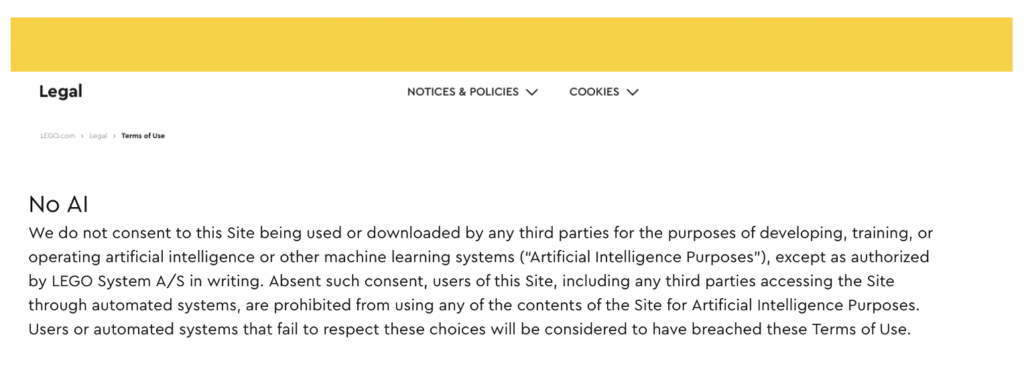
The LEGO Group’s website terms expressly restrict the use of its site and content for AI purposes. In a section titled “No AI,” the company states that it does not consent to its site being used or downloaded by third parties for “developing, training, or operating artificial intelligence or other machine learning systems” without written authorization. Automated systems that disregard those restrictions, LEGO says, breach its terms.
Elsewhere on its site, LEGO does something equally noteworthy: It tells the public how its intellectual property should, and should not, be used. Its “Fair Play” guidance explains how the LEGO trademark should appear, when its use may create a false impression of affiliation, why the LEGO logo should not appear on unofficial websites, and how the LEGO name should be used grammatically. This guidance was almost certainly drafted for internet users, not AI models, and yet, it offers a useful blueprint for the kind of brand information companies may want AI systems to encounter.
Taken together, the two sets of provisions shed light on an emerging issue for brands: Protecting content from AI access may be only part of the equation. Companies may also want to make information about their brands readily available for AI systems to find.
When AI Speaks for the Brand
Independent third-party AI systems generally sit outside the framework through which companies have traditionally exercised control over their brands. Yet, AI systems are starting to serve as common intermediaries between brands and consumers, synthesizing information obtained through model training, search and retrieval systems, and real-time web access into responses presented directly to consumers.
That creates a different kind of brand-management problem. AI systems can generate descriptions of a company and its products that diverge from language the company has deliberately adopted, including misstatements about affiliation, claims the company does not make, or descriptions of product features that are inconsistent with how the company itself defines them.
LEGO’s Fair Play guidance demonstrates what an authoritative public record can look like. Making similar guidance public and AI-accessible could give AI systems that retrieve information from the web a company-approved source to draw from when generating responses for consumers. At the same time, it would give companies a clear reference point when AI systems get it wrong.
Trade dress provides a particularly useful example of why consistency in brand and product descriptions, human and AI-generated alike, can matter. A company asserting trade dress rights in a product design must be able to articulate the specific elements that compose the claimed trade dress. In MZ Wallace Inc. v. Fuller, a federal court found that MZ Wallace failed to establish secondary meaning in its claimed handbag trade dress, pointing in part to eight different descriptions from the company, none of which matched the formulation asserted in the litigation. It is easy to see how AI-generated descriptions could add another layer of inconsistency to the way a product’s claimed features are defined and understood.
Functionality presents a separate concern. Since functional product features cannot be protected as trade dress, companies should be mindful that AI-generated descriptions could attribute utilitarian purposes or advantages to features they claim as source-identifying, particularly where they have not characterized those features in that way.
Together, these issues, among others, show how AI-generated descriptions can complicate companies’ efforts to define and protect their intellectual property.
Brand Protection in the AI Age
LEGO’s approach illustrates two questions for companies. First, under what circumstances may AI developers and automated systems access or use company content? Courts are beginning to answer that question in real time, while terms of use, like LEGO’s “No AI” provision, can form part of companies’ efforts to set their own boundaries.
Second, when AI systems do encounter a brand, what authoritative information has the company made available for those systems to find and draw from? That is a question companies can answer for themselves now by deciding what brand and product information they make publicly available and how clearly they articulate it.
LEGO’s approach offers a useful model. Restricting how AI systems access company content may be only half of the strategy. Brands may also need to make it easier for those systems to get the brand right.
Share