



Naghedi is pushing back in the latest round of its bid to register its signature woven neoprene pattern as a trademark. Challenging the U.S. Patent and Trademark Office’s determination that its repeating woven neoprene design is merely ornamental and lacks distinctiveness, the New York-based accessories maker argues that widespread third-party use of similar designs – often framed as “dupes” – supports a finding of acquired distinctiveness, such that the design functions as an indicator of source.
The Background in Brief: Naghedi filed a trademark application in February 2023 seeking registration for its woven neoprene design, described as a configuration of uniformly sized neoprene strips interlaced into a repeating diagonal pattern across the surface of its goods. In a series of Office Actions, the Examining Attorney refused registration on the basis that the applied-for mark – consisting of a repeating pattern used on the majority or entirety of the goods’ surface – is merely an ornamental feature that does not function as a trademark.
Making the Case for Distinctiveness
Setting the stage in its March 16 filing, as exclusively reported by TFL, Naghedi asserts that its woven pattern has come to function as a trademark through years of use, commercial success, and, critically, imitation by competitors, challenging the USPTO’s premise that the design is merely ornamental. The brand argues that the Office’s reliance on the pattern’s repetition across the surface of its bags is misplaced, contending that “a design that covers the entire surface can still serve as an indicator of source” and does not “somehow lose its origin-indicating property when it is so used.”
At the same time, Naghedi narrows the scope of its claim, emphasizing that it is not asserting broad rights in woven neoprene. Rather, it is seeking protection for “a repeating pattern comprised of slim, uniformly-sized rectangular straps of neoprene interlaced, folded and woven” into a diagonal configuration – what it characterizes as a “specific and narrow description” that consumers recognize as uniquely its own.
The company further maintains that the design has acquired distinctiveness through extensive and continuous use in commerce, pointing to its introduction of woven neoprene bags in 2015, “uninterrupted and widespread use for over ten years,” and significant advertising, sales, and media exposure as evidence of acquired distinctiveness.
When “Dupes” Define Distinctiveness
Where the dispute becomes more nuanced is in the treatment of third-party use. The USPTO points to the wide array of similar woven neoprene bags in the market as evidence that the design is commonly used and that Naghedi’s use is not “substantially exclusive.”
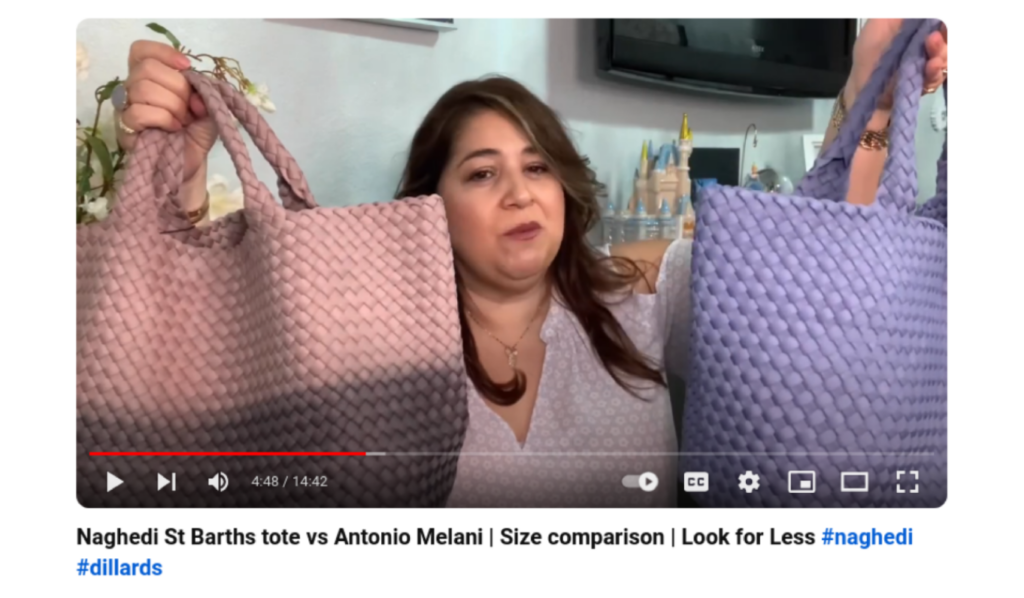
Naghedi, however, offers a different interpretation, arguing that “literally every single third-party example” cited by the USPTO consists of products that are “conceded imitations,” “inspired by” its design, or otherwise “recognized as imitations” of its design. In its view, this evidence reflects copying – not a crowded field – and reinforces, rather than undermines, the design’s source-identifying significance. Indeed, the company asserts that if its mark “were not distinctive and uniquely associated with [it], no one would be trying to copy that design,” framing the prevalence of “dupes” and “counterfeits” as evidence of acquired distinctiveness.
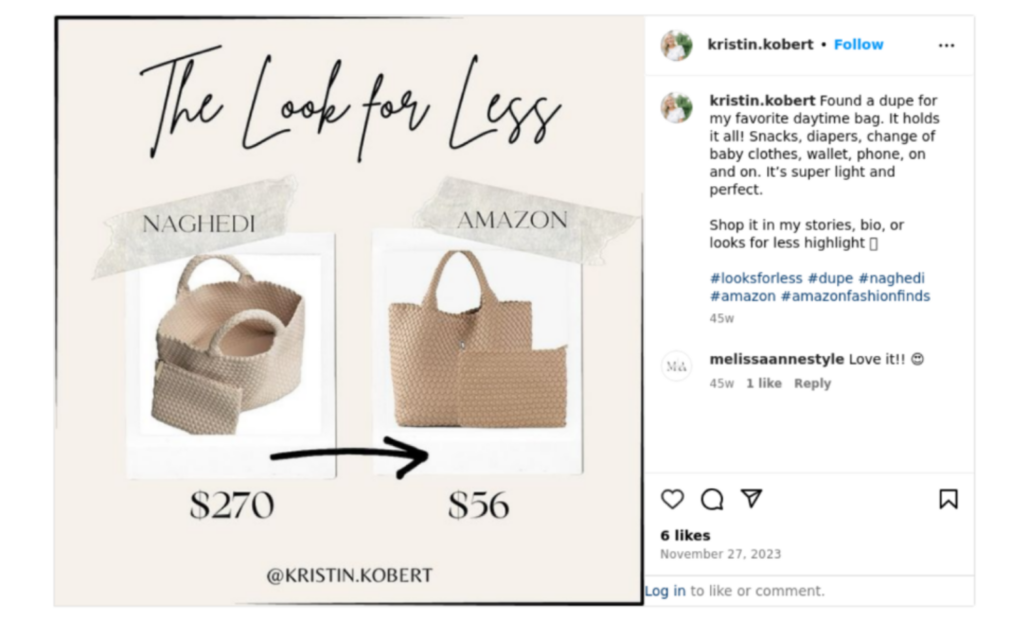
That position tracks established trademark principles under which intentional copying can support a finding of acquired distinctiveness. At the same time, however, widespread third-party use – regardless of its origin – may weigh against the “substantially exclusive” use required for registration.
Against that backdrop, Naghedi seeks to address the USPTO’s observation that it is unclear “who is copying whom” by asserting priority. It claims to have introduced woven neoprene handbags in 2015 and contends that many cited third-party sellers entered the market years later. If credited, that timeline could support an inference of copying, which may weigh in favor of acquired distinctiveness – even as the resulting market saturation continues to cut against it.
THE BIGGER PICTURE: Taken together, the USPTO’s refusals and Naghedi’s response highlight a core tension: the disconnect between market recognition and legal distinctiveness. Naghedi’s position reflects a brand-side view that widespread copying – particularly in the form of “dupes” – signals consumer association and supports acquired distinctiveness. The USPTO, on the other hand, treats that same proliferation of “copycat” goods as evidence that the design is commonly used and not “substantially exclusive.”
The result is a familiar but unresolved dynamic: The broader a design’s adoption, the more it may signal both source-identifying significance or its absence. Naghedi’s argument attempts to tip that balance in its favor by reframing imitation as proof of brand association.
Share