

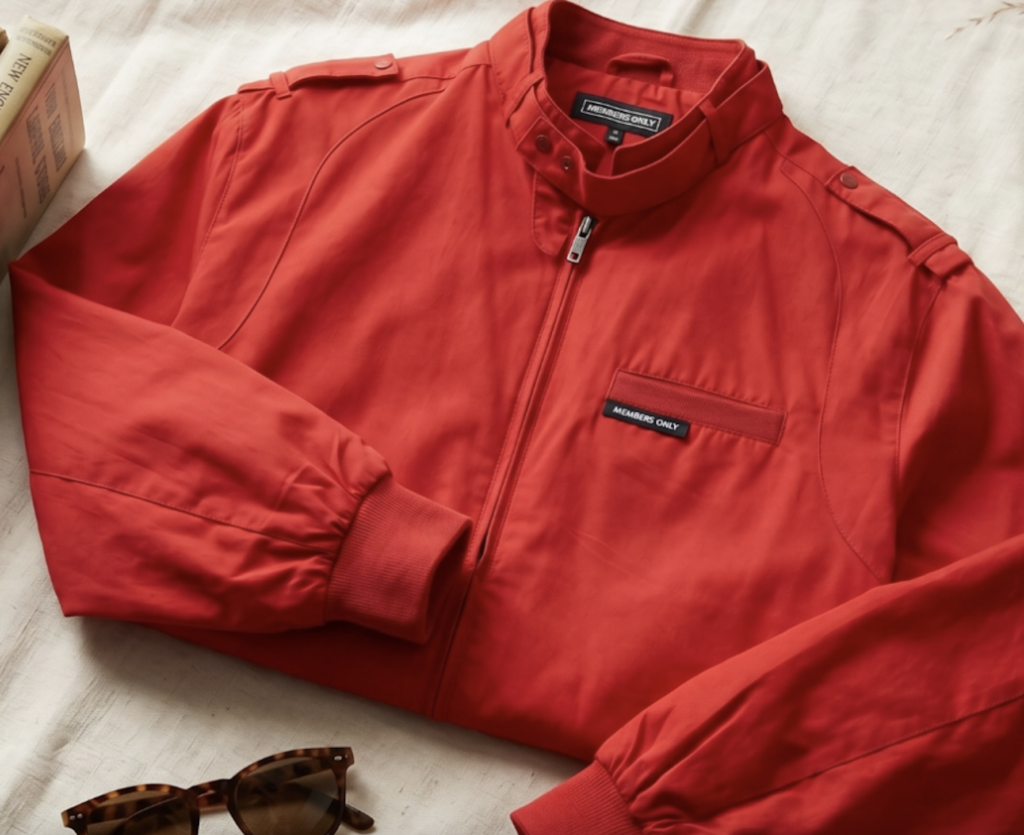
Members Only became synonymous with 1980s American fashion, with its signature jackets emerging as a widely recognized fashion staple that helped cement the brand’s place in popular culture. But according to a federal court in New York, that level of recognition is not necessarily enough to support a federal trademark dilution claim decades later.
A recent ruling in a dispute between Members Only and Canadian apparel company Groupe Dynamite underscores just how narrow the category of federally “famous” trademarks has become. In a May 21 decision, Judge Gary R. Brown of the U.S. District Court for the Eastern District of New York allowed trademark infringement claims over a sweatshirt bearing the phrase “MEMBERS ONLY” to proceed while dismissing the plaintiff’s federal dilution claim under the Trademark Dilution Revision Act (“TDRA”).
> The dispute stems from a hooded sweatshirt sold by Groupe Dynamite’s Garage brand. The garment featured “Palm Springs Country Club” on the back, with “MEMBERS ONLY” appearing beneath it in smaller capitalized lettering. JR Apparel World, which owns the Members Only trademark portfolio, alleged trademark infringement, unfair competition, and dilution under federal and state law.
The High Bar for Fame
Although the infringement claims survived, the court’s analysis of dilution offers the (arguably) more significant takeaway for brand owners. Setting the stage, the court acknowledged Members Only’s decades-long history, celebrity wearers, and appearances in film and television, but found that those assertions were insufficient to establish the level of fame required under the TDRA.
According to the court, TDRA fame is reserved for marks that approach the status of household names, a level of recognition that “spans generations, such that the average person would not only know of the brand herself but would expect her parents and children to know too.”
That formulation is not found in the statute itself, but it offers a striking articulation of what federal dilution fame means in practice. Under that view, cultural relevance, celebrity associations, and even decades of marketplace recognition do not necessarily translate into the type of household-name status that federal dilution law protects.
The Revival Paradox
In an even more consequential observation, Judge Brown pointed to allegations that JR had been working to “reestablish” and “revitalize” the Members Only brand and make it “relevant” again – a business objective that the court viewed as difficult to reconcile with JR’s claims of widespread contemporary fame.
That reasoning highlights a challenge that may resonate with brands seeking to regain – or reinforce – their relevance in the marketplace. Revival strategies often involve reintroducing consumers to a brand’s history, cultural significance, and enduring goodwill in an effort to make it relevant to a new generation. Yet those same efforts can raise questions about whether a mark already enjoys the sort of widespread recognition that federal dilution law demands.
In that sense, the decision exposes a tension between the narratives that often drive brand marketing and those that underpin federal dilution claims. The former may emphasize rediscovery, reinvention, and renewed relevance. The latter depends on persuading a court that a mark is already so widely recognized that it qualifies for the protections reserved for famous marks.
While efforts to revitalize a brand do not necessarily stand in the way of a successful dilution claim, the court’s reasoning suggests that where a company openly acknowledges the need to make a brand “relevant” again, that narrative may complicate arguments that the mark already possesses the type of ubiquitous public recognition contemplated by the TDRA.
THE BOTTOM LINE: The most consequential aspect of the decision may be the court’s willingness to treat a brand’s own revival narrative as evidence cutting against TDRA fame. For companies seeking to reintroduce legacy brands to new generations of consumers, efforts to make a mark “relevant” again may sit uneasily alongside arguments that it already enjoys the type of widespread public recognition reserved for federally famous marks.
The case is JR Apparel World LLC v. Groupe Dynamite, Inc., 2:25-cv-04374 (E.D.N.Y.).
Share